The Great Divide: How the US and China Are Splitting the AI World
AI Now a Geopolitical Dominance tool – Advice for Navigating AI for African Businesses In it's latest BCG Report – “The Great Divide: How the US and China Are Splitting the AI World” (June 2026), Boston Consulting Group argues that the US and China remain the two dominant AI superpowers, but their strategies have diverged
The Great Divide: How the US and China Are Splitting the AI World
AI Now a Geopolitical Dominance tool – Advice for Navigating AI for African Businesses
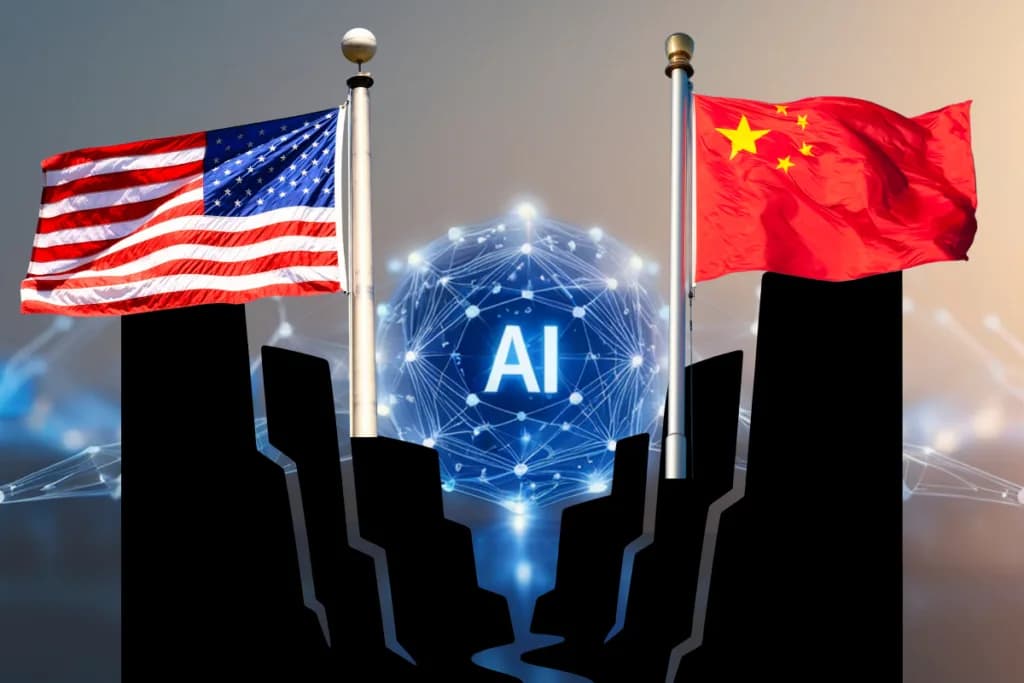
In it’s latest BCG Report – “The Great Divide: How the US and China Are Splitting the AI World” (June 2026), Boston Consulting Group argues that the US and China remain the two dominant AI superpowers, but their strategies have diverged sharply. Each is in essence building a largely self-contained technology stack designed to reduce dependence on the other. As a result, the two ecosystems are becoming increasingly incompatible, and companies and countries may soon face pressure to choose sides.
Relative Strengths (2026 update)
BCG assesses six key enablers of AI supply: capital, talent, IP, data, energy, and compute.
- The US maintains the overall lead, driven by superior talent pools and massive capital deployment.
- China has however closed the gap on compute and continues a strong “fast-follower” approach. It leads or is highly competitive in IP (especially patents and highly cited research) and is focused on rapid real-economy adoption.
Contrasting Strategies
United States – Scale and Frontier Models
The US approach centres on winning through a force of pure scale. The country’s tech empire continues to pour enormous capital into frontier model development and, increasingly, into the data-centre infrastructure needed for inference and AI agents. US tech giants’ combined CAPEX has surged and is projected to exceed $800 billion in 2026. A dense web of cross-investments between AI labs, chip designers, hyperscalers and capital providers reinforces this ecosystem. Policy in the US has emphasised speed, scale and exportable “AI stacks,” though national-security concerns and military considerations, are starting to constrain the most powerful models.
China – Cost-Optimised Models and Rapid Adoption
China prioritises affordable, high-performing models and widespread domestic deployment rather than matching US spending at the absolute frontier. Since the launch of DeepSeek R1, in early 2025, Chinese models have stayed competitive on capability while remaining significantly cheaper, aided by open-weight releases and architectural efficiency. China is aggressively building a domestic chip supply chain (e.g., Huawei Ascend) and pushing AI into manufacturing, services and public administration through its “AI+” initiative. High public optimism about AI and rapid token usage growth support this diffusion strategy. China also leverages trade and infrastructure ties (including Belt and Road) to export its lower-cost stack, particularly to Africa and across the Global South.
Growing Bifurcation
The two stacks (models, cloud, chips, applications, plus governance/security rules) are becoming harder to mix. Technical incompatibilities (e.g., NVIDIA CUDA vs Huawei CANN) and political restrictions are rising. Multinationals already run separate stacks for China and the rest of the world. Over time, companies may have to choose end-to-end ecosystems rather than picking layers freely.
Implications for the Rest of the World
Middle powers have limited options and are pursuing different paths:
- EU: Building sovereign compute and backing Mistral, though still far behind on scale.
- Japan: Investing heavily to secure a seat inside the US ecosystem (notably via SoftBank).
- UAE & Saudi Arabia: Positioning as infrastructure and talent hubs, often linked to US technology.
- India: Trying to engage multiple ecosystems at once and avoid a binary choice.
- Others (e.g., South Korea, UK) focus on narrow but hard-to-replace strengths such as high-bandwidth memory or chip-design IP.
This is a fair historical parallel, but the US–China AI split is not a clean repeat of earlier technology standards wars.
Will one side eventually have to capitulate?
Not necessarily in the classic Betamax-vs-VHS tech race or early-PC development sense.
In those earlier contests, a single dominant technical standard usually emerged because the market needed interoperability and network effects were strong. One format or platform won, and the other largely disappeared or became a niche.
AI is different in three important ways:
- It is tightly bound to geopolitics and national security. Neither the US nor China is likely to allow the other full dominance of the underlying stack.
- Both sides already have working, commercially viable systems. China does not need to “catch up” to the absolute frontier in order to deliver useful, lower-cost AI at scale. The US does not need Chinese models or chips to keep advancing.
- The two stacks are optimising for different strengths: the US for frontier capability and capital intensity; China for cost, speed of domestic diffusion, and exportability to markets that prioritise affordability.
The more probable outcome is prolonged parallel development rather than a decisive single winner. Some layers may remain somewhat interchangeable for a time (especially open-weight models), but the deeper layers — chips, cloud infrastructure, and governance rules — are already hardening into separate systems. Companies that assume one side will simply fold risk being caught on the wrong side of export controls, data rules, or technical lock-in.
Where this leaves Africa and African businesses
Africa sits outside both core ecosystems. That creates both risk and opportunity.
Risks
- Forced or de-facto alignment through funding, infrastructure deals, or procurement rules.
- Technical lock-in if systems are built on one stack and later become expensive or impossible to migrate.
- Cost disadvantage if businesses default to the more expensive US-centric tools without assessing cheaper Chinese or open alternatives.
- Data and sovereignty exposure if critical systems depend on foreign cloud or model providers subject to extraterritorial rules.
Opportunities
- Ability to select the best tool for each specific use case rather than adopting an entire ideology.
- Leverage of open-weight and lower-cost models for local language, cost-sensitive, or high-volume applications.
- Room to build hybrid or modular architectures while the bifurcation is still incomplete.
- Potential to position as a neutral or multi-stack market if African institutions and businesses act deliberately.
Practical navigation for African entrepreneurs and businesses
Treat stack choice as a business decision, not a technical or political one
Decide based on cost, performance for your specific workload, data residency needs, and long-term switching cost — not on which superpower is currently winning the narrative.
Build modularity from the start
- Prefer application layers and workflows that can swap underlying models with limited re-engineering.
- Avoid deep proprietary lock-in at the infrastructure layer unless the commercial upside clearly justifies it.
- Design so that a change in model provider or cloud region does not require rewriting the entire product.
Use open-weight and multi-provider approaches where feasible
Chinese open-weight models and other open alternatives are already competitive on many practical tasks and significantly cheaper. For many African use cases (customer service, content generation, basic analytics, local-language tools), the absolute frontier is unnecessary. Keep the option to run models on your own infrastructure or a neutral host.
Segment by use case and risk
- High-sensitivity or regulated data → prioritise sovereignty and clearer legal regimes.
- High-volume, cost-sensitive workloads → test lower-cost stacks aggressively.
- Customer-facing products in multiple markets → design for dual-stack capability early.
Watch the hardening points
Monitor three pressure points closely:
- Export controls and chip access
- Cloud and data residency rules
- Procurement or funding conditions attached to infrastructure or development finance These will determine how quickly the mixing window closes.
Avoid premature full commitment
Many African startups and SMEs do not yet need to bet the company on a single ecosystem. Maintain optionality while the technical and political walls are still going up. Once systems, data, and customer workflows are deeply embedded, switching costs rise sharply.
The AI Bottom line
This is less like Betamax vs VHS (one clear commercial winner) and more like the long coexistence of different industrial standards under geopolitical tension. One side may gain broader commercial reach; the other may retain superiority in certain high-end capabilities. Complete capitulation by either is unlikely in the near to medium term.
For African businesses the practical task is not to pick a permanent winner, but to stay deliberately modular, cost-conscious, and aware of switching costs. The organisations that treat AI infrastructure as a strategic supply-chain decision — rather than a pure technology or political choice — will be better positioned as the divide hardens.
The AI world is splitting into two increasingly separate spheres. The US leads on frontier capability and capital intensity; China competes on cost, IP volume and real-economy diffusion. For most organisations outside the two superpowers, the window to mix freely is narrowing, and deliberate choices about technology alignment will carry growing strategic consequences.