No Free Lunch – JEM – Automating Workforce Management via WhatsApp
Host of No Free Lunch – Greg Stewart interviews Simon Ellis, the co-founder and CEO of JEM, an innovative AI driven South African Startup, following the company’s announcement of an $8.4 million Series A raise. Our conversation traces Simon’s path from accounting and corporate work in London to entrepreneurship, while also exploring how JEM became
No Free Lunch – JEM – Automating Workforce Management via WhatsApp
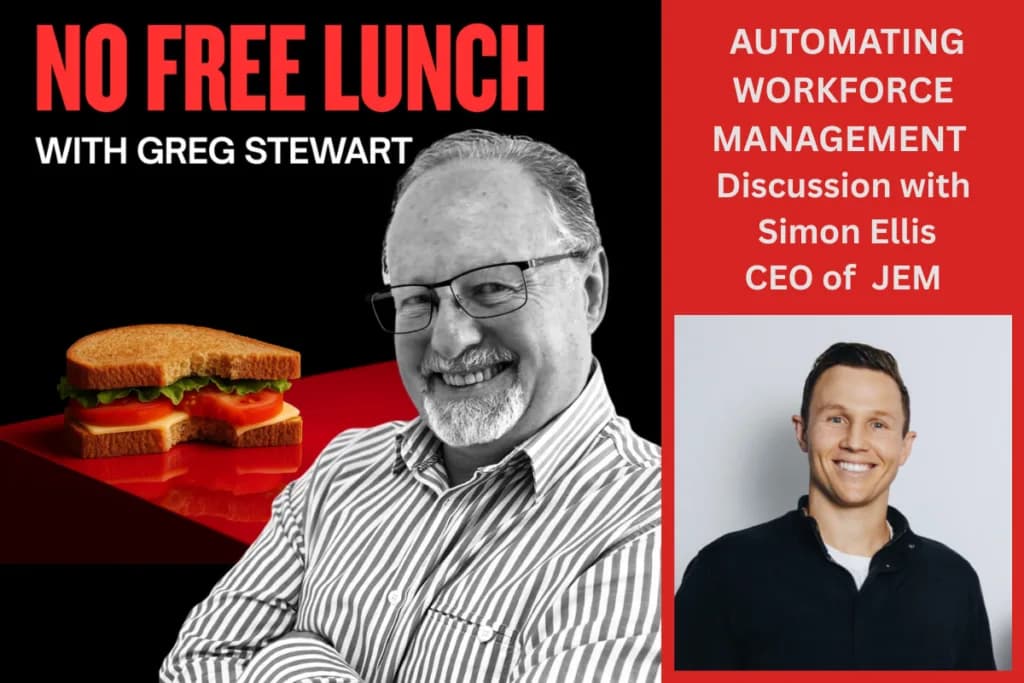
Host of No Free Lunch – Greg Stewart interviews Simon Ellis, the co-founder and CEO of JEM, an innovative AI driven South African Startup, following the company’s announcement of an $8.4 million Series A raise.
Our conversation traces Simon’s path from accounting and corporate work in London to entrepreneurship, while also exploring how JEM became a fast-growing workforce platform serving frontline and deskless employees across South Africa and beyond.
One of the central themes is Simon’s shift from traditional career expectations into building something of his own. He describes himself as a “recovering CA” and says he “got very lucky” early in his career to work on smaller teams and interesting projects. That exposure, combined with an early angel investment in 2016, sparked his interest in entrepreneurship. He also reflects honestly on failure, saying one of his biggest lessons was “not persisting long enough” and that he and his team had to learn that “you have to persist through those first few years.”
Listen to The Discussion Here:
From Missteps to Major Client Traction
A major point of the discussion is JEM’s evolution from missteps to product-market fit. Simon admits the company made “every mistake that one could make,” including the wrong people, product, and business model. But he explains that over the last two years the business changed by listening closely to customers, hiring better, refining positioning, and fixing pricing. That shift helped GEM create clear value and grow quickly.The interview also highlights JEM’s focus on South Africa’s massive deskless workforce. Simon notes that security guards, cleaners, baristas, and other frontline workers make up “75% of South Africa’s workforce,” yet technology has not historically served them well. GEM’s approach is to meet workers where they already are, especially through WhatsApp, which Simon describes as a powerful and accessible distribution channel. Simon emphasises that the platform combines “accessibility and utility,” making adoption simple and driving strong engagement.
Vision, Client Satisfaction and Ambition Driving Growth
Greg points to the business impact, including a customer reportedly saving around R6 million in administration costs. Simon responds with a practical example of how quickly JEM can roll out: a security business with 2,700 staff launched and had 40% registered within a day. He says that kind of adoption proves “product market fit” and shows the platform has low friction and real utility.The second half of the conversation focuses on scale and future growth. Simon explains JEM’s dual business model: an enterprise software layer for HR and workforce management, and a financial services layer that includes rewards and access to services like credit. He says JEM wants to become “the one place to do to help you connect and manage your workforce.”
Simon also notes the company is already active in seven other African countries and is seeing demand from customers outside South Africa.Simon closes by outlining GEM’s expanding product roadmap, including an MCP integration with Claude or ChatGPT, HRIS, time and attendance, rostering, mobile, EAP, and credit scoring. His long-term vision is clear: employers will want one provider rather than many, and “Jem plans to be that provider.”
Key Quotes from Simon
- “I’m a recovering CA.”
- “I think the profession is overhyped.”
- “One of the biggest learnings from my failures was not persisting long enough.”
- “We had the wrong people, we had the wrong products, we had the wrong business model.”
- “We’ve listened to our customers.”
- “Every single person that we come across on a day-to-day basis who we take for granted… make up 75% of South Africa’s workforce.”
- “We obsess over trying to understand where the world is going.”
- “The raise allows us to do is use this unique distribution channel.”
- “You don’t get adoption like that when something is difficult to use or there’s tension.”
- “If we stuff it up from here, it’s totally on us.”
- “Jem plans to be that provider.”