Guinea Targets Medusa Cable Link to Boost Internet Resilience
Guinea is looking to diversify its international internet links by exploring a connection to the Medusa submarine cable system. The move is aimed at strengthening the reliability and capacity of the country’s digital infrastructure. The proposal was discussed during a cabinet meeting on Monday, April 27, according to the Ministry of Communication, Digital Economy and
Guinea Targets Medusa Cable Link to Boost Internet Resilience
Guinea is looking to diversify its international internet links by exploring a connection to the Medusa submarine cable system. The move is aimed at strengthening the reliability and capacity of the country’s digital infrastructure. The proposal was discussed during a cabinet meeting on Monday, April 27, according to the Ministry of Communication, Digital Economy and Innovation. A memorandum of understanding with the Medusa consortium is expected to be signed on May 6, marking a step toward joining the project.
A High-Capacity Regional Digital Backbone
The Medusa submarine cable system is designed to deliver about 480 terabits per second (Tb/s) of capacity, using 24 fiber pairs that carry roughly 20 Tb/s each. Initially planned to link countries around the Mediterranean, the project has expanded to include African landing points, placing it among the larger intercontinental cable systems now under development. Once operational, the network is expected to connect 22 countries and support demand for faster internet, data services, and cloud connectivity across North Africa and parts of Sub-Saharan Africa.
Gradual Deployment Across Continents
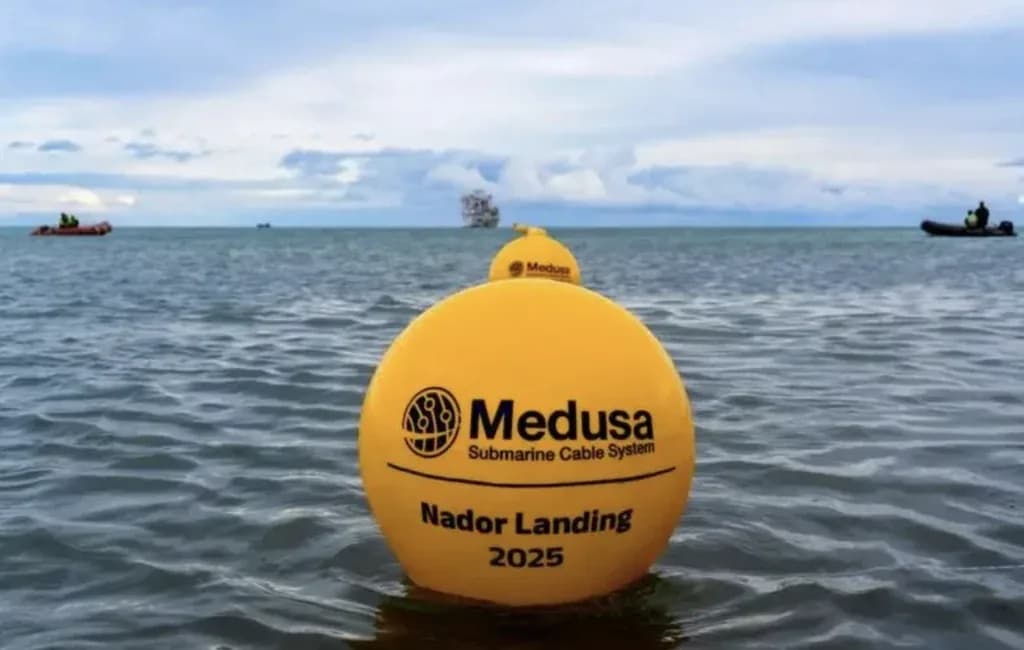
Deployment began in October 2025, when Orange S.A. completed the first landing in Marseille, France. The cable reached Tunisia in November and Morocco in December, with further expansion planned through 2026, although timelines for additional African connections remain open. Some countries have already outlined longer-term expectations, with Gabon targeting a possible launch around 2028 and Equatorial Guinea projecting commissioning between 2029 and 2030. If Guinea joins, it would form part of this phased rollout and gain access to a major new subsea network.
Addressing Guinea’s Single Cable Dependency
Guinea’s interest in the project is closely tied to the structure of its current connectivity. Since 2014, the country has relied mainly on the Africa Coast to Europe (ACE) submarine cable for international bandwidth. While this link has supported the expansion of broadband access, reliance on a single cable has left the network exposed to disruptions. Faults and maintenance work have repeatedly affected connectivity, at times causing nationwide instability. A second connection through Medusa would introduce redundancy and reduce the risk of widespread outages.
The country is also involved in other regional infrastructure projects, including the Amílcar Cabral submarine cable, which aims to create additional international routes across West Africa. At the same time, Guinea is participating in the World Bank-backed West Africa Regional Digital Integration Program (WARDIP), which focuses on infrastructure, regulatory reform, and expanding access to digital services. Taken together, these initiatives point to a growing focus on strengthening the country’s position within regional and global data networks.
Economic Impact of Expanding Cable Capacity
Submarine cables play a direct role in shaping internet costs, as increased capacity tends to lower prices. Research suggests that doubling international capacity could reduce fixed broadband prices by about 32% and mobile data costs by up to 50%. The World Bank reports more moderate but consistent effects, estimating that each doubling of capacity in Africa can reduce fixed broadband prices by around 7% and mobile data prices by about 13%. In markets where connectivity remains expensive, even smaller reductions can have a meaningful impact.
Affordability remains a challenge in Guinea. In 2025, the cost of 5 GB of mobile data represented about 5.16% of gross national income per capita, while fixed internet stood at 4.46%. Both figures exceed the 2% affordability benchmark. Across Africa, mobile data costs average 5.32% of GNI per capita, compared to 1.38% globally, with fixed internet prices showing a similar gap. Even so, internet use continues to grow, with penetration reaching 33.3% in 2024. While new cables like Medusa can expand capacity and ease pricing pressure, their impact depends on how effectively that capacity is distributed inland. Without stronger domestic networks, improved international links are more likely to benefit coastal cities than the wider population.