EdTech in Africa: Opportunities and Challenges
Scaling Innovation for the Future of Education in Africa A new Boston Consulting Group report, reveals both the potential—and the current roadblocks—of EdTech in transforming learning outcomes for the world's youngest population group who have been set back by numerous challenges. The report highlights four levers required to unlock Africa’s EdTech potential: Fast-tracking education change

EdTech in Africa: Opportunities and Challenges

Scaling Innovation for the Future of Education in Africa
A new Boston Consulting Group report, reveals both the potential—and the current roadblocks—of EdTech in transforming learning outcomes for the world’s youngest population group who have been set back by numerous challenges.
- 98 million children in Sub-Saharan Africa are currently out-of-school, while 72 million young people, aged from 15 to 24, are neither trained nor employed. Two thirds of them are women. In such a context, digital tools can foster transformation.
- Scalable solutions, such as mobile platforms or AI-powered learning applications, can improve access to qualitative courses that are in line with local working imperatives, but require a greater input from policy and independent investors.
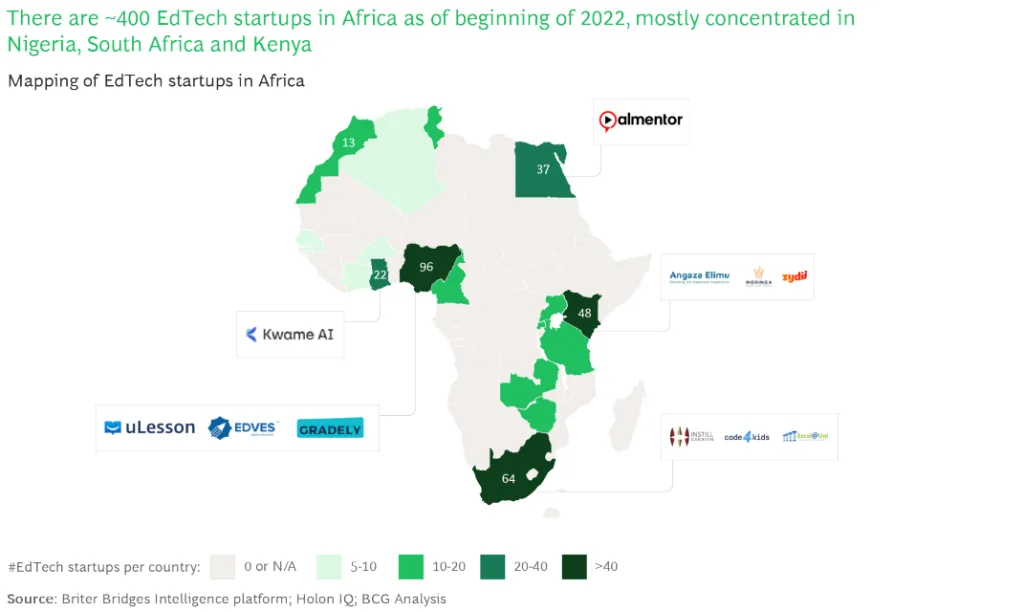
- Over 400 EdTech startups have developed throughout Africa, half of which are located in three countries: Nigeria, South Africa, and Kenya.
- Local EdTech innovators are already reaching remote learners and improving results—yet the sector is held back by funding gaps, a shortage of accelerators, and limited focus on skills training beyond K-12.
- EdTech startups face important market fragmentation: both Africa’s linguistic diversity and regulatory inconsistencies generate major barriers when it comes to scaling across national borders. Nevertheless, some success stories illustrate the potential of EdTech in Africa if existing challenges were effectively addressed. In Nigeria, uLesson has successfully raised $26.5 million, achieving over 3.5 million app downloads as of 2023, with users viewing more than 12 million educational videos, significantly expanding access to high-quality K-12 content.
- In South Africa, FoondaMate’s AI-powered platform, designed to deliver educational resources to remote areas with limited connectivity, reached over 3 million users by 2024.
The report highlights four levers required to unlock Africa’s EdTech potential:
- Clear government strategy,
- Business-user alignment,
- Increased funding,
- The emergence of pan-African accelerators.
Fast-tracking education change with digital solutions
Technology can strengthen education at all levels, starting from early childhood to adult training. The BCG analysis indicates, through multiple examples, the different ways in which digital solutions can be more inclusive, as they deliver scalable, cost-effective means to reach all populations.
For instance, Sayna, a Malagasy provider of gamified courses in tech skills, connects its learners to lucrative IT micro-tasks. Another case is that of the Kenyan platform Eneza Education, which has hit five million users living in remote areas through basic phones, improving exam scores by 5%.
“These statistics could grow, should Africa’s digitalisation expand,” says Badr Choufari, education, employment, and welfare lead, as well as managing director and partner at BCG Casablanca. ”Projections are encouraging: mobile penetration is expected to reach 51% in 2025, which is quite impressive, as it was only 3% in 2010.”
Ed-tech in Africa Requires a Boost
Technology seems to be Africa’s most powerful tool for promoting education. However, three different challenges are looming.
First of all, even though more than four hundred EdTech start-ups have developed throughout the continent, half of them are located in only three countries (Nigeria, South Africa and Kenya).
Moreover, some segments need reinforcement. Around 64% of EdTech startups in Africa serve K-12 levels, while fewer address higher education and professional skills. In contrast, North American EdTech startups emphasise workforce training and higher education more heavily, with only about 25% focusing on K-12, about 50% targeting vocational and workforce learning, and the remainder 25% serving higher education.
Funding Fundamental to Adressing Challenges
Last but not least, funding remains a major issue, as EdTech accounts for only 4% of African-tech fundraising. Startup development is impaired: between 2010 and 2021, the gap in the creation of new EdTech startups widened by a factor of seven relative to FinTech and doubled compared to AgTech. “Not to mention that, despite the sector’s potential, more than 70% of EdTech companies are founded by men, highlighting a significant gender gap in leadership,” adds Choufari.
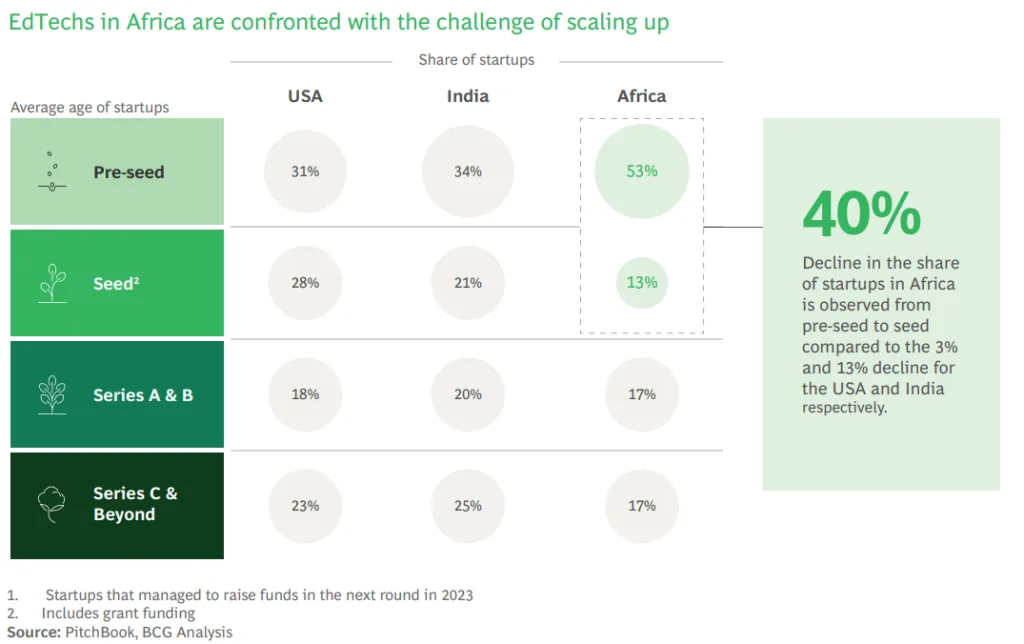
The BCG reports also underlines the fact that this slow progression is further compounded by the dominance of very early-stage start-ups: more than half of African EdTech startups are at the pre-seed stage. Only 13% reach the seed stage. The landscape is very different in countries like India or the USA that benefit from a more balanced distribution across funding stages.