Apple's Push for Generative AI in iPhones Amid Revenue Decline Focuses on China Market Revival
Apple's strategy to integrate generative AI into its iPhones to revitalize sluggish sales, particularly in the crucial Chinese market, will take centre stage on Thursday as the tech giant prepares to announce its largest quarterly revenue decline in over a year. While long revered on Wall Street, Apple shares have recently underperformed compared to other

Apples-Push-for-Generative-AI-in-iPhones-Amid-Revenue-Decline-Focuses-on-China-Market-Revival
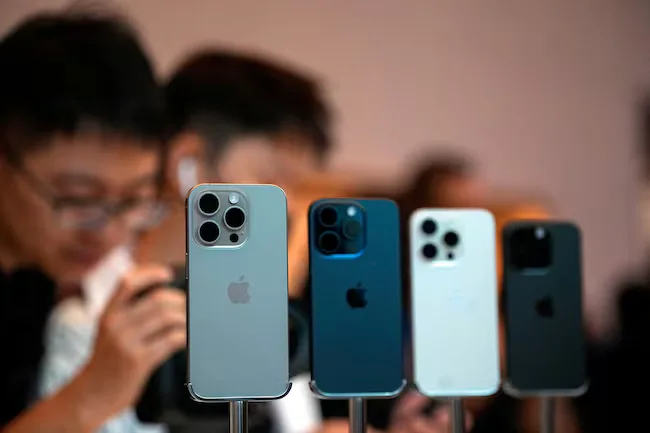
Apple’s strategy to integrate generative AI into its iPhones to revitalize sluggish sales, particularly in the crucial Chinese market, will take centre stage on Thursday as the tech giant prepares to announce its largest quarterly revenue decline in over a year.
While long revered on Wall Street, Apple shares have recently underperformed compared to other Big Tech companies, experiencing a decline of more than 10% this year. Concerns have mounted over its slow rollout of artificial intelligence services, coupled with a resurgent Huawei that has been gaining market share in China.
Analysts anticipate a significant drop in iPhone sales, which contribute roughly half of Apple’s revenue, by about 10.4% in the first quarter of 2024, according to LSEG. This projected decline would mark the sharpest fall in over three years.
Apple executives previously highlighted that the year-ago iPhone revenue, against which the 10.4% drop is measured, was exceptionally high due to pent-up demand following the Covid pandemic. Approximately $5 billion of the $51.3 billion in iPhone sales a year ago was attributed to catching up from disruptions in the December 2022 quarter, when Covid lockdowns in China affected iPhone production.
Even after accounting for this catch-up period, Wall Street still anticipates a slight decrease in iPhone sales, with analysts estimating a 5% decline in Apple’s total revenue for its fiscal second quarter ended in March. This would mark Apple’s most substantial revenue decline since the December 2022 quarter, when revenue fell by 5.5%.
Apple’s market value currently stands at $2.68 trillion after experiencing an 11.2% share price decline since the beginning of the year, causing it to lose its title as the world’s most valuable company to Microsoft.
The company is now looking to bolster its flagship device with AI features by collaborating with OpenAI and Alphabet-owned Google. These generative AI features, expected to be unveiled at Apple’s largest-ever annual developer conference in June, could drive demand for the next iPhone series, anticipated to be announced in September.
While major tech firms like Microsoft, Google, and Meta Platforms have been vocal about their AI strategies, Apple CEO Tim Cook has discussed the company’s plans for the emerging technology less frequently.
The addition of AI features to iPhones may also enhance Apple’s competitiveness against rivals like Huawei and Samsung Electronics, which recently reclaimed the title of the world’s top smartphone vendor from Apple, driven by demand for AI features in its Galaxy S24 smartphones.
Analysts foresee the potential for a strong iPhone 16 cycle, buoyed by replacement cycle tailwinds and incremental generative AI features. They believe that the weakness in China is more cyclical than structural and anticipate that AI integration could positively impact Apple’s performance in the region.
In addition to AI integration, Apple’s earnings report will also provide updates on its stock buyback plan and the performance of Vision Pro, the company’s first major product in years, launched in February. Soft demand has been observed for the $3,500 mixed-reality headset, with reports indicating that Apple has scaled back production estimates.
Apple’s hardware business, including iPads and Macs, is grappling with soft demand, with sales expected to decline by 11.4% and 4.3%, respectively, in the March quarter. To address this, Apple is expected to unveil a revamped iPad line-up and update every Mac model with faster, AI-focused M4 processors.
Despite challenges in the hardware segment, Apple’s services business, encompassing the App Store and subscription services like Apple TV, is projected to remain a bright spot with revenue growth of 7.7%.