AI Radar Report 2026 – Sharp AI Investment Growth Anticipated This Year
CEO’s Double-Down on Investments Despite No clear Path for Returns Boston Consulting Group today released their BCG AI radar 2026 report with telling statistics about the general direction of AI adoption. BCG’s third AI Radar draws on a survey of 2,300 C-level executives from 16 countries and provides a fairly robust outlook on the AI
AI Radar Report 2026 – Sharp AI Investment Growth Anticipated This Year
CEO’s Double-Down on Investments Despite No clear Path for Returns
Boston Consulting Group today released their BCG AI radar 2026 report with telling statistics about the general direction of AI adoption. BCG’s third AI Radar draws on a survey of 2,300 C-level executives from 16 countries and provides a fairly robust outlook on the AI developments globally.
One of the key findings of the report is that overall, corporate investments in AI have doubled in the last year and with a remarkable 94% of CEO’s saying that they intend to continue to invest in AI even should it not see a pay-off in 2026.
Putting this into perspective, the data from the report indicates that only 5% of Companies who have invested in AI are seeing any return on investment, while only 35% are starting to see value in their AI investments.
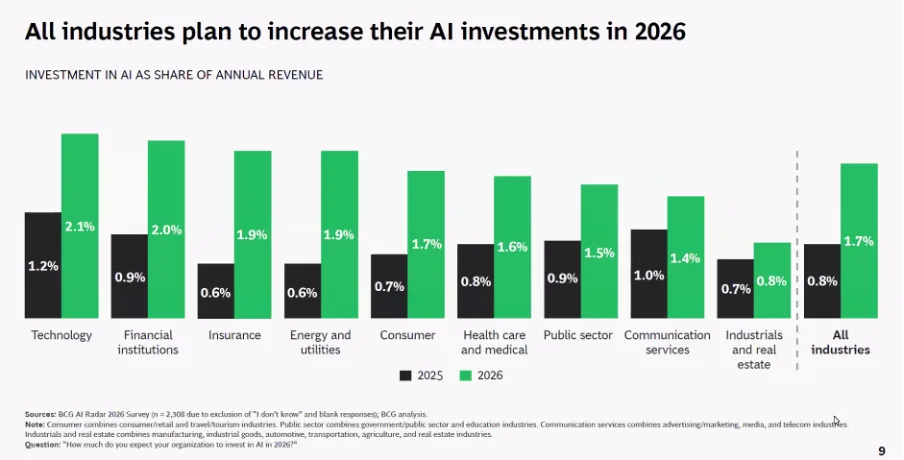
Overall company investment in AI is projected to more than double from an average of 0.8% of total company revenue in 2025 to 1.7% in 2026, with 24% of CEO’s saying they would ramp up AI investments if they did not see a return on investment this year.
Investment Projection Levels by Sector
Unsurprisingly the technology sector leads the market with an average of 2.1% of total revenue projected to be invested in AI in 2026. Financial institutions follow closely at 2% of turnover to be invested, while the energy sector and insurance are at 1.9% of totally company revenue on average.
At the bottom end of the spend spectrum are communication sector at 1.4% while industrials and Real Estate are only projecting 0.8% of total company revenue to be invested on AI adoption and developments
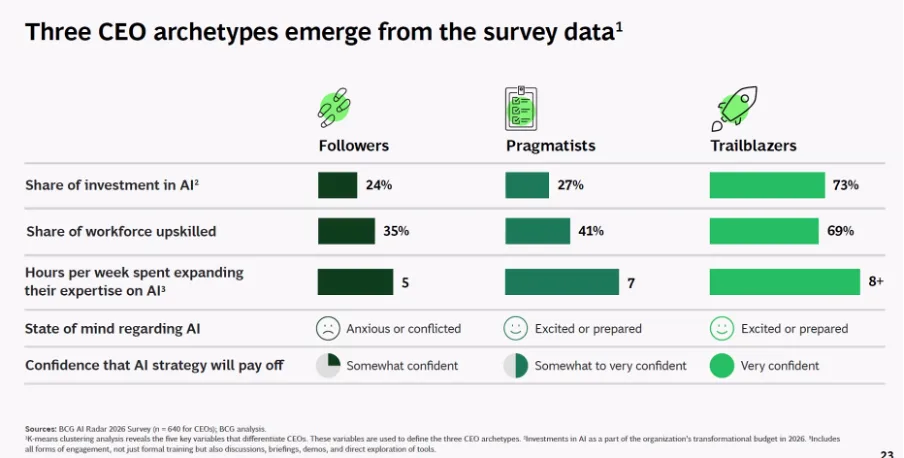
Skill development was flagged as a critical aspect of AI adoption and forms a major part of the investment by companies. The report identifies three categories of CEO’s with those more likely to invest more and ensure staff are upskilled categorised as Trailblazers while those with a more conservative approach categorised as Pragmatists or followers.
The report also highlights the importance of business leaders to upgrade their own knowledge on AI, with Trailblazer CEO’s spending more than 8+ hours per week expanding their knowledge and expertise on AI.
Is Optimism not Evidence Fuelling Investments?
Another major finding is that corporate AI transformation has seen a clear shift from a CIO to CEO-led priority, with CEO’s highlighting this as a make-or break key performance issue. 50% of CEO’s indicted their job security depended on them getting AI right in their organisation.
So leading on from this, a key question for CEO’s to consider is this: Is their current position on AI and further AI investments a double-down due to pressure to see AI deliver a return, or are they actively seeing real possibilities beyond the current investment phase that will bring active return on investments downstream?
The research findings show definite optimism with 82% indicating they are more optimistic to see a return on investment on AI this year than last year, but is this based on evidence of improvements or tangible advantages being built within the company structures?
Agentic AI – Real Game Changer or New Hype-Cycle Catalyst
Agentic AI has certainly become the new buzzword within the AI industry and the report shows just how much it has become the next area of AI development focus.
With around 90% of CEOs stating that they are excited about Agentic AI developments and believe that these will enable measurable ROI in 2026, it is no surprise that the CEO’s canvassed for the report indicate that more than 30% of their organisation’s AI investment in 2026 will be for agentic AI agent development.
Reports outside of the AI radar report, indicate Agentic AI is starting to deliver the biggest leap beyond basic generative AI. The rapid development is creating agents that can autonomously handle complex, multi-step workflows. Early adopters report 30–50% faster process execution, higher accuracy, and the ability to automate tasks that previously required human judgment.
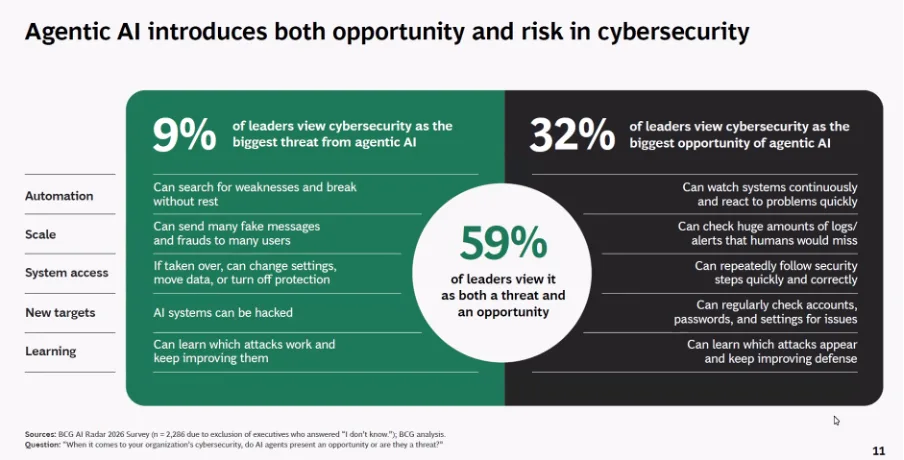
While AI agents are the hot development focus for this year, business leaders also acknowledge that threat that agentic AI presents to their cyber security. The majority of business leaders seem to have a balanced view with 59% indicating that Agentic AI is both a threat and an opportunity to strengthen their cyber defences.
Current estimates of agentic AI cyber-attacks form around only 2–4% of all cyber-attacks. The first documented large-scale AI-orchestrated (largely autonomous) espionage campaign was only reported in November 2025 (Anthropic). However Agentic AI attacks are growing rapidly and are expected to surge in 2026.
Examples of Successes
Supply chain & logistics companies using agentic agents for dynamic routing and inventory optimization have seen a 15–28% efficiency gains. The Google cloud AI 2025 report indicated that Organisations using agentic AI agents achieved significantly higher returns than those using only generative AI, typically in IT operations, customer support, and software development.
In the Healthcare Sector and specifically within Healthcare Revenue Cycle Management (RCM), AI agentic systems automating claims processing and prior authorisations reported 40–65% reduction in processing time and 25–35% cost savings.
While Investments in AI continue to hog headlines and absorb greater chances of corporate investments, it is still a rocky road ahead for many business leaders. A clear focus and strategy around AI investments combined with a priority on staff development and security readiness seems to offer the best path ahead.
“Despite economic uncertainty, this anticipated surge in spending reflects how much of a priority AI has become in the business world,” said Christoph Schweizer, BCG’s CEO and co-author of the report. “AI is no longer confined to IT or innovation teams; it’s reshaping strategy and operations from the top down with CEOs taking a leading role. Nearly three-quarters of CEOs say they are now the main decision makers on AI, and half believe their jobs depend on it.”