AI Expo – Talking Bubbles and AI in Africa
The AI Expo Africa kicked-off with a sobering perspective from Expo co-founder and AI expert Kieth Jones. From his perspective there is no doubt about the AI bubble, that ever expanding mushroom of global tech enthusiasm is expanding to a point where it will inevitably burst.. The picture developed by Jones is however not a

AI Expo – Talking Bubbles and AI in Africa
The AI Expo Africa kicked-off with a sobering perspective from Expo co-founder and AI expert Kieth Jones. From his perspective there is no doubt about the AI bubble, that ever expanding mushroom of global tech enthusiasm is expanding to a point where it will inevitably burst..
The picture developed by Jones is however not a single bubble but a series of bubbles that are inter-related. The first he speaks of is the Infrastructure Bubble.
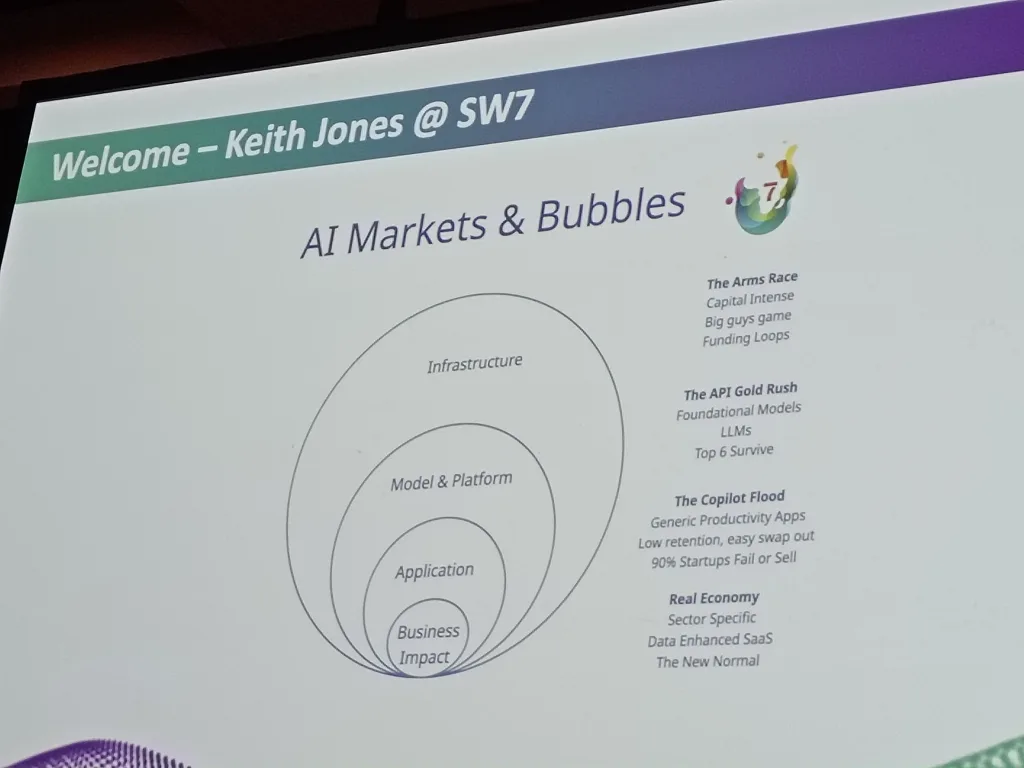
Kieth Jones comments that “When it collapses, we’re all going to be better off, because we’re all going to get cheap tech. So when we talk about bubbles, this is an infrastructure bubble”.
While there’s a lot of hype to AI developments, Jones points out that companies are building real stuff, “They’re actually trying to do real things. So when the bubble collapses, what’s left behind is going to be really, really good stuff. So we’re not going to have the dot-com bubble that collapses and then nothing’s left behind, he surmises.
The second bubble is the API Gold Rush. This is the LLM’s. And this is where an enormous amount of current VC money is heading. According to Jones, he sees that this bubble is also likely to collapse leaving behind around six survivors.
So Who Will be the Survivors?
OpenAI, Claude, Grok, Llama, and Gemini, according to Kieth Jones, with a question mark about the other two that make it. “So our top four are kind of locked in” says Jones. “Gemini has to make it, Google’s got nine businesses that have got a billion users each business, so they’re going to make it.”
The likely survivors have mostly already reached critical mass with Llama sitting with around 700 million users with, 250 million downloads. Grok currently leads with around a million developers, and as Jones points out, OpenAI, ironically sitting with a billion users has only got 40 million paying subscribers leaving its position somewhat vulnerable.
The Third Bubble:
Co-pilot – this area of AI development is where most activity is concentrated at this point. Massive development around generic productivity apps, providing low retention and easy churn. This is where Jones predicts that 90% of startups are going to fail.
“This is the easy come, easy go market Bradshaw comments, Build an app, and then your app gets collapsed when one of the big guys launches a platform update, page three, bullet point two, collapses your whole market” he states. “So the big guys are just coming at a pace with the features, and they’re collapsing the third bubble really quickly”.
The Last Bubble – Business Impact
The last bubble, according to this model is business impact, and in the view of Kieth Jones, this is a bubble that will not collapse.
“This is where the real growth and activity is happening, he says, “so this bubble is not going to collapse”.It’s a business impact bubble. It’s sector specific, data-enriched SaaS. It’s going to survive” he contends .
Current Venture Capital Investment Aimed at Later Stage Start-ups
Data around VC investments in AI indicate that most of the VC is going into later stage ventures, avoiding the early stage VC enterprises and avoiding the collapsing bubbles.
The result is early stage start-ups experiencing difficulty in landing funding while in late stage start-ups, there’s big checks being written. Jones comments that “They’re all thinking when the bubble collapses, they’re going to be the ones surviving, so it’s the largest tech growth market we’ve ever seen in the history of tech”.
AI Opportunity Lies in Africa
According to GPT 2024 statistics, 80% of users were men, with 53% of chats were work-based. Move onto2025, and there is a significant shift with over 50% of users female, with 33% of chats personal. Growth was four times faster in low-income countries, and 50% of users come from the under 26 year old grouping.
If you jump across to Africa, it is a low-income economy. So arguably, Africa should be adopting AI four times faster than anyone else and Africa also sits with the largest youth population in the world.
“So 50% of consumption is coming from youth. We’ve got more youth than anyone else. So those two factors alone give us a multiplier” says Jones.
“All the factors are lining up to say we should get it (AI investment), but the Africa challenge – complex, fragmented, disconnected markets means we’re going to struggle getting it” he says.
“So we’re going to start to use AI in the last mile, we’re going to start to try to use it on phones, we’re going to start to try to use it on local servers, we’re going to start to push processing power down to the end. We’re going to try to do last mile’. “That’s how Africa works” he says.