Google Launches AI Weather Lab to improve Cyclone Forecasting
Picture by Google Africa is increasingly vulnerable to climate Weather shocks, including tropical cyclones that strike along its southeastern coast affecting countries like Mozambique, Madagascar, and South Africa. These storms bring not only physical destruction but also long-term economic setbacks. Accurate, AI-powered forecasts from tools like Weather Lab can play a crucial role in enhancing infrastructure planning, strengthening early warning
Google Launches AI Weather Lab to improve Cyclone Forecasting
Picture by Google
Africa is increasingly vulnerable to climate Weather shocks, including tropical cyclones that strike along its southeastern coast affecting countries like Mozambique, Madagascar, and South Africa. These storms bring not only physical destruction but also long-term economic setbacks. Accurate, AI-powered forecasts from tools like Weather Lab can play a crucial role in enhancing infrastructure planning, strengthening early warning systems, and supporting government decision-making for disaster response and budgeting. By adopting such innovations, African nations stand to reduce future economic losses and improve climate resilience a vital step toward sustainable development.Read more here
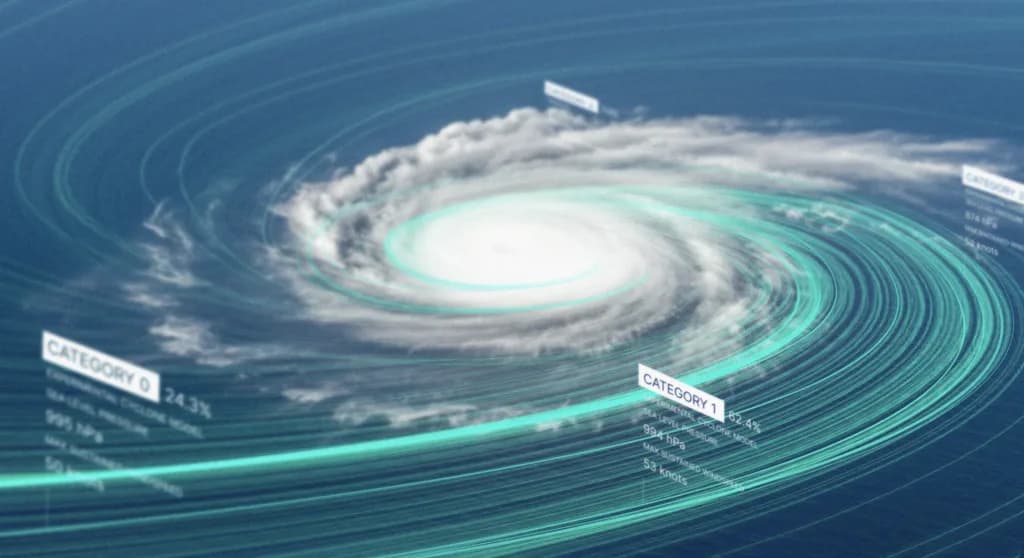
In this context, Google DeepMind and Google Research have launched Weather Lab, a powerful interactive platform showcasing experimental artificial intelligence (AI) models designed to predict tropical cyclone behavior more accurately. The tool is part of a broader collaboration with the U.S. National Hurricane Center (NHC), aiming to improve forecasts and early warnings during cyclone seasons worldwide.
Tropical cyclones also known as hurricanes or typhoons are massive, rotating storms that form over warm ocean waters, fueled by heat, moisture, and convection. Due to their sensitivity to small atmospheric changes, these storms are notoriously difficult to forecast. In the last 50 years, cyclones have caused approximately $1.4 trillion in economic damage globally. More accurate forecasting tools can support timely evacuations, disaster preparedness, and risk mitigation, especially in vulnerable regions like southern Africa.
A New Generation of AI Forecasting
Weather Lab’s standout feature is an experimental AI-based tropical cyclone model trained on stochastic neural networks. This model can predict a storm’s formation, track, intensity, size, and shape up to 15 days in advance, generating 50 possible forecast scenarios. Google has also released a paper detailing the core model and made historical cyclone track data publicly available for testing, analysis, and research.
Internal tests show that the AI model’s predictions are often as accurate or more accurate than traditional physics-based forecasting methods. The NHC is now using the model’s live predictions alongside conventional tools to better assess cyclone risks in the Atlantic and East Pacific basins. This real-time input could enhance early warning systems and lead to faster, more informed emergency responses.
Access to Historical and Live Predictions
Weather Lab features both live cyclone forecasts and over two years of historical AI predictions, presented alongside forecasts from physics-based systems like the European Centre for Medium-Range Weather Forecasts (ECMWF). Models such as WeatherNext Graph and WeatherNext Gen are available for real-time comparisons, allowing meteorologists, emergency planners, and researchers to evaluate storm behavior across multiple scenarios.
While Weather Lab is not based in South Africa or on the continent, its open-access design ensures that African weather experts, disaster agencies, and institutions can leverage its data and tools to improve decision-making and risk analysis across cyclone-prone regions.
Technical Breakthroughs in Cyclone Prediction
Historically, cyclone forecasting models face a trade-off: global models excel at tracking storm paths, while regional high-resolution models are better at predicting intensity. Google’s experimental AI model overcomes this limitation. It is trained on a hybrid dataset that combines global weather reanalysis data with nearly 5,000 observed cyclone events over the past 45 years.
Results from the 2023 and 2024 cyclone seasons show that the model’s 5-day track predictions are, on average, 140 kilometers closer to actual cyclone locations than ECMWF’s leading ensemble model (ENS) representing a 1.5-day improvement that typically takes a decade to achieve through traditional methods.
Furthermore, the AI model outperformed NOAA’s Hurricane Analysis and Forecast System (HAFS) in predicting cyclone intensity and showed comparable accuracy in forecasting storm size and wind radii.
A Tool for the Future
Although Weather Lab is a research platform and its forecasts are not official warnings, it is a significant advancement in the integration of AI into global disaster forecasting. For African governments, insurers, businesses, and emergency response teams, it represents an opportunity to build resilience through data-driven planning and innovation.