A new formula for telcos’ success, driving value beyond core business focus areas
The recent Mobile World Congress (MWC) underscored the industry's expansion beyond its traditional focus on mobile technology. It now encompasses a wide array of technological disruptions, with 50% of attendees at this year's event originating from sectors outside of telecommunications. This shift is highlighted in BCG's 2024 Telecommunications Value Creators Report, titled "A New Formula

A-new-formula-for-telcos-success-driving-value-beyond-core-business-focus-areas

The recent Mobile World Congress (MWC) underscored the industry’s expansion beyond its traditional focus on mobile technology. It now encompasses a wide array of technological disruptions, with 50% of attendees at this year’s event originating from sectors outside of telecommunications.
This shift is highlighted in BCG’s 2024 Telecommunications Value Creators Report, titled “A New Formula for Success,” which explores the diverse strategies adopted by leading companies to achieve success. Typically, these companies have fortified their core business, made strategic investments in network enhancements, implemented rigorous cost controls, and begun leveraging the capabilities of artificial intelligence.
The report analyzes 59 publicly traded companies in the global telecommunications sector. It reveals that over the five-year period from 2019 to 2023, these companies achieved a median annualized total shareholder return (TSR) of 6%. This marks an improvement from the 3% TSR reported in BCG’s 2023 report, reflecting steady growth. TSR is measured over a five-year period to mitigate the impact of short-term market fluctuations, resulting in gradual changes in rankings. Remarkably, 70% of the top 20 companies, ranked by TSR, maintained their positions from the previous year, indicating sustained performance.
But before they break out the champagne, telcos should consider some critical context. From 2019 to 2023, the S&P 1200 index of global stocks had an annualised TSR of 13%, meaning that the telco industry performed below the market average. In fact, for the most recent five-year period, telcos ranked 31st among the 33 sectors BCG tracks.
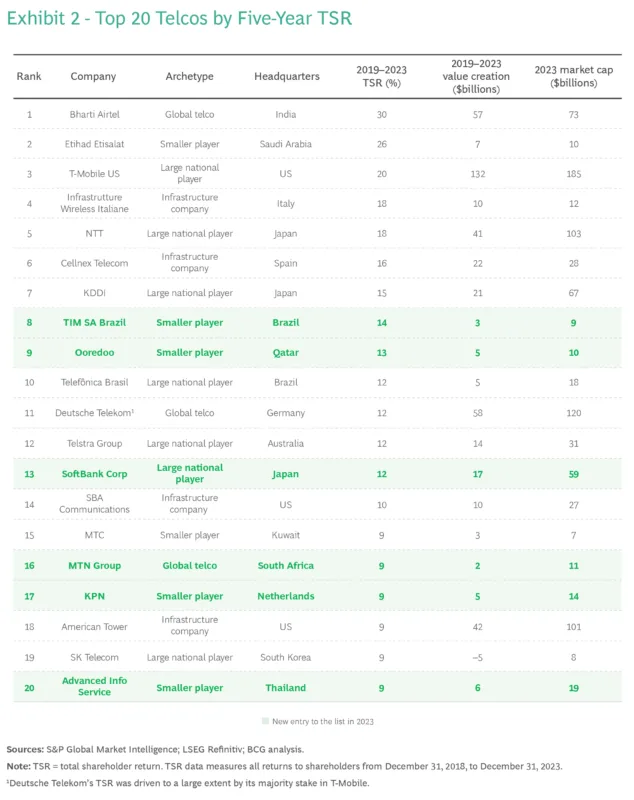
Two telcos operating in Africa rank in the list of Top 20 Telcos by five-year annualised TSR. Topping the list is Bharti Airtel, which is strong in its home market of India but also operates in other parts of South Asia and in 14 African countries, primarily in East, West, and Central Africa as Airtel Africa. Over the past five years, Bharti Airtel generated an annualised TSR of 30% – higher than any of the other 58 companies in BCG’s sample – driven by an annual 32-percentage-point boost to net income margin and an annual 13-percentage-point increase in sales.
Airtel Africa has 147.7 million voice and 59.8 million data customers and is expanding its network in both rural and semi-urban areas. It also offers digital services like live TV and sports, and mobile money services that reach 36.5 million customers.
“We are seeing strong performances from telcos with an African presence. The penetration of Airtel Africa’s mobile data and money services continue to rise and it recently began rolling out a 5G network in three countries, starting in Nigeria. The company also launched Nxtra, a new data centre business to meet the continent’s growing digital needs,” says Kitso Lemo, Associate Director at BCG in Johannesburg.
To unpack these results in more detail, the report divides the industry into four archetypes:
- Global telcos: These resilient firms saw their median annualised five-year TSR rebound to 7%, up from 3% for the period from 2018 to 2022. These companies make up 20% of the survey sample, but they generated 32% of the total value.
- Large national players: At 6%, the median annualised five-year TSR for these firms is slightly lower than that of global players, but it still represents an improvement on the five-year mark of 3% posted last year. Large national players account for more than one-third of the companies in the study, and they created $267 billion in value, roughly half of the sector total.
- Smaller players: The five-year median annualised TSR for these companies is the lowest of the four segments at 3%, showing a slight improvement from last year’s 2%. Although they represent 36% of the companies in the sample, their value generation of $33 billion is just 6% of the total.
- Infrastructure players: These companies manage infrastructure for other carriers and the six infrastructure companies analysed had a median annualised five-year TSR of 10%. This is the highest of the four archetypes but down from 12% in 2022. Although the six infrastructure companies in the study amount to just 10% of the total, they generated $89 billion, 16% of the sector’s total net value.
MTN which was included in the survey, ranks 16th on the list of the Top 20 Telcos by five-year annualised TSR globally, the only South African listed company to do so.
MTN fits into the global telco archetype, and although global telcos have relied on different performance drivers, TSR disaggregation shows that they have generally benefitted from rising revenues and net margins.
New formula for value creation
Looking ahead, new thinking will be needed for creating value over the next five years. In pursuing a formula for success, BCG identified seven key areas of focus for telcos to deploy to achieve optimal results.
These include to defend the core; drive growth outside the core; maximise asset leverage; radically optimise costs; adopt core to cloud optimisation; deploy next generation architecture and turn GenAI magic into impact.
Commenting on one area of diversification, Lemo says, “Regionally, we have seen how MTN has driven growth outside of its core and captured revenues adjacent to the network business by offering a comprehensive range of financial services under the Mobile Money (MoMo) brand across its pan-African network footprint. MoMo allows users to purchase airtime and data, pay bills, send, and receive money, and the ability to apply for personal loans. Since its launch in 2019, the user count on MoMo has grown rapidly from 28 million to 72.5 million in 2023.”
Of the seven areas, BCG believes GenAI presents a massive opportunity to the telco industry, not merely as a technological advance; it can catalyse profound transformation along the entire value chain. From reducing costs to creating new products and experiences, the benefits of GenAI are tangible and far-reaching. For instance, GenAI-enabled customer service may at some point reduce service interactions by 50% or more, while improving customer satisfaction.
Realising this potential, however, demands more than just technological integration. Executives must think about where and how to deploy it. With so much potential available for tapping, they should think big.
“We have seen how the most innovative telcos have begun harnessing the power of GenAI, with early applications in areas such as task automation, product and services hyper-personalisation, and business process transformation showing promising progress toward commercial success,” says Lemo.
This was in evidence at MWC where tech played a central role in all the keynote speeches, panels, and conversations in which BCG’s team on the ground took part—not to mention the fact that the topic of artificial intelligence was everywhere.
The strategies above are not instant fixes; they require sustained effort. Falling interest rates may free up more capital to invest, but they will not ease many of the industry’s other problems such as uneven returns from 5G investments and static revenue.
Against this background, it should be no surprise that the industry’s value creation tends, on average, to fall below that of most other sectors over a five-year period. Nevertheless, the upper ranks of the telco industry’s TSR tables are occupied by companies whose leaders have achieved much more. These value creators show the way for others; senior leaders can combine and customise the seven recommended drivers for success above to create their own, company specific formula for success.