Space and Satellite Competitor Flight Crash
Deep Blue Aerospace (DBA), a Chinese private rocket company, launched its new Nebula-1 rocket, a pioneering reusable rocket powered by kerosene. The company announced that their inaugural test flight resulted in an unsuccessful landing on Sunday. While the launch and high altitude test was attained the rocket was unable to successfully complete a high-altitude recovery
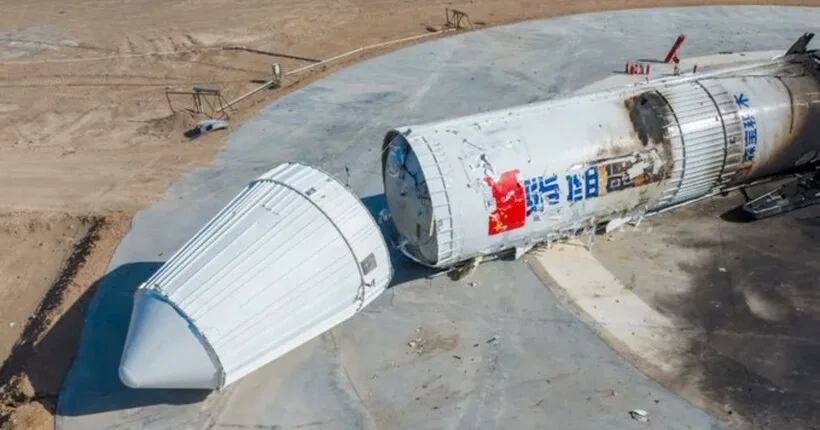
Deep Blue Aerospace (DBA), a Chinese private rocket company, launched its new Nebula-1 rocket, a pioneering reusable rocket powered by kerosene. The company announced that their inaugural test flight resulted in an unsuccessful landing on Sunday.
While the launch and high altitude test was attained the rocket was unable to successfully complete a high-altitude recovery test.
The Nebula-1 is a two-stage space rocket having a diameter of 3.35 meters. The rocket is fuelled via a mix of kerosene and liquid oxygen and features nine variable thrust Thunder-R1 engines, which are 3D-printed, on its first stage
Despite the successful take-off and flight, that met 10 out of 11 objectives during the vertical take-off and vertical landing (VTVL) trial, the rocket encountered issues in its final phase, leading to a crash that destroyed the rocket (See the crash landing here).
DBA said that the Nebula-1’s triple engines had fired as expected, propelling the rocket to a high altitude. The descent process began smoothly, with two engines shutting down as per their flight scheduled plan.
The second landing stage sees the Nebula-1 powered by a single engine. The engine configuration used in this test flight would enable the rocket to fly a total load capacity of 2000 kilograms to a low Earth orbit hight. Future larger versions are expected to be capable of carrying a load capacity of up to 8000 kilograms according to their statement.
Space science engineers, have commented previously that alternative fuels usage such as kerosene, methane, and liquid oxygen could significantly reduce costs and make rocket launches more efficient.
There have been a spate of private Chinese space companies testing new design spacecraft over the past year. These start-ups see themselves being positioned for increasing demand for space flights and satellite deployments in the country’s commercial space sector. This development is part of what is seen as challenger activity to establish satellite constellations that could potentially rival Elon Musk’s Starlink Satellite Network, currently the biggest globally.