Zimbabwe Tightens Lithium Exports Further as Refinery Investments Gather Pace
Zimbabwe is stepping up efforts to move its lithium industry beyond raw mineral exports, with fresh investments in local refining supporting the government’s strategy to capture more value from one of the country’s most important mineral resources. The latest development came on May 19, when Chinese mining company Sinomine Resource announced plans to raise up
Zimbabwe Tightens Lithium Exports Further as Refinery Investments Gather Pace
Zimbabwe is stepping up efforts to move its lithium industry beyond raw mineral exports, with fresh investments in local refining supporting the government’s strategy to capture more value from one of the country’s most important mineral resources. The latest development came on May 19, when Chinese mining company Sinomine Resource announced plans to raise up to 5.2 billion yuan (approximately $764 million) to fund several projects, including the construction of a lithium sulfate refinery in Zimbabwe.
As Africa’s largest lithium producer, Zimbabwe has become a key supplier of the battery metal used in electric vehicles and energy storage systems. However, much of the country’s production is still exported as spodumene concentrate, an intermediate product that attracts significantly lower prices than refined lithium chemicals.
Refining Capacity Expands as Investors Back Value Addition
Zimbabwean authorities have increasingly encouraged mining companies to process lithium domestically rather than exporting raw concentrate. The objective is to develop a local value-addition industry capable of producing lithium sulfate, a critical input in battery manufacturing.
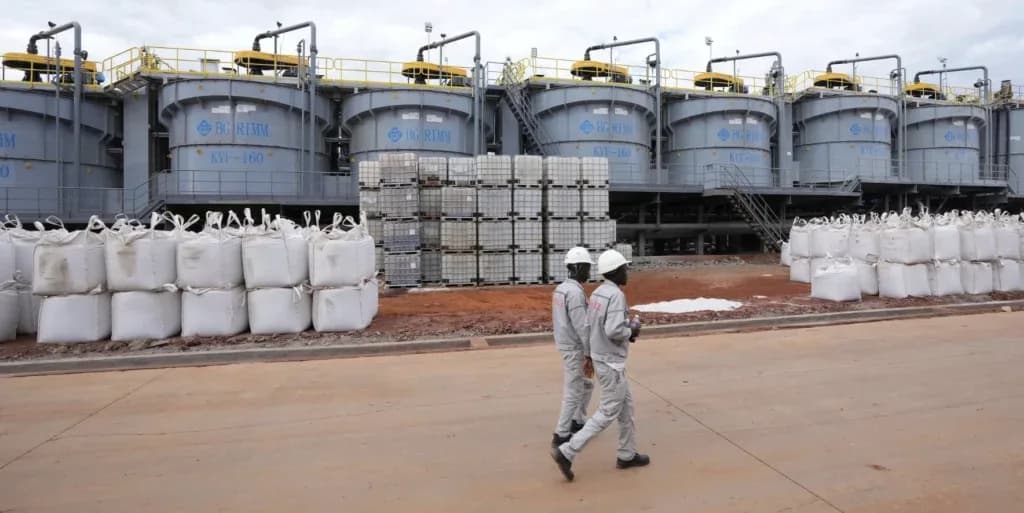
Earlier this year, Zhejiang Huayou Cobalt marked a milestone by completing what government officials described as Africa’s first exports of lithium sulfate produced in Zimbabwe. The company recently commissioned a refinery at its Arcadia mine with an annual processing capacity of 50,000 tonnes, an important step toward establishing a downstream battery materials industry within the country.
Sinomine is preparing to follow a similar path at its Bikita lithium operation. The company said part of its planned capital raise will support the construction of a lithium sulfate processing facility linked to the mine. Once completed, the refinery is expected to produce up to 100,000 tonnes of lithium sulfate annually, significantly expanding Zimbabwe’s domestic processing capacity. Previous reports estimated the project’s cost at around $400 million.
The drive toward local processing is also attracting additional investment from Chinese mining groups. Sichuan Yahua recently began construction of its own lithium sulfate plant at the Kamativi mine, further strengthening Zimbabwe’s refining ambitions and supporting the development of a more integrated lithium value chain.
Export Controls Support Industrialisation Strategy
The wave of refinery investments comes as Zimbabwe tightens regulations on lithium exports. In February, authorities announced a ban on lithium concentrate exports before replacing it with a quota-based system in April designed to prepare producers for a complete export ban scheduled for January 2027.
The government believes the policy will encourage greater investment in domestic processing facilities while boosting export revenues through the sale of higher-value lithium products. Officials see beneficiation as a key component of the country’s broader industrialisation strategy, allowing Zimbabwe to retain more of the economic value generated by its mineral resources.
Higher Prices Strengthen the Case for Local Processing
The financial incentive for refining lithium within Zimbabwe remains substantial. On May 20, lithium sulfate delivered to China traded at approximately $8,751 per tonne on the Shanghai Metals Market, compared with around $2,595 per tonne for spodumene concentrate. The significant price difference highlights the potential gains available through local beneficiation.
Sinomine has also noted that domestic processing can reduce transportation costs while enabling producers to capture a larger share of value from global lithium demand.
Zimbabwe earned roughly $571 million from lithium exports in 2025, reflecting the growing importance of the mineral to the national economy. The success of the government’s strategy will now depend largely on whether mining companies complete planned refinery projects and expand processing capacity at scale. If successful, Zimbabwe could strengthen its position not only as Africa’s leading lithium producer but also as an emerging supplier of refined battery materials to global markets.