Wealth Concentration in Africa: Historical, Economic, and Institutional Factors
Dollar Millionaires in Africa Growing but Concentrated The infographic alongside is from Visual Capitalist, based on the 2022 Henley & Partners Africa Wealth Report, showing total private wealth at $2.1 trillion, heavily concentrated in cities like Johannesburg ($239B), Cape Town ($131B), Cairo ($128B), Lagos ($97B), and Nairobi ($48B). It highlights four main regions—South Africa, Egypt,
Wealth Concentration in Africa: Historical, Economic, and Institutional Factors
Dollar Millionaires in Africa Growing but Concentrated
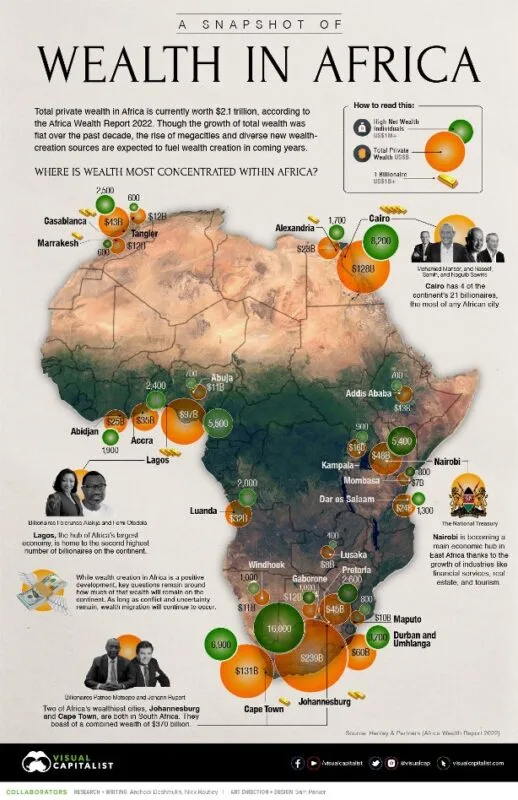
The infographic alongside is from Visual Capitalist, based on the 2022 Henley & Partners Africa Wealth Report, showing total private wealth at $2.1 trillion, heavily concentrated in cities like Johannesburg ($239B), Cape Town ($131B), Cairo ($128B), Lagos ($97B), and Nairobi ($48B). It highlights four main regions—South Africa, Egypt, Nigeria, and Kenya—with Morocco as a notable addition. These areas account for the bulk of Africa’s high-net-worth individuals (HNWIs: those with $1M+ in assets), billionaires, and investment inflows.
For context, updated data from the 2025 Africa Wealth Report shows total private wealth has grown to $2.5 trillion, with millionaire numbers projected to rise 65% by 2034 (from 172,000 to 283,000). The concentration remains similar: South Africa (41,100 millionaires), Egypt (22,700), Nigeria (9,800), Kenya (8,500), and Morocco (6,900) hold 56% of Africa’s millionaires and over 90% of its billionaires. Top cities include Johannesburg (12,300 millionaires), Cape Town (7,400), Cairo (7,200), Nairobi (4,400), and Lagos (4,200). These hubs attract 80% of foreign direct investment (FDI) into Africa, often in finance, real estate, tech, and manufacturing.
Why Such Concentrations of Wealth?
Wealth clusters in these regions are due to a combination of economic diversification, urban infrastructure, market access, and historical advantages. Unlike many African economies reliant on raw commodities, these areas have well developed or advanced service sectors (finance, tech) and manufacturing, which generate higher-value jobs facilitating higher capital investments.
- South Africa: Holds 34% of Africa’s millionaires, driven by mining (gold, platinum), finance (Johannesburg Stock Exchange), and diversified industries like automotive and tourism. Post-apartheid reforms boosted Foreign Direct Investment (FDI), with wealth supported by strong property markets and wealth management services.
- Egypt: Wealth growth here is predominantly its geographic position. The economy benefits from the Suez Canal trade route (handling 12% of global trade), tourism Mainly European and Middle East), and manufacturing with proximity to European markets key. Cairo’s role as a regional hub draws large Middle Eastern and European investment.
- Nigeria: One of Africa’s largest economies by GDP, is fuelled predominantly by oil and natural gas (though volatile), services, and a rapidly growing tech market (e.g., fintech unicorns), and boosted by its own local massive population providing growth in sectors such as food and retail (over 200M) creating consumer markets.
- Kenya: Nairobi’s “Silicon Savannah” attracts major tech FDI; agriculture (tea, flowers) and finance support its growth. Kenya is a key a logistics hub for East Africa.
- Morocco: Manufacturing in this region is growing rapidly, now boasting the largest automotive manufacturing hub in Africa and advances in tech areas such as aeronautics boosting investments. In addition, phosphates, and tourism drive wealth, with the country’s proximity to Europe supporting growth in trade.
These five countries produce half of Africa’s $3.1 trillion GDP, with urban agglomeration effects amplifying wealth: better education, infrastructure, and networks create self-reinforcing growth cycles. Inequality persists, however—Gini coefficients exceed 0.50 in most, with wealth skewed to urban elites.
(Data Source: Africa Wealth Report 2025)
Is the Link to British Colonialism Coincidental?
As most of these regions were previously British colonies, there is some rationale to the strength of the top wealth regions being ex-colonies, and the link is not entirely coincidental, however this not the sole factor. South Africa, Egypt (British protectorate 1882–1922), Nigeria, and Kenya were under British influence, while Morocco was a French/Spanish protectorate. British colonial policies often emphasized indirect rule, preserving some local institutions while building infrastructure (railways, ports) for export economies. This left legacies like English-language education, property rights and legal systems, and market-oriented institutions that facilitated post-independence growth, per theories in “Why Nations Fail” by Acemoglu and Robinson.
In South Africa, Afrikaner-led development post-1910 built on British gold/coal foundations, creating industrial bases and power grids. British colonies generally saw more investment in human capital (e.g., schools) and legal systems than Belgian or Portuguese ones, correlating with higher GDP per capita today. However, colonialism overall extracted resources (e.g., commodity exports), created inequalities, and disrupted local economies, likely making Africa poorer than counterfactual scenarios without it. Morocco’s inclusion shows other colonial models (French) could yield similar outcomes with stability and diversification.
Counterexamples: Ghana (British colony) has grown (via cocoa, oil), but lags due to instability; Botswana (British protectorate) succeeded via good governance despite resources, highlighting that post-colonial policies and developments matter more than colonial origins alone.
Why Haven’t Resource-Rich Nations Like DRC, Ghana, or Zambia Seen More Development?
These countries exemplify the “resource curse” (the paradox of plenty): abundant minerals leading to economic volatility, corruption, and conflict rather than broader infrastructure and economic development.
- DRC: Holds 70% of global cobalt, vast copper, gold, and forests, yet ranks among the poorest (GDP per capita ~$600). Belgian colonialism left weak institutions; post-independence wars (1996–2003, ongoing in east) killed millions. Corruption siphons revenues (e.g., mining contracts favor elites/foreign firms), with poor infrastructure and governance preventing diversification. 70M+ people depend on subsistence; illicit trade loses billions in taxes.
- Ghana: Rich in gold, cocoa, oil; achieved middle-income status (GDP per capita is around $2,200). But dependence on exports causes volatility (e.g., oil price crashes); corruption and debt (over 80% of GDP) limit investment. Political instability post-independence (coups until 1992) delayed growth.
- Zambia: 70% of exports from copper; GDP per capita is around $1,400. Nationalisation of industries during the 1970s was a failure triggering multiple debt crises’ (defaulted 2020) and price and currency swings hindered development. Weak diversification and corruption have exacerbated inequality.
Unlike Botswana (diamond-rich but stable governance) or Norway (oil funds), these lack transparent institutions to drive reinvestment revenues. Colonial legacies (e.g., DRC’s extractive Belgian rule) have compounded issues.
Concentration of Wealthy Individuals: Result of Economy or Economic Driver?
It’s a chicken-egg dynamic where economies create wealth opportunities, but wealthy individuals reinforce growth through investment. Though relevant in Africa, widespread elite capture in corruption, often widens gaps in economic well-being with elites siphoning off funds intended for development and denying wider community economic growth and pegging poverty in these societies.
Strong local economies (e.g., diversified sectors, stability) attract and produce HNWIs, who then invest in real estate, startups, or philanthropy, boosting GDP. For instance, South African billionaires like Patrice Motsepe fund infrastructure. However, wealth migration (e.g., HNWIs leaving for UAE, UK) drains capital, and corruption ties elites to extractive models rather than broad development. Overall, economy drives initial wealth creation, with individuals amplifying it in virtuous cycles where institutions support reinvestment.
What African States Should be Doing To Attract HNWI’s and Investors
To attract more wealthy individuals (HNWIs) and investments, African states should adopt targeted, multi-pronged strategies that build on successes in hubs like Mauritius, Morocco, Rwanda, and Seychelles, while addressing continent-wide challenges.
1. Enhance political stability, governance, and rule of law — Consistent, transparent institutions reduce perceived risk, as seen in Mauritius (+63% HNWI growth over the past decade) and Rwanda (+48%). Strong anti-corruption measures and reliable legal systems are essential to retain and draw capital.
2. Implement investor-friendly policies and incentives — Offer tax breaks (e.g., preferential regimes for new residents, low income taxes on foreign-sourced income for 5–10 years), streamlined business registration, and protection of investor rights. Special economic zones, free trade incentives, and residence-by-investment programs (like Egypt’s, Mauritius’, and São Tomé’s) channel foreign capital into infrastructure without debt burdens.
3. Invest in infrastructure and diversification — Prioritize digital connectivity, renewable energy, logistics, and urban development to support high-growth sectors: fintech, green tech, eco-tourism, e-commerce, biotech, and wealth management. Sovereign wealth funds (SWFs) can manage resource revenues transparently, reinvest domestically, and de-risk projects for international partners.
4. Promote lifestyle and global mobility appeal — Develop premium real estate, healthcare, education, and leisure in lifestyle destinations (e.g., Cape Winelands, Marrakech, Whale Coast) to position Africa as an alternative to less attractive traditional hubs (EU/UK). Encourage public-private partnerships and regional integration via AfCFTA for larger markets.
5. Foster local capital retention and reinvestment — Strengthen pension funds, national development banks, and tax systems to curb outflows, while improving ease of doing business to boost FDI (currently low at ~3–4% globally despite high returns).
These steps, when meaningfully implemented, can accelerate the projected 65% millionaire growth by 2034, turning wealth concentration into broader community prosperity by driving the growth of small business, opening the doors for entrepreneurial endeavours, and dealing a decisive blow to unemployment and poverty.