US Tariffs Revisited – South Africa and Angola Targeted
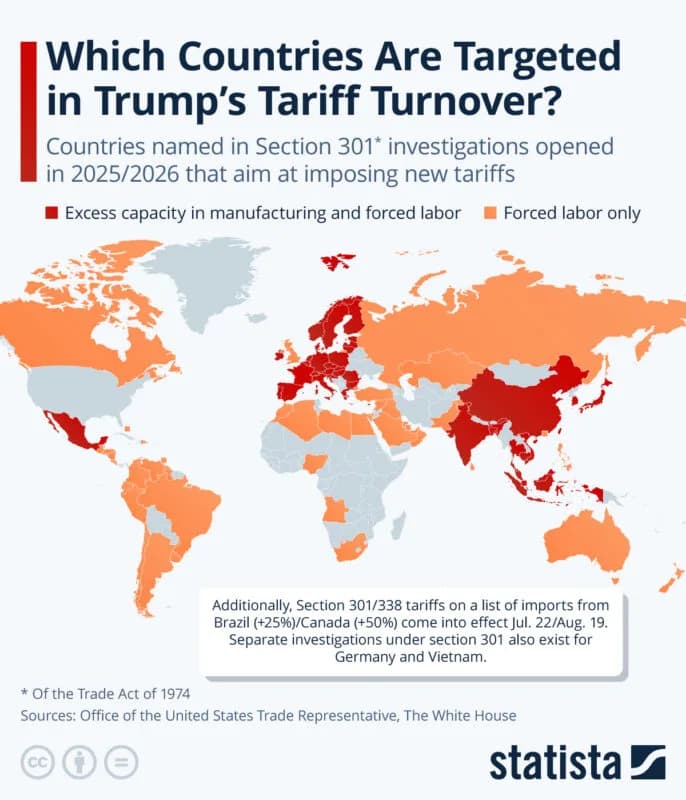
South Africa and Angola are among the African States targeted by new US Tariffs In March 2026 the US Trade Representative (USTR) opened Section 301 investigations into 60 economies (covering more than 99% of US imports) over their alleged failure to impose and effectively enforce a prohibition on the importation of goods produced with forced
US Tariffs Revisited – South Africa and Angola Targeted
South Africa and Angola are among the African States targeted by new US Tariffs
In March 2026 the US Trade Representative (USTR) opened Section 301 investigations into 60 economies (covering more than 99% of US imports) over their alleged failure to impose and effectively enforce a prohibition on the importation of goods produced with forced labour.
A specific start date for the new tariffs has not been announced yet, however trade lawyers and analysts note that USTR is likely aiming to finalise and implement the measures around or shortly after the expiration of the temporary 10% global Section 122 tariffs on 24 July 2026. Some commentary has suggested a possible start date as early as 25 July 2026, but this remains speculative until the final Federal Register notice is issued.
The tariff implementation is however, not a finding that South Africa or Angola are systematically producing export goods with forced labour. The legal basis is that their failure to maintain and enforce an import ban equivalent to the US regime (Section 307 of the Tariff Act / Uyghur Forced Labor Prevention Act-style measures) is “unreasonable” and burdens US commerce by allowing forced-labour goods into global supply chains.
Evidence of Forced Labour in South Africa
South Africa’s Constitution and labour laws prohibit forced labour. The government has anti-trafficking legislation (PACOTIP) and regularly shuts down illegal operations. The cases that surface are typically small-scale, illegal sweatshops involving illegal migrants producing counterfeit clothing or similar goods, with many also involved in illegal mining opperations. These are criminal enterprises that authorities disrupt when discovered.
The US State Department’s Trafficking in Persons reports continue to place South Africa on the Tier 2 Watch List, citing ongoing problems with trafficking for labour and sex exploitation, weak implementation of certain parts of the law, and vulnerabilities in domestic work, agriculture and informal sectors. However, there is no credible evidence of large-scale, systematic forced labour embedded in South Africa’s major formal export industries (automotive, platinum group metals, citrus, wine, etc.). South African officials, including Trade Minister Parks Tau, have publicly asked the US for the specific evidence underpinning the investigation and have sought product exemptions.
Angola and the Lobito Corridor
Angola also finds itself on the 12.5% list. Historical colonial-era forced labour in diamond mining is well documented, and artisanal mining in the broader region carries risks of coercive practices. In the formal sector linked to the Lobito Corridor (the US- and EU-backed rail and port project intended to move critical minerals from the DRC and Zambia through Angola), the main contemporary concerns are more about governance, displacement and labour standards in construction and logistics than classic forced labour in mineral production itself.
Including Angola looks set to create an obvious tension with Washington’s strategic minerals agenda. The Lobito Corridor is explicitly designed to reduce reliance on Chinese-controlled supply routes for copper, cobalt and other transition minerals.
Why Not the DRC, Ghana or Other High-Risk Countries?
The investigations deliberately targeted the largest US trading partners by import volume. Countries with well-documented forced-labour problems in artisanal and small-scale mining (DRC cobalt, parts of Ghana’s gold sector, etc.) were largely excluded because their overall trade volumes with the United States are smaller. This is a volume-driven exercise covering ~99% of US imports, not a pure ranking of the worst forced-labour offenders.
Is This Primarily Political Leverage?
Yes, to a significant degree. After US courts constrained the use of broader emergency tariff authorities, Section 301 has become a vehicle for re-imposing relatively broad tariffs under a forced-labour framing. The list is systematic rather than purely bilateral, but existing political friction with Pretoria (foreign policy differences, AGOA discussions, etc.) makes South Africa’s inclusion more consequential. For Angola the inclusion sends mixed signals given the minerals partnership.
Likely Outcomes and Fallout
- Tariffs: 12.5% additional duties are the current proposal for South Africa and Angola, subject to public hearings (July 2026) and final determination. Product-specific exemptions are possible and are already being sought (PGMs, vehicles, citrus, etc.).
- Pressure to legislate: Targeted countries will face sustained pressure to pass and demonstrate enforcement of forced-labour import bans.
- AGOA risk: For African countries the process sits alongside AGOA eligibility debates and could complicate preferential access.
- Economic impact: Higher costs for exporters, potential loss of competitiveness in the US market, and incentives to divert supply chains.
- Diplomatic response: South Africa is already engaging formally and seeking evidence and exemptions. Angola and others will do the same. Broader African reaction is likely to frame this as selective and inconsistent with development and minerals partnership goals.
- Strategic contradiction: For critical minerals corridors the policy creates friction that Washington may later try to manage through carve-outs or bilateral deals.
In essence, this is a broad, trade-volume-driven tool dressed in forced-labour language. It is less about proven systemic forced labour inside South African or Angolan export factories and more about creating leverage and a durable tariff architecture after earlier legal setbacks. The practical fallout for targeted African countries will depend heavily on how many product exemptions are ultimately granted and whether AGOA preferences are affected.
Preventative actions for South African startups and SMEs currently exporting to the US
The proposed 12.5% Section 301 tariffs (still subject to final determination after July 2026 hearings and comments) would apply at the country level. Individual companies cannot easily “opt out,” but they can take practical steps to reduce exposure, strengthen their position, and prepare for higher costs or disruptions.
1. Strengthen your own documentation and supply-chain transparency
Even though the tariff is not based on forced labour inside South African factories, US Customs and buyers will likely increase scrutiny.
- Map your full supply chain (especially any imported inputs) and keep clear records of origin, labour compliance, and supplier declarations.
- Document your own labour practices thoroughly (contracts, payslips, working-hour records, no child or forced labour policies).
- Where feasible and affordable, obtain independent social compliance audits or certifications relevant to your sector. For very small firms this may not be realistic — focus first on internal records that can be produced quickly if a US buyer or customs broker requests them.
2. Review and renegotiate commercial contracts with US buyers
- Check existing contracts for tariff, duty, and “change in law” clauses. Clarify who bears any new Section 301 duties.
- Open discussions now with key US customers about possible cost-sharing, price adjustments, or longer lead times if the 12.5% is finalised.
- Consider shorter contract terms or price-review mechanisms until the final tariff outcome is clear.
3. Model the financial impact and build contingency
- Calculate the landed-cost increase of a 12.5% additional duty on your specific products (HS codes matter).
- Stress-test margins and cash flow under the higher duty scenario.
- Identify which products or customers would become unviable and prioritise diversification for those lines.
4. Accelerate market diversification
This is the most important structural action for most SMEs.
- Prioritise alternative markets: EU (with existing preferential arrangements), UK, African Continental Free Trade Area (AfCFTA) markets, Middle East, and selected Asian buyers.
- Use existing export promotion support (Trade & Investment South Africa, provincial agencies, sector export councils) to open new channels.
- Test smaller trial shipments to non-US markets while the US situation is unresolved.
5. Engage collective advocacy and government channels
Individual SMEs have limited voice, but collective action matters.
- Join or actively participate in relevant industry associations and export councils that are making submissions to the USTR and engaging the Department of Trade, Industry and Competition (DTIC).
- Feed your specific product data and commercial impact into those collective submissions — especially if your products fall into categories South Africa is seeking to exempt (e.g., certain agricultural goods, metals, vehicles/components).
- Monitor DTIC and AmCham SA updates closely for guidance on exemption requests and final determinations.
6. Check AGOA status and rules of origin
- Confirm your products still meet AGOA rules of origin and that your company remains eligible.
- Keep origin documentation tight. Any additional US scrutiny could also surface AGOA compliance questions.
7. Practical operational steps
- Speak to your freight forwarder / customs broker about possible bonding, duty-drawback options, or classification reviews that might mitigate impact.
- Build a small inventory buffer if cash flow allows, in case of temporary clearance delays once any new duties take effect.
- Avoid long-term exclusive dependence on a single US buyer or product line.
Realistic expectations for startups and small firms
Most SMEs cannot afford expensive US legal counsel or full social audits. Focus on the high-impact, lower-cost actions: clean internal records, contract reviews, financial modelling, and active market diversification. Use industry associations and government export support as force multipliers rather than trying to engage Washington alone.
The final tariff decision and any product-specific exemptions are still pending. Staying plugged into official DTIC and industry association updates will be essential over the coming weeks. Companies that treat this as a temporary cost shock and a signal to reduce single-market dependence will be in a stronger position regardless of the exact final rate.