US-Saudi Arabia Security Deal Could Solidify Kingdom's Dollar Alignment
The United States and Saudi Arabia are on the verge of signing a comprehensive security agreement, which experts believe could reinforce the kingdom's alignment with the US dollar amid speculation about Saudi Arabia ending oil sales in the currency. According to a Wall Street Journal report, the Biden administration is nearing a deal that would
US-Saudi-Arabia-Security-Deal-Could-Solidify-Kingdoms-Dollar-Alignment
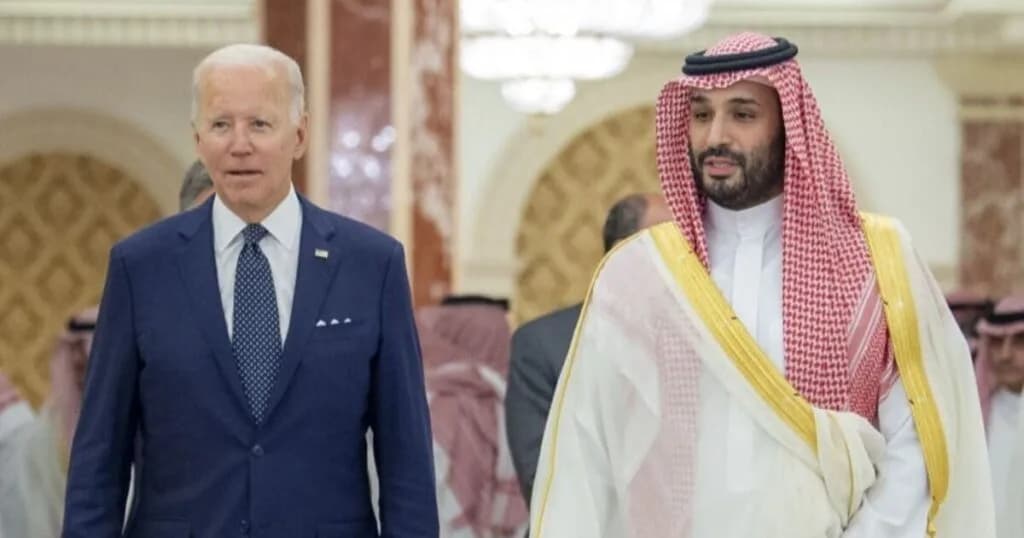
The United States and Saudi Arabia are on the verge of signing a comprehensive security agreement, which experts believe could reinforce the kingdom’s alignment with the US dollar amid speculation about Saudi Arabia ending oil sales in the currency.
According to a Wall Street Journal report, the Biden administration is nearing a deal that would include a security treaty and a civil nuclear agreement between the two nations. This agreement could also facilitate progress toward establishing a Palestinian state and addressing the conflict in Gaza.
“The signing of a security treaty would further align Washington and Riyadh’s interests in the region and reverse the long-standing tough position US President Joe Biden had with the Saudi regime,” said Francesco Sassi, a research fellow at Ricerche Industriali Energetiche in Bologna.
Such a deal would likely hinder the Saudi-China partnership in terms of security and diplomatic outreach, curbing any speculation that Saudi Arabia might abandon the dollar. “The security deal would put the brakes on the Saudi-China partnership, further delaying any possible speculation of Saudi Arabia ending its use of the dollar,” Sassi added.
The US is also seeking closer ties with the UAE, particularly in artificial intelligence, aiming to outpace China in the global AI race. Recently, Microsoft invested $1.5 billion in Abu Dhabi-based AI and cloud company G42, strengthening the Emirates’ role as a regional tech hub.
Speculation Over Petrodollar Deal
Last week, reports suggested that the longstanding US-Saudi petrodollar agreement had expired, raising concerns that Saudi Arabia might start selling oil in multiple currencies, potentially including the Chinese yuan. This led to a spike in Google searches for “petrodollars,” driven by viral stories claiming Saudi Arabia did not renew a 50-year agreement to price oil in dollars. Financial analysts, however, have dismissed these reports.
“Many crypto speculators desperately want to believe in the dollar’s demise. Confirmation bias encourages people to ignore what is realistic if their prejudices are seemingly confirmed. This is a poor investment strategy,” said Paul Donovan, chief economist of UBS Global Wealth Management.
Despite these speculations, the Saudi riyal remains pegged to the dollar, and the majority of Saudi financial assets are dollar-focused. “The dollar’s reserve status depends on how money is stored, not how transactions are denominated,” Donovan emphasized.
Historical Context and Current Dynamics
About 80% of global oil sales are conducted in dollars, and Saudi Arabia has historically traded oil exclusively in the currency as part of an informal agreement with the US. This arrangement dates back to June 1974, following the 1973 oil crisis, when the US and Saudi Arabia established a joint commission for economic cooperation.
Recently, Saudi Arabia has explored trading in yuan, with China becoming its top trading partner and largest crude buyer. The kingdom has also balanced its relationships with the US, China, and Russia, its key energy partners within OPEC+.
China and Saudi Arabia signed a local currency swap agreement worth $7 billion last year to boost trade and reduce reliance on the dollar. More recently, Saudi Arabia joined the mBridge project, a collaborative effort between several central banks to develop a new system for cross-border payments using central bank digital currencies.
Future Prospects and Global Shifts
Despite China’s push for the use of the renminbi in crude oil payments, Saudi Arabia’s riyal peg to the dollar makes budget planning easier, and the dollar remains the dominant global reserve currency. “The dollar’s position as the world’s major reserved asset remains still dominant, which gives little incentive for the Saudis to switch to other currencies,” said Shigeto Kondo, a senior researcher at the JIME Centre of the Institute of Energy Economics, Japan.
Abu Dhabi Commercial Bank expects the Saudi riyal’s peg to the dollar to continue in the “near and medium term,” emphasizing its role in maintaining currency and macroeconomic stability.
While the dollar remains the predominant currency in global reserves, its share has decreased from over 70% in 2000 to about 55% by the end of 2023. This decline has been partially offset by the rise of non-traditional reserve currencies, including the Australian dollar, Canadian dollar, Chinese renminbi, and others.
China’s yuan is now the fourth most-transacted currency globally, despite the country’s controls on capital account transactions. The yuan’s growing role signals a shift towards a more multipolar financial system, challenging the historical dominance of Western currencies.
Nevertheless, the US dollar continues to be the world’s leading reserve currency and safe haven asset, making up about 60% of global foreign exchange reserves and dominating international trade and foreign currency transactions.
The US Dollar Index has gained over 3% this year, reflecting its strength amid geopolitical instability and economic shifts, underscoring its continued significance in the global economy.
Main Image: Bloomberg