The End of Race-Based Governance? A Landmark High Court Challenge in South Africa
In a move that could reshape the economic and social landscape of post-apartheid South Africa, the Rescue South Africa Civil Rights Alliance (RSACRA) launched a constitutional challenge on 19 May 2026 in the Gauteng Division of the High Court in Pretoria. The case argues that the South African state lacks any lawful mechanism to classify
The End of Race-Based Governance? A Landmark High Court Challenge in South Africa
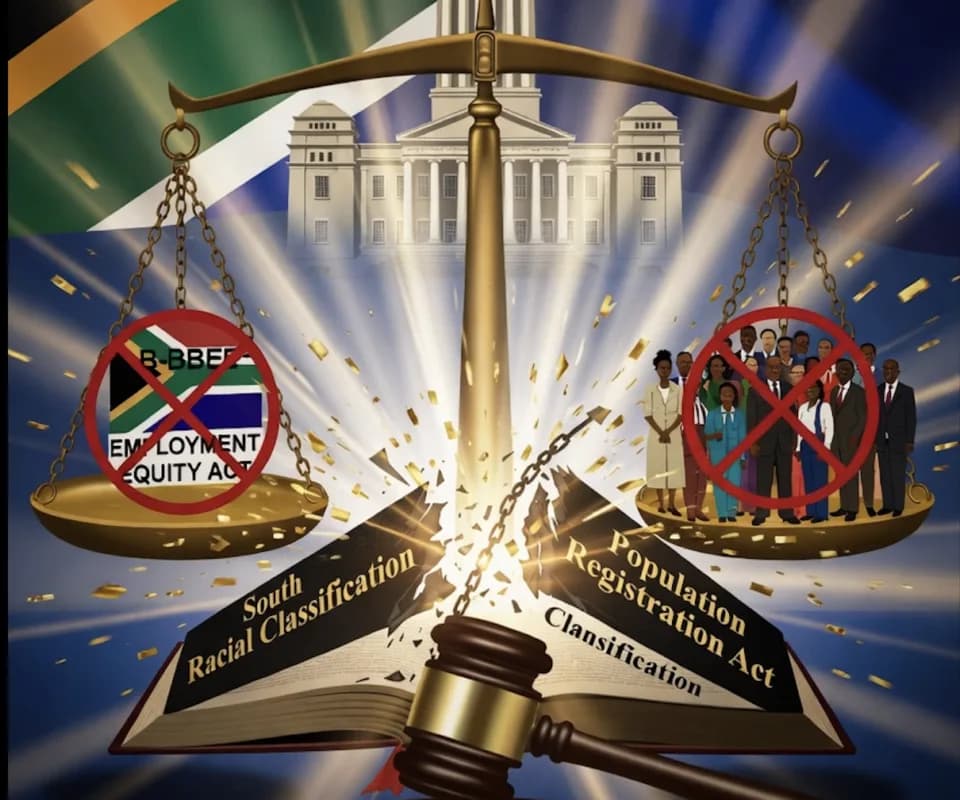
In a move that could reshape the economic and social landscape of post-apartheid South Africa, the Rescue South Africa Civil Rights Alliance (RSACRA) launched a constitutional challenge on 19 May 2026 in the Gauteng Division of the High Court in Pretoria. The case argues that the South African state lacks any lawful mechanism to classify citizens by race, rendering much of the country’s transformative legislation constitutionally defective.
At the heart of the application is a seemingly straightforward but explosive point: the apartheid-era Population Registration Act of 1950, which formally categorised every South African as White, Black, Coloured, or Indian, was repealed in 1991. No constitutionally compliant replacement was ever enacted. Yet, decades later, a vast edifice of laws continues to demand racial classification for employment, procurement, ownership, licensing, and economic participation.
The Legal Argument

RSACRA, directed by Errol Naidoo (also of the Family Policy Institute), contends that this creates a fatal flaw. The Constitution’s Section 9(2) permits “legislative and other measures designed to protect or advance persons, or categories of persons, disadvantaged by unfair discrimination.” However, such measures must still comply with the rule of law, rationality, and non-arbitrariness.
The applicants argue that current race-based frameworks fail these tests. There are no objective, verifiable criteria for determining race. Self-identification is subjective and open to abuse. Reliance on apartheid-era definitions is unlawful following the 1991 repeal. Moreover, many laws lack clear, measurable goals or sunset clauses, turning temporary remedial action into permanent racial engineering.
The case is being argued by prominent constitutional advocate Mark Oppenheimer SC. It seeks a declarator of invalidity for key statutes, including:
- Broad-Based Black Economic Empowerment (B-BBEE) Act
- Employment Equity Act
- Preferential Procurement Policy Framework Act
- Public Procurement Act
- Minerals and Petroleum Resources Development Act
- Skills Development Act
- National Small Enterprise Act
- National Empowerment Fund Act
Collectively, these laws — and over 140 others with racial elements — underpin South Africa’s transformation agenda.
Historical and Constitutional Context
The challenge revives a long-simmering debate. When the Population Registration Act was repealed, it symbolised a break from apartheid’s pseudoscientific racial bureaucracy. The 1996 Constitution enshrined non-racialism as a founding value. Yet governments have continued using racial categories, often defaulting to self-identification or historical records, without statutory backing.
Critics of the system, including organisations like the Institute of Race Relations, have long warned that this creates legal vulnerability and practical absurdity — forcing businesses and individuals into racial declarations without clear rules. Proponents counter that race remains a proxy for disadvantage in one of the world’s most unequal societies, where apartheid’s legacy persists in wealth, education, and opportunity gaps.
RSACRA positions the case as defending the Constitution’s promise of a non-racial democracy, not opposing redress. They argue that genuine empowerment should target poverty and disadvantage directly, rather than perpetuating racial labels indefinitely.
Potential Fallout
If successful, the implications would be profound. A declaration of invalidity could suspend or strike down core transformation tools, forcing Parliament to either repeal race-based elements, replace them with race-neutral alternatives (e.g., based on socio-economic status), or — controversially — attempt to reintroduce formal racial classification, which would face massive political and moral backlash.
Economically, sectors like mining, construction, public procurement, and professional services (already seeing BEE-related court battles) would face upheaval. Foreign investment, already wary of policy uncertainty, might react positively to reduced racial quotas but negatively to instability. Black-owned businesses and beneficiaries of current policies could see immediate disruptions in ownership targets, tenders, and equity deals.
Socially, the case touches raw nerves. Supporters of BEE view it as essential redress; opponents see it as reverse discrimination that has enriched a connected elite while failing the broader poor. A ruling against race-based laws could accelerate demands for class- or need-based policies, potentially realigning politics around poverty rather than race.
Politically, it puts the Government of National Unity and ANC policies under scrutiny. Failure to address the legal gap could invite more litigation. Success might embolden challenges to other race-conscious policies. RSACRA has signalled this is only the first of several cases.
Chances of Success
The case faces an uphill battle. South African courts, including the Constitutional Court, have repeatedly upheld race-based affirmative action under Section 9(2), provided it is rational, proportional, and aimed at substantive equality (Minister of Finance v Van Heerden, South African Police Service v Solidarity). Judges have shown deference to Parliament on transformation.
However, the novel angle — absence of a lawful classification mechanism — has not been directly tested at this scale. Previous cases focused on implementation, not foundational legality. If the court accepts that racial categories lack statutory or constitutional definition, it could force a systemic rethink.
Realistically, prospects at High Court level may be modest, with strong likelihood of appeal to the Constitutional Court. A full victory is ambitious; a partial win (e.g., requiring clearer criteria, sunset clauses, or stricter scrutiny) is more plausible. The case could still succeed in highlighting policy flaws and prompting legislative reform.
Broader Implications
This challenge arrives amid growing fatigue with transformation outcomes. Despite 30+ years of BEE, inequality remains extreme, unemployment is high, and black poverty persists. Critics argue race-based policies have sometimes enabled cronyism rather than broad upliftment. Defenders insist they are still necessary given historical imbalances.
Ultimately, the case forces South Africa to confront a fundamental question: Can a constitutional democracy built on non-racialism sustainably operate a parallel system of racial preferencing without clear legal foundations? The answer will shape the country’s economic future for decades.
Whether the court agrees with RSACRA or not, the debate is now judicially live. South Africans of all backgrounds will be watching closely as the judiciary grapples with reconciling redress, rule of law, and the dream of a truly non-racial society.