The Mining Wrap
The continent-wide Timbuktoo MineTech Accelerator Programme has scaled its second phase by awarding equity-free funding to startups building tech-enabled solutions for mining operations and sustainability. The program targets early-stage companies working on operational efficiency, safety, and environmental monitoring. This gives founders capital without dilution, accelerating product development and pilot deployments. It also signals stronger investor
The Mining Wrap
The continent-wide Timbuktoo MineTech Accelerator Programme has scaled its second phase by awarding equity-free funding to startups building tech-enabled solutions for mining operations and sustainability. The program targets early-stage companies working on operational efficiency, safety, and environmental monitoring. This gives founders capital without dilution, accelerating product development and pilot deployments. It also signals stronger investor appetite for mine tech across Africa. The move helps bridge the gap between prototype and mine-site adoption.
Acquisitions and Corporate Deals
Isambane Mining Completes Take-Private Buyout Through Providere JV
Isambane Mining has completed a take-private acquisition buyout through the Providere JV. The deal consolidates ownership and gives the company more flexibility on long-term operational planning. It removes public-market reporting pressure and allows capital to be redirected into mine development. This is part of a broader trend of resource firms restructuring to fund growth. The buyout positions Isambane to advance projects without shareholder dilution.
Gold Mining Near “City of Gold” Wins Broader Bank Support
A new loan facility from South Africa’s Absa and Nedbank CIB will fund gold mining near Johannesburg. The arrangement replaces the previous IDC and Absa funding announced in June last year. Broader bank backing improves liquidity and lowers financing risk for the project. It also reflects renewed lender confidence in South African gold assets. The facility supports both near-term development and longer mine life planning.
ZCCM-IH Launches Kyalo Goldfields Gold JV in Zambia
Zambia’s state-owned ZCCM Investments Holdings has launched Kyalo Goldfields Limited to explore and develop gold in the northwest. ZCCM-IH will hold a 51% controlling stake, with a partner experienced in tin, tantalum, and tungsten holding the rest. KGL will evaluate the Kikonge Mining Area and formalize artisanal and small-scale mining. The JV aims to build processing infrastructure to retain more value in-country. This diversifies Zambia’s mining base beyond copper and creates regulated gold supply chains.
Technology, Equipment and Processing
Exxaro Resources Opens Mine 1 at Matla Coal Mine
Exxaro Resources has officially opened the new Mine 1 operation at its Matla coal mine in Mpumalanga. The strategic expansion supports continuous mining operations and meets requirements under its coal supply agreement with Eskom. The upgrade improves reliability of supply to South Africa’s power grid. It also extends the life of a critical domestic energy asset. The investment reinforces coal’s role in near-term baseload generation.
Konkola Copper Mines Resumes Chingola “B” After 18-Year Shutdown
Konkola Copper Mines has resumed operations at the Chingola “B” copper mine after an 18-year halt. Restarting the shaft adds production capacity and recalls skilled labor to the Copperbelt. The move signals renewed confidence in Zambia’s copper sector. It also increases feed for downstream processing. The resumption helps meet rising global copper demand tied to electrification.
Giyani Metals K-Hill Project Hits Battery-Grade Manganese
Giyani Metals’ K-Hill project advanced after achieving battery-grade manganese testing results. The milestone validates the ore’s suitability for EV battery supply chains. It de-risks offtake discussions and supports project financing. High-purity manganese is a critical input for lithium-ion cathodes. The results position K-Hill as a potential non-DRC source of battery materials.
JCB Launches Full Hydrogen-Powered Equipment Range
JCB has fully launched its hydrogen-powered construction equipment range, including the hydrogen combustion backhoe loader. The platform offers a diesel-like work cycle without carbon emissions at the tailpipe. It gives mines a practical alternative where battery charging infrastructure is limited. Hydrogen combustion also reduces reliance on complex battery chemistries. The rollout supports site decarbonization targets without major workflow changes.
Metso and Pilot Crushtec Bring LT400J Diesel-Electric Crusher to Africa
Metso, with Pilot Crushtec, has introduced the diesel-electric Lokotrack LT400J mobile jaw crusher to the African market. The hybrid system cuts fuel use while maintaining high crushing performance. Operators can switch power sources based on site conditions and energy costs. This improves cost control in remote or power-constrained operations. The machine targets large sites where efficiency gains directly lift output.
MMD & Magna Partner on Digitalized Mobile Crushing in Southern Africa
MMD and Magna announced a partnership to deliver digitalized mobile crushing solutions across Southern Africa. The collaboration integrates telematics and automation into crushing circuits. This gives operators real-time data on throughput, wear, and energy use. Predictive insights help reduce unplanned downtime. The offering supports mines aiming to modernize processing without full plant rebuilds.
RCT Rolls Out AutoNav Lite Semi-Autonomous Bulldozer System
RCT has rolled out the AutoNav Lite semi-autonomous bulldozer system. The system allows remote and semi-autonomous dozing in hazardous or repetitive zones. It improves operator safety by removing people from high-risk areas. Productivity gains come from consistent blade control and reduced fatigue. The platform is designed for quick deployment across mixed fleets.
Tharisa Minerals Completes First Underground Blasts at Rustenburg
Tharisa Minerals has completed its first underground blasts at the Rustenburg PGM and chrome operation. The milestone moves the project from development into production. It unlocks access to higher-grade underground ore. The shift supports longer mine life and more stable output. Underground access also improves flexibility to respond to commodity cycles.
Komatsu Launches PC9000-12 Mining Excavator Globally
Komatsu has launched the PC9000-12 mining excavator globally. The new shovel is built for high-volume loading in large open pits. It focuses on fuel efficiency, uptime, and operator ergonomics. Compatibility with fleet management systems supports data-driven maintenance. The launch gives miners another option for lowering cost per ton.
Caterpillar Upgrades Cat 6040 Shovel With Remote Diagnostics
Caterpillar has upgraded the Cat 6040 shovel with remote diagnostics capabilities. The system streams machine health data to support faster troubleshooting. This cuts mean time to repair and reduces on-site technician exposure. It also enables condition-based maintenance planning. The upgrade helps keep critical loading units available during peak production.
AI, Electrification and Advanced Mining Projects
Tharisa & Datacentrix Deploy Africa’s First RADWIN FiberinMotion Network
Tharisa Minerals and Datacentrix have deployed Africa’s first RADWIN FiberinMotion wireless network at Tharisa Mine. The system delivers high-bandwidth, low-latency connectivity across a moving fleet. Reliable comms enable better telemetry, automation, and safety systems underground and on surface. It reduces blind spots and data lag that limit autonomous operations. The network forms a foundation for further digital mine upgrades.
Volvo Construction Equipment Starts Serial Production of Electric Haulers
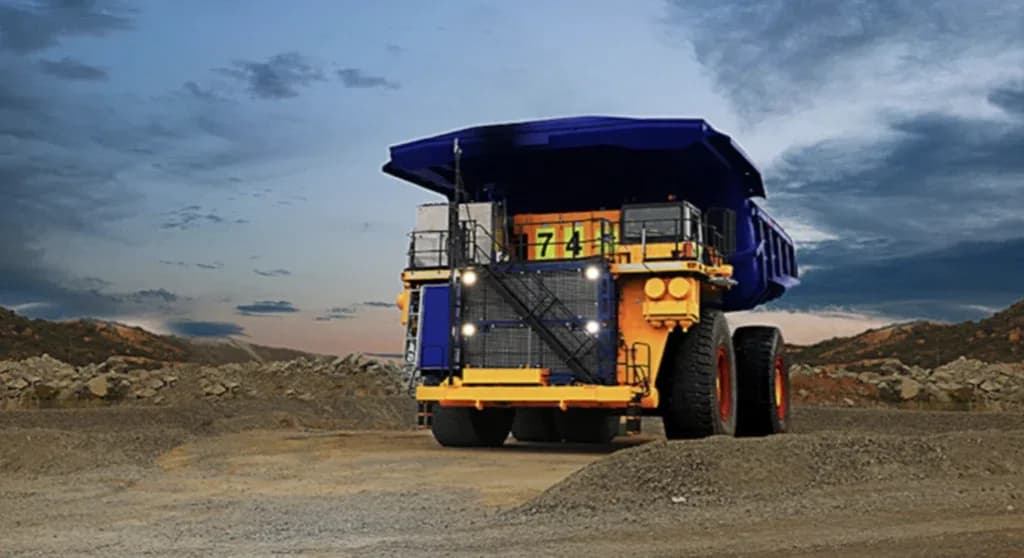
Volvo Construction Equipment has started serial production for electric articulated haulers. Moving to series builds signals commercial readiness and supply chain maturity. Electric haulers cut diesel use, emissions, and noise in pits and quarries. Lower ventilation and fuel costs improve overall site economics. The shift supports operator net-zero targets without sacrificing payload.
Caterpillar Expands Nvidia Partnership and Launches Cat AI Assistant
Caterpillar has expanded its Nvidia partnership and launched the Cat AI assistant. The assistant uses generative AI to help technicians diagnose issues and source documentation faster. Integration with machine data shortens troubleshooting loops. This boosts wrench time and reduces downtime. The collaboration points to more AI copilots across heavy equipment fleets.
Hitachi Invests in Rithmik for AI-Powered Asset Health
Hitachi Construction Machinery has invested in Rithmik Solutions to strengthen AI-powered asset health monitoring. The platform uses machine learning to predict failures before they happen. Early warnings allow planned interventions instead of emergency fixes. This extends component life and improves availability. The deal deepens Hitachi’s push into predictive maintenance services.
SANY Showcases Autonomous and Electric Fleets at Global Mining Summit
SANY showcased autonomous and electric mining fleets at the Global Mining Summit. The lineup included battery-electric trucks and self-driving capabilities for haulage. The demo highlighted progress on integrated charging and fleet autonomy. These systems target lower operating costs and safer operations. The showcase reflects China’s growing role in next-gen mine equipment.
Liebherr Unveils Interoperable Automation and Autonomous Haulage Tech
Liebherr unveiled interoperable automation and autonomous haulage technologies. The platform is designed to work across mixed OEM fleets, not just Liebherr machines. Open interfaces reduce vendor lock-in and simplify scale-up. This helps mines automate haulage without full fleet replacement. The approach accelerates autonomy adoption at brownfield sites.
ESG, Supply Chains and Strategic Resources
DRC Revokes 90 Mining Titles Covering 12,767.5 sq km
The Democratic Republic of Congo revoked 90 mining titles linked to Acacia and Kwango Mines over unpaid annual surface fees. The withdrawn permits span five provinces and include gold, diamond, and bauxite assets. The move reclaims ground for reassignment and signals stricter enforcement of compliance. It also reshapes the junior exploration landscape in-country. The decision may open new licensing rounds for investors willing to meet obligations.
DRC Activists Raise Health Concerns Near Ruashi Mining Site
Ruashi Mining faces new accusations over environmental and health impacts in Kolwezi neighborhoods, Lualaba province. The claims were raised on May 14, 2026 in Kinshasa by NGO Initiative Bonne Gouvernance et Droits Humains (IBGDH). The group called for suspension of trial operations until protection measures are implemented. The case highlights rising community scrutiny of mine impacts. It increases pressure on operators to demonstrate social license and transparent monitoring.
Zambia Eases Sulfuric Acid Exports to Aid DRC Miners
Zambia has authorized a limited resumption of sulfuric acid exports to the Democratic Republic of Congo. The move gives partial relief to Congolese copper and cobalt producers facing months of input shortages. Sulfuric acid is critical for leaching and processing. Easing flows helps stabilize production and avoid smelter curtailments. The decision underscores how regional trade policy directly affects mine output.
MCSA Hosts Missing Persons Locator Systems Workshop
The Minerals Council South Africa ran a Missing Persons Locator Systems Workshop focused on mineworker safety technology. The session reviewed tracking, proximity detection, and emergency response tools. Adoption of these systems improves location accuracy during incidents. It also supports faster rescue and better shift-level accountability. The workshop pushes standardization across South African operations.
Barrick’s Biggest Mali Contractor Quits, 600 Jobs Cut
Barrick’s biggest contractor in Mali has quit, resulting in 600 job cuts. The exit disrupts mining and support services at key sites. It raises short-term risk to production continuity and local employment. The move reflects contractor exposure to security, payment, and operating conditions. Barrick will need to re-tender or in-source work to stabilize output.
Read more about the Mining WRAP here