The Birth of Battery and Magnet Manufacturing in Southern Africa
Southern African states and are shifting from pure raw material mining and supply and taking their first meaningful steps toward becoming players in the global electric vehicle (EV) batteries and magnet value chain. For decades, the region has been a major exporter of raw critical minerals such as manganese, lithium, vanadium, and others, and simultaneously
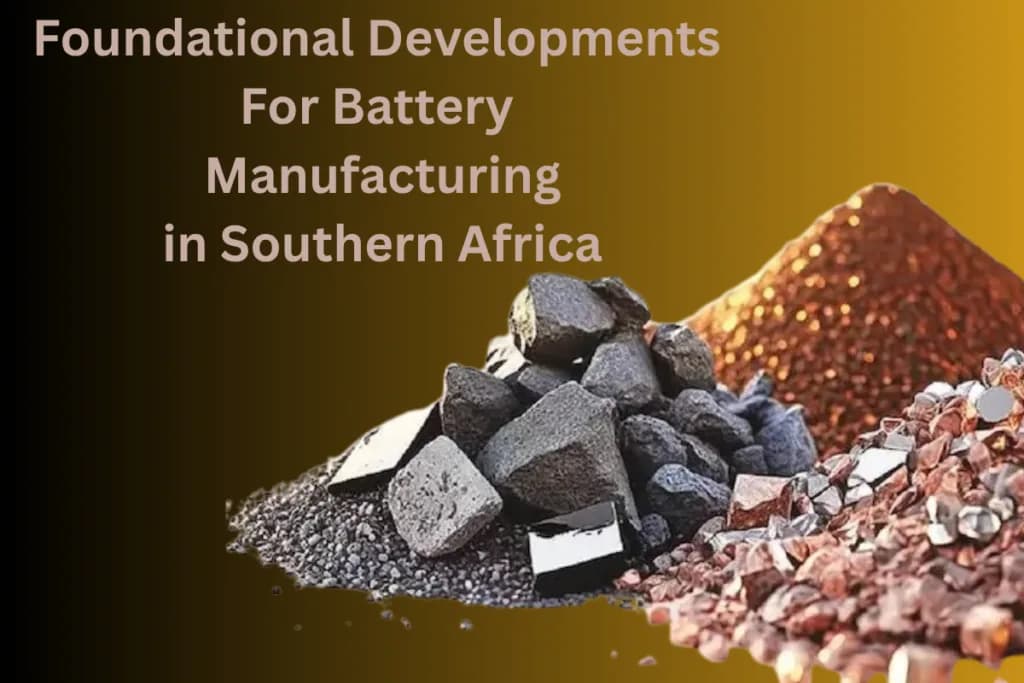
The Birth of Battery and Magnet Manufacturing in Southern Africa
Southern African states and are shifting from pure raw material mining and supply and taking their first meaningful steps toward becoming players in the global electric vehicle (EV) batteries and magnet value chain. For decades, the region has been a major exporter of raw critical minerals such as manganese, lithium, vanadium, and others, and simultaneously importing finished battery and other materials and cells at high cost. That model is beginning to shift. Recent policy moves, combined with existing processing capabilities and emerging projects, signal the early birth of local battery materials manufacturing in Southern Africa.
Junior Mining Developments Igniting Prospects
At the Junior Mining Indaba today (10 June 2026) Several junior mining projects provided updates of projects that are set to change the landscape for downstream beneficiation and potentially create a foundation for manufacturing developments in the region. Adams Intelligence reports indicate that rare earth minerals demand for magnet production is set to grow by a multiple of 7X to current demand by 2040 with prices increasing around 4-5% per annum over this period. Currently China is the global dominant player in this market, holding around 90% of global rare earth metals refining capacity and 95% of global magnet production currently. This is a major supply-chain issue with a single country holding the global EV motor production in its hands.
Angola’s Rare Earth Treasure
Tim George, the CEO of Pesana, a junior mining house, explained that their new Longonjo mine located in a rural area of Angola, was set to change this equation, holding the worlds largest known deposit of Rare Earth Ore at around 313 million tonnes. The mine contains a thick surface blanket of high-grade mineralization over 1.5 km wide and the current reserve is based on upper surface 30 metres with further drilling and exploration anticipating an estimated billion ton of ore deposit. The mine is linked to the Lobito rail corridor and Lobito Port providing easy export efficiencies. They have six off-take agreements sitting on the table with a new refinery in France and local ore refining developments planned in Angola. There is significant funding for the project with high grade ore and low capex based on excellent infrastructure driving an anticipated high operating margin of 80% EBIDTA.
South Africa’s Zandkopdrift Rare Earth Project
This junior mining project based in the Northern Cape Region, is as per C0-founder and CEO, James Kenny, mostly a chemical conversion plant, with only 2% of overall costs focussed on mining. The balance will be used to produce battery grade magnesium sulphate that is increasingly replacing nickel and lithium in batteries. the project will also be producing higher grade, processed material than that produced by China.
The project has as investors, the South African and South Korean government’s providing stability and capital and has already been Designated as a Strategic Project by the EU under the Critical Raw Materials Act for magnet rare earths and battery grade manganese in 2025. The company also has strategic technology supply and off-take agreements signed with Carester, the leading non-Chinese rare earths technology separation supplier, in 2025
Policy Push: Extending Incentives to Battery Minerals
In late May 2026, the South African Department of Trade, Industry and Competition (dtic) published draft amendments to the Automotive Production and Development Programme Phase 2 (APDP2). The proposals aim to add critical minerals used in EV batteries, including lithium, graphite, copper, cobalt, rare earths, iron, and manganese, to the list of qualifying “standard materials.”
Under the changes, a 50% Standard Value Added (SVA) would apply to these materials, allowing local processors and battery component manufacturers to claim higher production credits and customs rebates. The move is designed to encourage beneficiation, attract investment in precursor production, and help the automotive sector transition to EVs. Public comments are still being accepted, with implementation likely targeted for early 2027.
This policy builds on existing incentives, such as accelerated depreciation allowances for EV-related investments, and reflects a strategic recognition that South Africa must move up the value chain or risk losing its automotive manufacturing base to competitors like Morocco.
Current Manufacturing Scale and Scope
While Southern Africa’s battery materials industry remains in its infancy, however there are pockets of real capability.
Manganese Metal Company (MMC), based in Mbombela, Mpumalanga, is the most advanced player. Established in 1974, MMC is a privately held South African company and one of the world’s leading producers of high-purity electrolytic manganese metal. It is currently commissioning a 6,000 tonnes per annum High-Purity Manganese Sulphate Monohydrate (HPMSM) plant, which is a critical cathode precursor for lithium-ion batteries. Plans exist to scale this to 30,000 tonnes per annum in subsequent phases.
Bushveld Minerals, listed on the London AIM market, operates through Bushveld Energy. It has commissioned an 8 million litre per annum vanadium electrolyte plant for Vanadium Redox Flow Batteries (VRFB), primarily for stationary energy storage.
Giyani Metals is advancing the K.Hill Manganese Project in Botswana with a demonstration plant in South Africa. Smaller ventures are also emerging in battery recycling, such as Cwenga Lib, which is building lithium-ion recycling capacity to recover materials locally.
Potential Impact
If these initiatives scale successfully, the benefits could be substantial. Battery materials processing and component manufacturing are more labour-intensive than raw mining. A meaningful industry could create thousands of direct and indirect jobs in engineering, chemistry, logistics, and advanced manufacturing, while building technical skills currently in short supply.
Moving from raw mineral exports to battery-grade precursors would significantly increase value per tonne and diversify export earnings. Success would also drive demand for reliable electricity, improved rail and port logistics, and water management — areas where investment is badly needed.
Importantly, the emergence of smaller battery startups and ventures is adding innovation and agility to the ecosystem. Companies like Giyani Metals, Leaper Innovate Green Energies (working on alternative battery chemistries), and recycling players such as Cwenga Lib are creating a more dynamic environment. These startups are not only developing niche solutions but are also attracting early-stage capital, fostering skills development in areas like electrochemistry and materials science, and building a broader innovation pipeline that could feed into larger manufacturing operations. This startup layer increases the chances of technology adaptation to local conditions and creates additional employment opportunities for engineers and technicians.
For the automotive sector, local battery materials and components could reduce import costs and lead times for vehicle manufacturers. This is critical as global OEMs push for regionalised supply chains. Greater local content could help South Africa retain and expand its automotive assembly footprint, which has been losing ground to Morocco and Egypt.
Realistic Hurdles
A level-headed view must acknowledge significant challenges. Perhaps the most critical and immediate barrier is energy security and cost.
Battery materials production, particularly the conversion of manganese ore into high-purity manganese sulphate monohydrate or other precursor chemicals, is extremely energy-intensive. Processes such as electrowinning and high-temperature calcination require stable, high-volume electricity supply 24/7. South Africa’s chronic load shedding, even as it has improved somewhat in 2026, remains a major risk for any investor considering large-scale chemical processing plants.
Electricity prices for industrial users in South Africa are already among the highest in the world when factoring in reliability. Unreliable supply forces companies to invest in expensive diesel generators or battery backup systems, dramatically increasing operating costs and undermining competitiveness. Several promising projects have already been delayed or scaled back due to energy uncertainty.
Furthermore, the transition to renewable energy brings its own complications for energy-intensive industries. Intermittent solar and wind power requires substantial battery storage or hybrid systems to provide the consistent baseload that chemical plants demand. While some companies are exploring dedicated renewable-powered micro-grids, the regulatory framework and infrastructure for large-scale private power generation still lag behind ambition.
This energy bottleneck affects not only direct production costs but also investor confidence. International partners repeatedly cite reliable power as a make-or-break factor. Without a credible, long-term solution to South Africa’s energy crisis, the vision of a competitive local battery industry will remain extremely difficult to realise.
Other major hurdles include high capital intensity, the need for advanced technology partnerships, policy uncertainty around B-BBEE and labour laws, and fierce global competition, particularly from China.
Can This Revive the Auto Industry?
Potentially yes — but only if execution is strong. Providing competitively priced, locally produced battery materials could improve cost structures for assemblers and help South Africa meet rising rules-of-origin requirements in export markets.
The birth of battery and magnet production in Southern Africa is underway. It represents a rare opportunity to convert mineral wealth into industrial capability and long-term economic resilience. The next few years will determine whether this early momentum translates into a genuine new pillar of the regional economy, or remains another promising but unfulfilled ambition.