Dry Stack Tailings: ESG Expectation or Financial Impossibility for African Mines?
Tailings management has become one of the most closely watched issues in the mining industry. For decades, mines around the world have relied on large tailings dams to store the waste produced after minerals are extracted from ore. These dams hold finely ground rock mixed with water and processing chemicals, forming a slurry that is
Dry Stack Tailings: ESG Expectation or Financial Impossibility for African Mines?
Tailings management has become one of the most closely watched issues in the mining industry. For decades, mines around the world have relied on large tailings dams to store the waste produced after minerals are extracted from ore. These dams hold finely ground rock mixed with water and processing chemicals, forming a slurry that is pumped into large containment areas. While this system has long been standard practice, several high profile tailings dam failures over the past decade have pushed the industry to reconsider how mining waste is handled.
Understanding Dry Stack Tailings
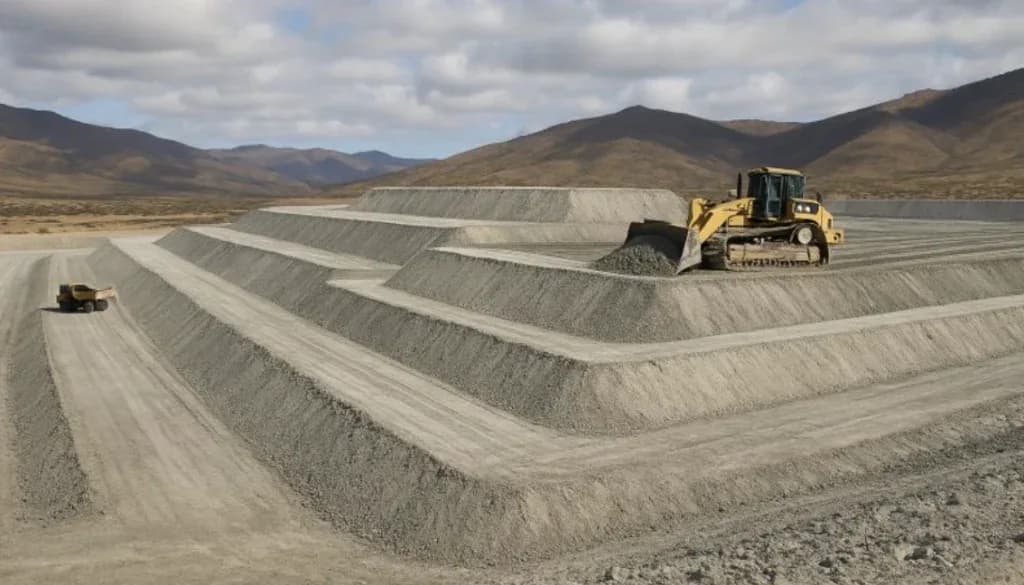
One technology increasingly discussed in this context is dry stack tailings. Instead of pumping tailings as a liquid slurry into dams, this method removes most of the water through filtration systems. The remaining material, which has the consistency of damp soil, can then be transported and stacked in compact layers. The result is a storage structure that looks more like a waste rock pile than a conventional tailings pond.
From an environmental and safety perspective, the advantages are clear. Dry stacked tailings reduce the risk of catastrophic dam failures because the material is no longer stored as a large body of water-saturated slurry. The method also allows mines to recover and reuse significant amounts of water during processing. In water-stressed regions, this can be an important operational advantage. Additionally, dry stacks generally occupy a smaller surface footprint and allow progressive rehabilitation of the storage area as mining continues.
Alignment with ESG Expectations
These characteristics align closely with the expectations that now define environmental, social and governance (ESG) performance in mining. Investors, regulators and communities increasingly demand stronger oversight of tailings storage, particularly after disasters that have caused loss of life and widespread environmental damage in other parts of the world. In that environment, dry stack tailings are often presented as a safer and more responsible alternative to conventional dams.
Financial and Operational Challenges
Yet the picture is far more complex when applied to the realities of mining operations across Africa. Installing a dry stack system requires specialised filtration plants, additional material handling infrastructure, and higher energy consumption. These requirements significantly increase both capital expenditure and operational costs. For large mines processing millions of tonnes of ore each year, the cost difference can be substantial.
Scale is also an important factor. Many African mining operations, particularly in commodities such as copper or iron ore, process extremely large volumes of material. Filtering and stacking such volumes can become technically challenging and economically difficult. In some cases, the cost of implementing dry stack tailings can affect the overall viability of a project.
Balancing ESG Pressure and Economic Reality
This tension between sustainability expectations and economic realities is at the heart of the debate. On one side are investors and environmental groups who argue that safer tailings management must become a standard industry practice. On the other are mining companies that must balance safety improvements with the financial constraints of operating large scale mines in competitive global markets.
In practice, the future of tailings management in Africa is unlikely to be defined by a single solution. Some projects, particularly smaller or high-value operations, may adopt dry stack systems where the economics allow it. Others may continue using conventional tailings dams while improving monitoring systems, engineering standards and risk management practices.
What is clear is that tailings management has moved from a technical issue buried deep within mine engineering departments to a central part of mining’s ESG conversation. Whether dry stack tailings become the new industry standard or remain a specialised solution will depend largely on how the industry balances environmental responsibility with the financial realities of mining on the African continent.