South Africa’s Solar PV Industry Surpasses 10 GW Milestone
The South African Photovoltaic Industry Association (SAPVIA) has released its Annual Report for the 2025/26 financial year, highlighting a transformative period for the country’s solar sector. South Africa crossed a major milestone by surpassing 10.12 GW of installed solar PV capacity, representing a positive 19% year-on-year growth. This achievement cements the country’s position as Africa’s
Solar PV
The South African Photovoltaic Industry Association (SAPVIA) has released its Annual Report for the 2025/26 financial year, highlighting a transformative period for the country’s solar sector.
South Africa crossed a major milestone by surpassing 10.12 GW of installed solar PV capacity, representing a positive 19% year-on-year growth. This achievement cements the country’s position as Africa’s leading solar market and one of the top 20 globally.
The report highlights solar PV’s emergence as the primary driver of new generation capacity nationwide, supported by strong public and private investment across utility-scale, commercial & industrial (C&I), and distributed generation segments. While the residential market normalised post-load shedding, utility-scale and C&I projects delivered sustained momentum.
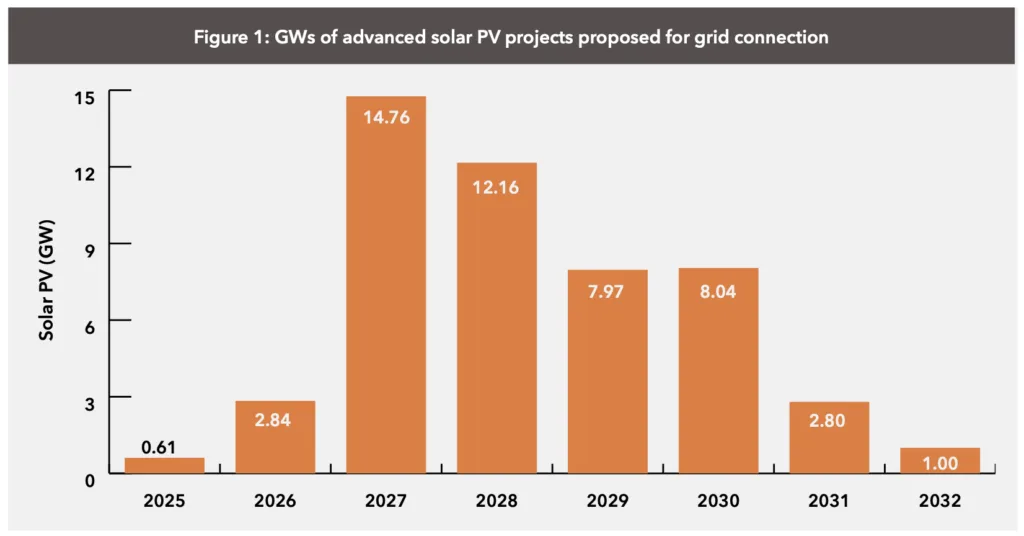
The 4th South African Renewable Energy Grid Survey (SAREGS 2025) has further identified a strong pipeline of solar PV projects proposed for grid connection up to 2030, with around 14.76 GW anticipated to be activated in 2027 alone (peak year).
- Total advanced-stage solar PV projects: Over 46 GW
- This includes standalone solar PV and hybrid configurations (mainly solar + Battery Energy Storage Systems – BESS)
Key Accomplishments
Capacity Milestones and Pipeline Strength
Total installed capacity reached 10.12 GW, with non-REI4P projects (private sector-led) contributing 7.46 GW (21% growth) and REI4P projects adding 2.66 GW (13% growth). Several landmark projects reached Commercial Operation Date (COD), including the Springbok Solar Project (150 MW) — a pioneering multi-buyer corporate PPA serving Amazon, Sibanye-Stillwater, and Vodacom — and the innovative Umoyilanga hybrid power plant.
The 4th South African Renewable Energy Grid Survey (SAREGS 2025), co-led by SAPVIA, revealed an impressive national renewable energy pipeline exceeding 220 GW, with solar PV dominating at over 46 GW of advanced-stage projects proposed for grid connection by 2030. This robust pipeline aligns closely with the Integrated Resource Plan (IRP) 2025 targets.
Policy and Regulatory Wins
SAPVIA played a leading role in more than 15 formal policy engagements. Key successes include:
- Advocacy in NEDLAC for the IRP 2025’s 16 GW distributed generation allocation to be treated as a flexible guideline rather than a hard cap.
- Successful contribution to the approval and gazetting of NERSA’s Grid Capacity Allocation Rules (GCAR).
- Removal of the Professional Registration Number (PRN) sign-off requirement for residential small-scale embedded generation (SSEG) systems.
- Expanded staffing of Eskom’s Grid Access Unit following sustained engagement.
The Association also made substantive submissions on SANS 10142-1 standards, electricity trading rules, carbon credit markets, and import duty/rebate regimes.
Industry Capability and Quality Assurance
The PV GreenCard (PVGC) programme issued 1,054 certificates — a 54% increase — supported by an expanded network of 21 endorsed training centres and 17 assessment centres. This initiative continues to drive higher installation quality and consumer confidence.
Skills Development Focus
Skills development remained a strategic priority. In a notable youth empowerment achievement, all 100 young electricians enrolled in the National Business Initiative (NBI) and Absa-backed programme graduated in November 2025, with close to 20 successfully placed with SAPVIA member companies. The Skills4PV Working Group advanced competency frameworks (Papers A, B & C) and supported broader curriculum alignment with QCTO requirements. The PowerUp skills platform and various workshops further strengthened industry capability across the value chain.
Support for Smaller Businesses and Inclusion
SAPVIA’s Gender and Economic Development Working Group actively promoted opportunities for small, medium and micro enterprises (SMMEs). Key initiatives included providing free exhibition access for 30 SMMEs at Solar & Storage Live and launching the SAPVIA Gender Diversity Guideline at Windaba 2025. This sector-specific framework sets practical standards for gender equity, youth participation, and B-BBEE compliance. Additional webinars on digital literacy and financial inclusion targeted women-led businesses, enhancing broader participation in the solar value chain.
Partnerships and Industry Voice
SAPVIA’s seven working groups convened 474 participants across 40 meetings, serving as the “engine room” of the Association. The organisation secured a US$150,000 ClimateWorks Foundation grant and strengthened collaborations through the South African Renewable Energy Masterplan (SAREM), KVP ZAF, and GOGLA Southern Africa Working Group.
Media efforts generated 345 articles reaching a cumulative audience of 276 million, delivering significant value to the sector.
Outlook and Strategic Implications
The report paints an optimistic yet pragmatic picture. While grid constraints, policy implementation delays, and infrastructure challenges continue to create challenges, the combination of strong pipeline momentum, policy wins, and industry collaboration positions the sector for continued growth. SAPVIA’s focus on skills development and inclusive participation also indicates a commitment from the industry to ensure that the solar boom creates broad-based economic opportunities, including for smaller businesses and young South Africans. South Africa’s solar PV sector continues to offer substantial opportunities, including gaps for smaller businesses, supported by improving regulatory clarity, ongoing skills development programs and a maturing ecosystem.