South Africa’s QES December 2025 – Fewer Jobs, Fatter Pay Cheques, and the Public-Sector Skew
The Stats SA Quarterly Employment Statistics (QES) release for the quarter ending December 2025, published on 31 March 2026, paints a picture that is at once familiar and deeply troubling for South Africa. Total formal non-agricultural employment rose modestly by 18 000 (0.2 %) quarter-on-quarter to 10.551 million, but fell 102 000 (–1.0 %) year-on-year.

SA unemployment at record high!

The Stats SA Quarterly Employment Statistics (QES) release for the quarter ending December 2025, published on 31 March 2026, paints a picture that is at once familiar and deeply troubling for South Africa. Total formal non-agricultural employment rose modestly by 18 000 (0.2 %) quarter-on-quarter to 10.551 million, but fell 102 000 (–1.0 %) year-on-year. At the same time, the total gross earnings bill jumped R74.7 billion (7.4 %) from the September quarter to R1.080 trillion and was still R49.6 billion (4.8 %) higher than December 2024. Average monthly earnings (including bonuses and overtime) reached R29 690 in November 2025, up 4.9 % year-on-year. Basic wages alone rose 4.5 % year-on-year.
This scenario is classic “jobless wage growth” – fewer people earning more money. The data reveals a structural disparity between employment contraction in the private sector and sustained (or accelerated) compensation growth, particularly in the community, social and personal services sector (the closest proxy Stats SA provides for public-sector and government-linked employment).
The result is a widening gap between the number of workers and the size of the wage bill, even as service delivery metrics in many government departments remain dismal.
Sectoral Employment: Private-Sector Pain, Public-Sector Stability
Table A below shows a clear picture. Manufacturing shed 25 000 jobs (–1.9 %) year-on-year and another 11 000 in the final quarter. Construction lost 20 000 (–3.3 %) over the year and 13 000 in Q4. Transport and business services also contracted. Only wholesale & retail trade managed a quarterly gain of 37 000, but it was still down 12 000 year-on-year.
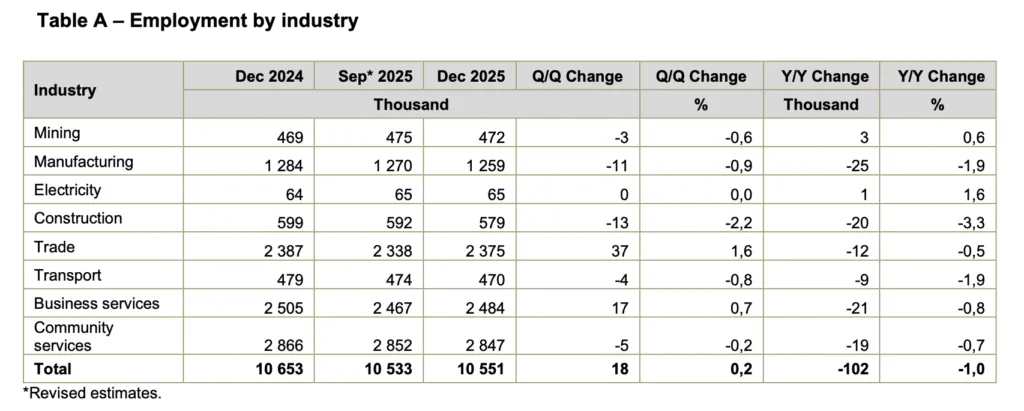
Community, social and personal services, which includes national and provincial departments, local government, health, education, NGOs and some private social services, recorded a milder annual decline of 19 000 jobs (–0.7 %). In absolute numbers this sector still employs 2.847 million people, or roughly 27 % of all formal non-agricultural workers. Its employment base is therefore large enough that even a small percentage movement moves the national needle, yet the decline was smaller than in most private-sector industries.
Full-time employment fell by 69 000 (–0.7 %) and part-time employment fell 33 000 (–2.9 %) over the year. The labour market is not only shrinking; it is also becoming more precarious for those still employed.
Earnings: The Bonus Season and the Wage-Bill Paradox
The earnings story is the mirror image. Gross earnings in community services rose 5.7 % year-on-year to R343 billion, outpacing the national 4.8 % increase. Basic wages in the sector grew 5.2 %. Bonuses across the economy surged 92.5 % quarter-on-quarter (classic December effect) and were still 7.6 % higher year-on-year. Community services bonuses jumped 69.5 % from September to December.
When you strip out the December bonus spike, the underlying trend remains: compensation per worker is rising faster than headcount.
Average monthly earnings at current prices increased 4.9 % year-on-year, comfortably above headline CPI for most of 2025. The QES constant-price series (Table 11) confirms real wage growth in several sectors.
This is not organic productivity-driven growth across the board. It is concentrated. Private-sector industries such as manufacturing and construction showed modest earnings growth (2.7 % and 2.8 % respectively) while shedding jobs. Community services delivered both relative employment resilience and faster wage-bill expansion.
Is the Public Sector Skewing the Numbers?
Yes – and the data quantifies how.
Community services accounted for approximately 31.7 % of the total gross earnings bill in December 2025 while representing only 27 % of employment. Its year-on-year earnings growth (5.7 %) exceeded the national average (4.8 %). In absolute terms, the sector contributed R18.6 billion of the national R49.6 billion increase in gross earnings.
Public-service wage agreements have historically delivered 6–8 % nominal increases (the 2025/26 round was widely reported in that range). Even if the QES does not isolate “pure government” payrolls from NGOs and private social services, the community-services category is dominated by public payrolls. The 5.7 % earnings growth and 69.5 % quarterly bonus surge in this sector are entirely consistent with those agreements plus performance bonuses and overtime in departments that remain heavily unionised.
Meanwhile, the private sector is shedding lower-paid, lower-skilled roles and retaining or hiring higher-paid, higher-skilled workers, in a classic “hollowing out” dynamic. The net effect on the national averages is that the wage bill keeps rising while headcount falls.
The Human and Economic Cost
South Africa already has one of the world’s highest unemployment rates. The QES covers only the formal non-agricultural sector; when combined with the QLFS household survey, the broader picture is bleaker. Every net job loss in formal employment pushes more people into unemployment, under-employment or the informal economy, where earnings are lower and protections weaker.
At the same time, the public-sector wage bill, already the single largest item in the national budget, continues to grow faster than the economy and faster than employment.
This creates a classic “bloated administration” problem: more money per employee, fewer total employees, yet persistent complaints of poor service delivery in health, education, local government and SOEs. The data does not capture productivity or output quality, but ordinary citizens experience the gap daily with long queues at clinics, government departments, potholed roads, under-resourced schools.
This dynamic also exacerbates inequality. The workers who remain in formal employment (especially in the public sector) are capturing real wage gains, while the unemployed and informally employed see none. The Gini coefficient, already extreme, is unlikely to improve under these conditions.
Why Is This Happening?
Several structural factors are at play:
- Public-sector wage rigidity: Collective bargaining agreements with unions lock in above-inflation increases for millions of public employees, regardless of economic growth or productivity.
- Private-sector contraction: Energy insecurity, logistics bottlenecks, high interest rates and weak domestic demand continue to pressure manufacturing, construction and trade.
- Skills mismatch and automation: Employers in surviving firms are retaining higher-skilled (higher-paid) workers and shedding lower-skilled roles.
- Bonus culture and year-end accounting: December always inflates the quarterly earnings figures, but the year-on-year bonus increase (7.6 %) suggests structural pressure to retain key talent with cash incentives.
- Statistical base effects: The QES data is enterprise-based on VAT-registered entities; it misses informal and small-business dynamics that may be absorbing some of the displaced formal workers.
Policy Implications
The QES December 2025 numbers should be a wake-up call. A labour market in which employment contracts while the wage bill expands is unsustainable in a country with 32–35 % unemployment (depending on the measure).
- Public-sector wage negotiations must be tied to measurable productivity and service-delivery targets, not automatic above-inflation hikes.
- Private-sector incentives (tax breaks for job creation, skills-development rebates, energy-cost relief) are urgently needed to reverse manufacturing and construction losses.
- Active labour-market policies – expanded learnerships, wage subsidies for first-time hires, and targeted support for SMEs – must bridge the gap between the shrinking formal payroll and the growing pool of job-seekers.
Without these, South Africa risks a future in which a shrinking core of relatively well-paid formal workers (heavily weighted toward the public sector) co-exists with mass unemployment and stagnant living standards for the majority.
The December 2025 QES is not just a statistical snapshot; it is a warning that the current growth model is delivering higher pay for fewer people while the social contract frays.