South Africa’s Automotive Sector: Strong Domestic Rebound Masks Deeper Structural Challenges – NAAMSA Q1 2026 Analysis
The South African automotive industry delivered its strongest first-quarter performance in over a decade, yet the latest NAAMSA Quarterly Review of Business Conditions reveals a tale of two sectors: robust domestic demand colliding with weakening production and export volumes. Released on 27 May 2026, the report highlights both encouraging momentum and persistent vulnerabilities in one
South Africa’s Automotive Sector: Strong Domestic Rebound Masks Deeper Structural Challenges – NAAMSA Q1 2026 Analysis
The South African automotive industry delivered its strongest first-quarter performance in over a decade, yet the latest NAAMSA Quarterly Review of Business Conditions reveals a tale of two sectors: robust domestic demand colliding with weakening production and export volumes. Released on 27 May 2026, the report highlights both encouraging momentum and persistent vulnerabilities in one of the country’s most important industrial pillars.
Robust Domestic Sales Growth
Aggregate new vehicle sales in Q1 2026 rose 12.4% year-on-year, reaching the best Q1 figures since 2013. Passenger car sales increased by 12.5%, while light commercial vehicles grew by 13.0%. This broad-based recovery was supported by lower interest rates, moderating inflation, improved consumer confidence, and a flood of new, competitively priced models — particularly from Chinese brands.
The growth momentum continued a remarkable run, with March 2026 marking the 18th consecutive month of positive sales growth. This performance significantly outpaced many global markets, including the European Union’s more modest +4.0% rise in new car registrations for the same period.
Production and Exports Under Pressure
Beneath the surface of strong sales lies a more concerning picture on the manufacturing side. Domestic vehicle production fell 5.3% year-on-year in Q1 2026, largely due to softer export demand. Vehicle exports declined by 10.3%, with notable drops to Europe and Asia. While exports to Africa and North America held firmer, the overall trend reflects the impact of global protectionism and new model launch preparations.
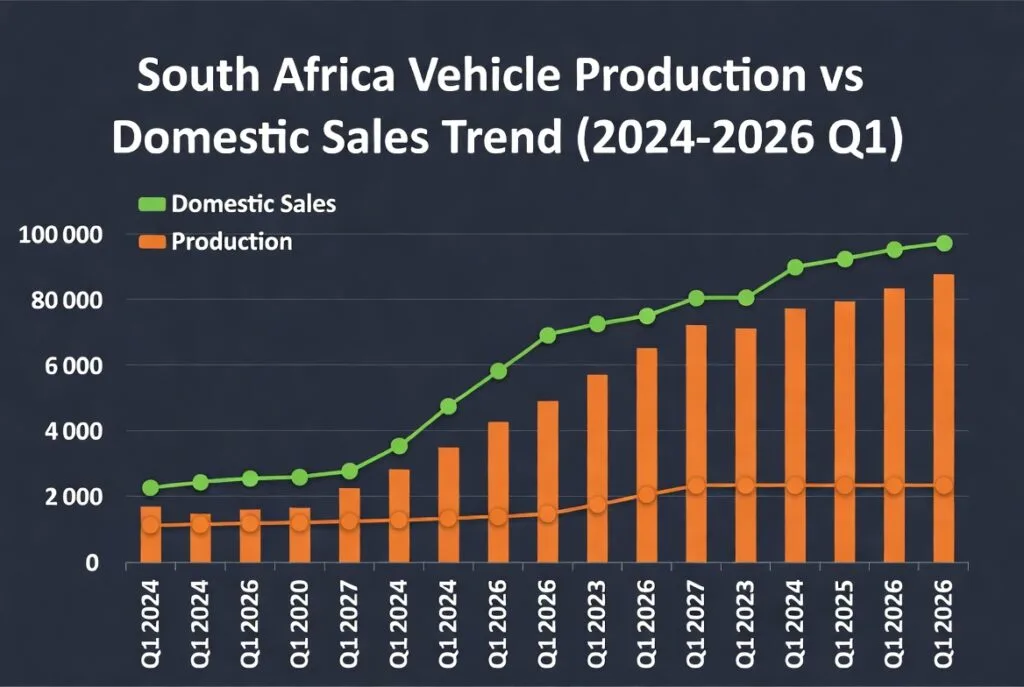
Capacity utilisation also eased in several segments. The car segment averaged 78.6% utilisation, down from stronger levels in previous years, reflecting lower production volumes driven by export softness.
Employment and Investment Trends
Manufacturing employment showed marginal stability, rising slightly to 31,905 workers by end-March 2026 (up 27 jobs from December 2025). The independent importers segment added 136 jobs, reaching 8,034 employees. However, full-year 2025 employment averaged lower than 2024, reflecting production adjustments at major OEMs.
Capital expenditure by major light vehicle manufacturers reached R7.2 billion in 2025, focused on new model investments and the transition toward electrified vehicles. This continued commitment to future-proofing plants is positive, though overall industry investment levels remain sensitive to policy certainty under the upcoming APDP2 review.
Accelerating Shift Toward New Energy Vehicles
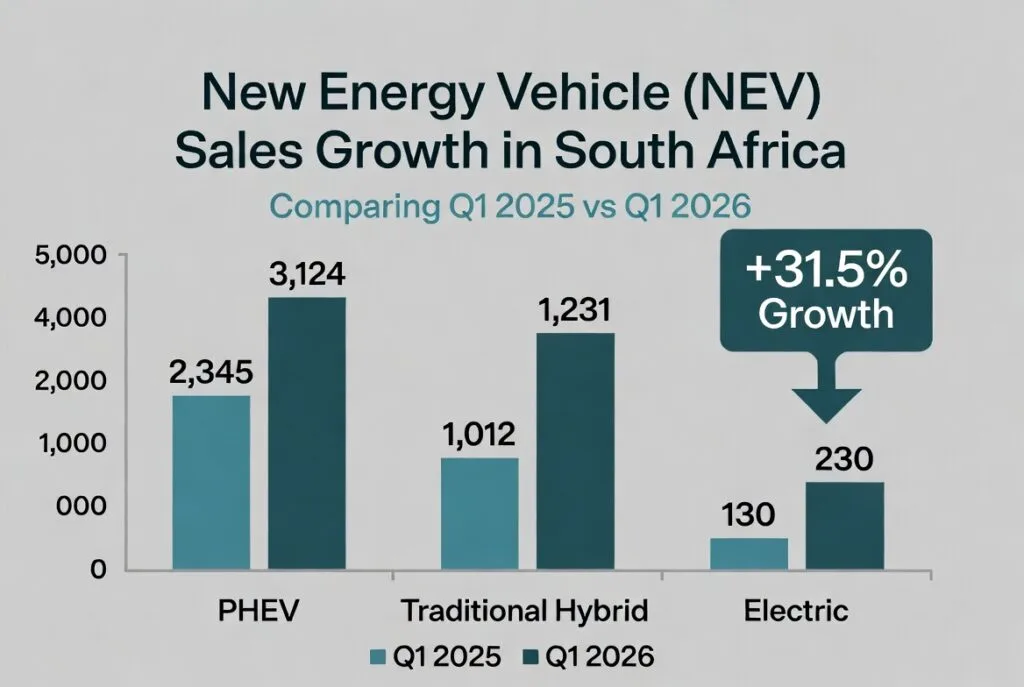
One of the brightest spots is the rapid uptake of New Energy Vehicles (NEVs). Sales by 23 brands grew 31.5% to 4,585 units in Q1 2026. Plug-in Hybrid Electric Vehicles (PHEVs) showed particularly strong momentum, with 1,277 units sold in the quarter alone.
This reflects South African consumers’ pragmatic approach — favouring hybrids that offer electric benefits without full reliance on still-limited charging infrastructure. Government’s new Section 12V tax incentive (150% deduction for EV-related assets), effective from March 2026, should further support this transition.
Global Context
While South Africa’s domestic market outperformed, global automotive production grew modestly by 3.5% in 2025 to 96.4 million units. South Africa’s global production share slipped slightly to 0.64%, maintaining its 21st ranking. The country remains Africa’s dominant producer (50.3% of continental output) but faces increasing competition from lower-cost manufacturers in Asia.
The Import Challenge: China and India
The flood of affordable vehicles from China and India continues to reshape the South African market. The country recorded a massive R90 billion vehicle trade deficit with these two nations in 2025. Chinese brands have captured significant market share in the entry-level and mid-range segments with well-equipped, competitively priced offerings.
This import surge is driven by:
- Lower production costs in China/India
- Aggressive pricing strategies
- Faster model refresh cycles
- Consumer demand for value-for-money vehicles
Only about 37% of vehicles sold in South Africa are now locally manufactured, putting intense pressure on local assembly plants, component suppliers, and jobs.
Outlook for 2026–2027
NAAMSA remains cautiously optimistic. Domestic sales momentum is expected to carry through 2026, supported by new model introductions and relatively favourable macro conditions. However, risks are mounting: the escalating Middle East conflict could drive inflation and disrupt supply chains, while global protectionism continues to weigh on exports.
Full-year 2026 vehicle production is projected to be flat to modestly higher than 2025, with stronger growth dependent on export recovery and successful implementation of SAAM 2035 and APDP2 reforms.
Policy Implications: How Should Government Respond?
The DTIC is already reviewing higher import tariffs (potentially up to 50%) on vehicles from China and India. While necessary to protect local industry and jobs, policymakers must balance this carefully to avoid significantly higher vehicle prices for consumers.
Recommended actions include:
- Strengthening local content requirements under APDP2
- Fast-tracking incentives for hybrid and EV component manufacturing
- Supporting deeper regional integration through AfCFTA to boost intra-African exports
- Accelerating investment in port, rail, and energy infrastructure to improve competitiveness
Conclusion
South Africa’s automotive sector demonstrated remarkable resilience in Q1 2026, with domestic demand firing on all cylinders. However, the divergence between strong sales and softer production/export performance underscores deep structural challenges — particularly the rising tide of Asian imports.
The coming months will be critical. With APDP2 and SAAM 2035 under review, South Africa has a strategic window to reposition its automotive industry for the electrified, regionally integrated future. Failure to act decisively risks further erosion of local manufacturing capacity and thousands of jobs.
The industry has shown it can grow — now it needs the right policy framework to ensure that growth is sustainable and locally anchored.