South Africa Misses Economic Growth Opportunity Amid Global Commodity Boom
South Africa reaped substantial benefits from the global commodity boom in 2021 and 2022, with mining companies achieving record profits and contributing significantly to the national revenue. However, the country failed to fully capitalize on this opportunity to boost foreign exchange earnings and economic growth, according to a 30-year macroeconomic review by the Bureau of

South-African economy
South Africa reaped substantial benefits from the global commodity boom in 2021 and 2022, with mining companies achieving record profits and contributing significantly to the national revenue. However, the country failed to fully capitalize on this opportunity to boost foreign exchange earnings and economic growth, according to a 30-year macroeconomic review by the Bureau of Economic Research (BER).
Despite favourable export prices driven by a weakening rand against the dollar and rising commodity prices, South Africa’s exports have declined since 1994. The mining industry, typically a beneficiary of a weaker currency, saw its exports become more valuable in rand terms. The rand’s depreciation from just over R3 to the US dollar in 1994 to around R18 per dollar in 2024 should have significantly increased the value of mining exports. Coupled with the commodity boom following the pandemic-era lockdowns, the country’s exports should have soared.
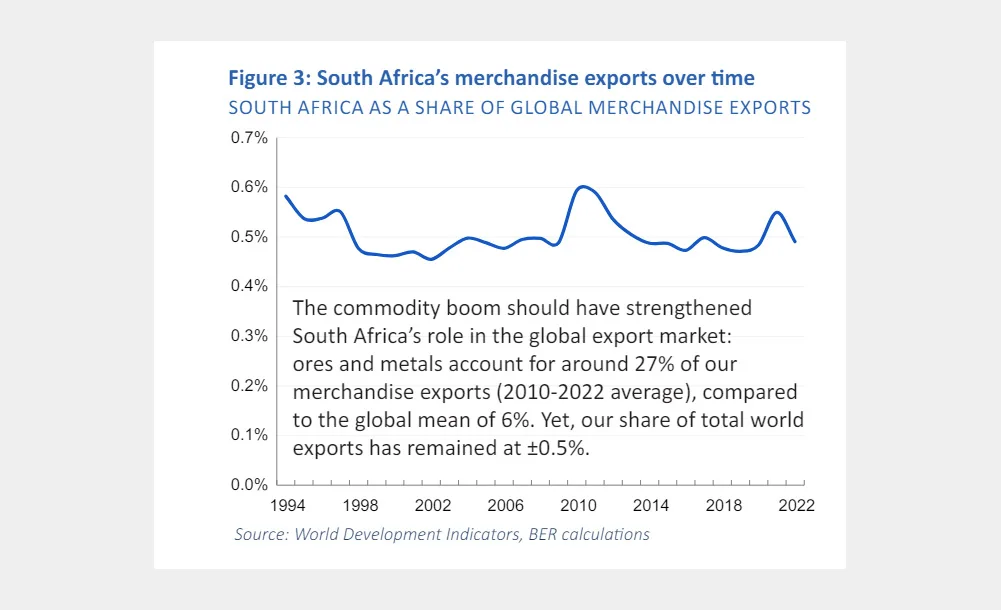
However, deteriorating logistics, load-shedding, and regulatory uncertainty hampered the mining industry’s output, preventing South Africa from capitalizing on the commodity boom. The BER noted that the boom should have enhanced South Africa’s global export market role and its position in the global supply chain. Ores and metals, which experienced the boom, account for about 27% of the country’s exports compared to the global average of 6%. Despite this, South Africa’s share of the global export market remained flat at 0.5%.
The missed opportunity has had significant consequences for the South African economy. The government lost around R52 billion in tax collections due to the failure to export minerals and commodities effectively. Mining companies, facing significant revenue declines, began cutting jobs. The Minerals Council of South Africa estimated that logistical and port infrastructure challenges cost the country R150 billion in exports during the commodity boom. Additionally, a study by the GAIN Group highlighted losses of R353 billion due to Transnet’s problems, suggesting that South Africa’s economic growth could have been over ten times higher at 5.4% in 2023 if Transnet had operated at full capacity.
Beyond these immediate losses, the country faces a longer-term issue of declining mining output. Data from the Reserve Bank shows that the mining sector has not grown meaningfully since 2019. The sector still employs over 477,000 people and contributes significantly to the economy, but this contribution is smaller than it was five years ago. The Reserve Bank attributes the decline in mining output to high operating costs, regulatory uncertainty, inefficient logistics, and electricity disruptions. Consequently, South Africa is now considered an unattractive mining investment destination, ranking among the ten least attractive mining destinations according to the Fraser Institute.
In summary, South Africa’s failure to fully leverage the global commodity boom due to logistical, regulatory, and infrastructural challenges has led to substantial economic losses and missed growth opportunities. The country’s mining sector, despite its significant contributions, faces a challenging future unless these fundamental issues are addressed.
Main Image: The Cape Independent