South Africa – Contraction of Growth As Capital Exits and Policy Constricts
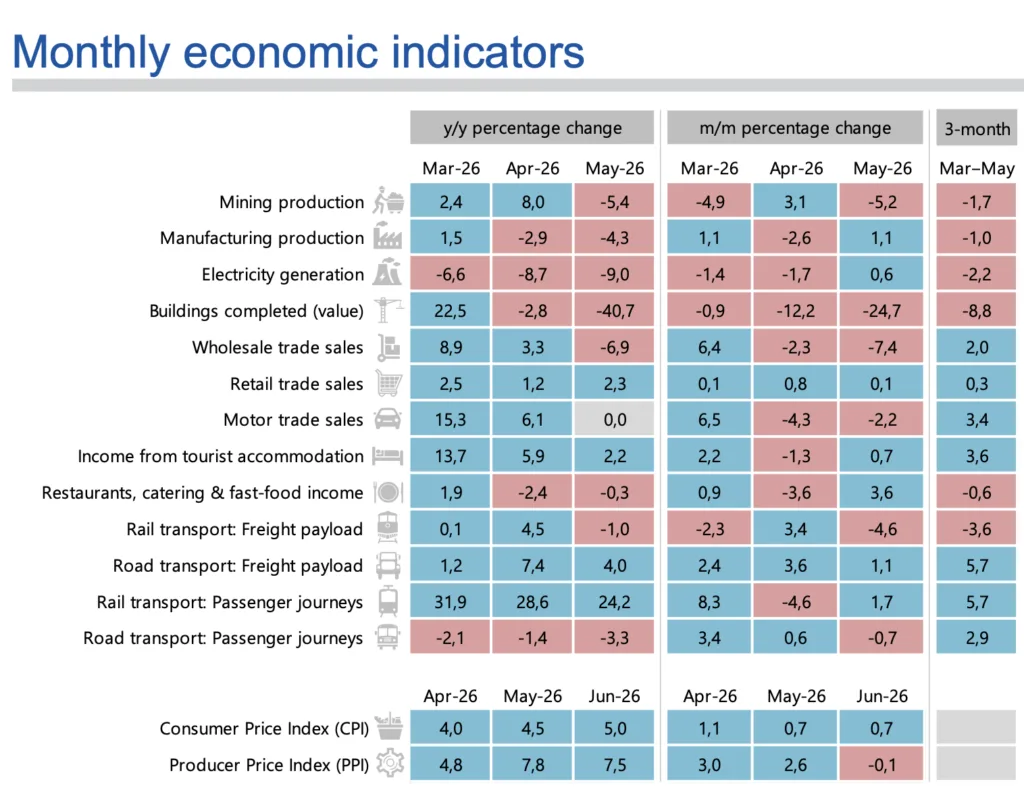
The latest Stats SA monthly indicators paint a clear and uncomfortable picture. Core sectors of the South African economy are contracting or stagnating at a time when the country can least afford it. Mining production fell by -5.4% year-on-year in May 2026. Manufacturing output declined by – 4.3% while Electricity generation dropped -9.0 percent. The

South Africa – Contraction of Growth As Capital Exits and Policy Constricts
The latest Stats SA monthly indicators paint a clear and uncomfortable picture. Core sectors of the South African economy are contracting or stagnating at a time when the country can least afford it. Mining production fell by -5.4% year-on-year in May 2026. Manufacturing output declined by – 4.3% while Electricity generation dropped -9.0 percent. The value of buildings completed collapsed by -40.7%, and wholesale trade sales contracted -6.9%. These are not simply isolated monthly blips. They form part of a broader pattern of weakening real economic activity that has become increasingly difficult to ignore.
The data, published in Stats SA’s Stats Biz newsletter for July 2026, covers the key production and trade indicators that drive employment, tax revenue and long-term growth. When these numbers move together in the wrong direction, the signal is unambiguous. Productive capacity is under pressure. Fixed investment is hesitant. The physical economy is not expanding at the rate required to absorb new entrants into the labour market or to stabilise public finances.
Structural and Cyclical Concerns Combined
A closer look at the individual series reveals both cyclical weakness and deeper structural problems. Mining’s sharp decline in May reversed earlier gains and points to ongoing challenges with logistics, energy reliability and investment confidence. Manufacturing has now posted consecutive months of year-on-year contraction, consistent with weak domestic demand and the high cost of doing business. The collapse in the value of buildings completed is particularly striking. Construction activity is a leading indicator of confidence in the future. When developers and contractors pull back this sharply, it usually reflects uncertainty about returns, regulatory risk and the reliability of basic infrastructure.
Some of the surface narratives around these numbers require correction. The recent rise in construction employment between 2020 and 2024 is frequently cited as evidence of recovery. In reality it is largely a base effect. The industry was heavily disrupted during the COVID lockdowns. Employment in 2024 remained well below the levels recorded in 2017. Presenting the post-2020 increase as a structural recovery misreads the data.
Energy and Transport Weaknesses
Electricity generation tells a more complicated story. The 9% decline in measured output partly reflects the rapid growth of private and embedded solar generation. Businesses and households have invested heavily in alternative power precisely because the grid has been unreliable for years. This substitution reduces the volume of electricity that Stats SA records from the national utility. At the same time, Eskom’s long-running operational and maintenance failures remain a binding constraint. The two effects reinforce each other. Unreliable supply drives private investment in alternatives, which then further reduces measured utility generation. The net result is still a constrained energy environment for energy-intensive industries that underpin the South African Economy.
Transport data adds another layer. Rail freight remains weak, reflecting the well-documented deterioration of the network. Road freight has held up better, but the shift from rail to road raises logistics costs and increases wear on the road network. For an economy that relies on bulk commodity exports and imported intermediate goods, inefficient freight movement is a direct tax on competitiveness.
These sectoral weaknesses do not exist in isolation. They sit against a backdrop of rising public debt, persistent fiscal pressure and a policy environment that continues to raise the cost and risk of long-term capital commitment. South Africa’s growth problem is not primarily a lack of resources or human capital. It is a problem of incentives and institutions.
Poor Policy Represents South Africas Biggest Economic Challenge
The policy framework has steadily increased the regulatory and political risk attached to investment. Energy policy failures over more than a decade created the conditions for the current electricity constraint. Logistics policy and governance failures at Transnet have undermined the freight rail system. Crime and the uneven protection of property rights raise the cost of operating formal businesses. Layered on top of these operational failures is an ongoing emphasis on ownership and employment targets that prioritise demographic outcomes over productivity and capital formation.
The latest efforts to enforce racial quotas more rigidly illustrate the problem. Whatever the political intention, the economic effect is predictable. Compliance costs rise. Deal structures become more complex and less transparent. Some investors simply walk away. Others delay or reduce the scale of new projects. In a capital-scarce economy, the loss of marginal investment compounds quickly. Foreign direct investment is particularly sensitive to these signals. When the rules of ownership and control are perceived as unsettled or secondary to political objectives, the required return on capital rises and the volume of new projects falls.
The cumulative result is visible in the statistics. Fixed investment remains too weak to drive sustained growth. Construction activity, a proxy for confidence in the future, has weakened sharply. Mining and manufacturing, the traditional engines of formal employment and export earnings, are contracting. The state continues to borrow against a softening tax base.
None of this is abstract. It is the measurable outcome of decisions taken over many years.
Why Capital Has Exited – Time for Accountable Governance
There is no single villain and no simple reversal. The electricity constraint will ease only as private generation scales and the utility’s operational performance improves. Logistics will improve only when the rail and port systems are managed for commercial efficiency rather than political allocation. Investment will return only when the expected return exceeds the perceived risk by a sufficient margin. That calculation is shaped by policy choices on ownership, regulation, crime and the reliability of basic services.
The current data does not yet show a full-scale recession across every sector. Retail sales have held up modestly and some services continue to expand. But the production side of the economy is flashing clear warning signs. When mining, manufacturing, electricity and construction all move in the same direction for sustained periods, the growth outlook deteriorates. Capital responds by becoming more selective. Projects are delayed. Expansion plans are scaled back. In the most discouraged cases, capital leaves.
South Africa’s challenge is no longer primarily about diagnosing the problem. The statistics are consistent and the causal links are well understood. The difficulty lies in changing the policy settings that continue to constrict growth. Until the incentive structure shifts towards rewarding investment, productivity and reliable infrastructure delivery, the pattern visible in the latest numbers is likely to persist.
The contraction is not accidental. It is the result of decades accumulated poor choices.