Private Sector Building Activity Reveals Deep Provincial Divides in South Africa
By Greg StewartBusiness Tech Africa | July 2026 New data from Statistics South Africa’s Selected Building Statistics of the Private Sector (P5041.3, 2025) paints a stark picture of divergent provincial fortunes. While the national value of buildings reported as completed rose modestly by 2.6% (R1.352 billion) in 2025 compared to 2024, the gains were heavily
Private Sector Building Activity Reveals Deep Provincial Divides in South Africa
By Greg Stewart
Business Tech Africa | July 2026
New data from Statistics South Africa’s Selected Building Statistics of the Private Sector (P5041.3, 2025) paints a stark picture of divergent provincial fortunes. While the national value of buildings reported as completed rose modestly by 2.6% (R1.352 billion) in 2025 compared to 2024, the gains were heavily concentrated.
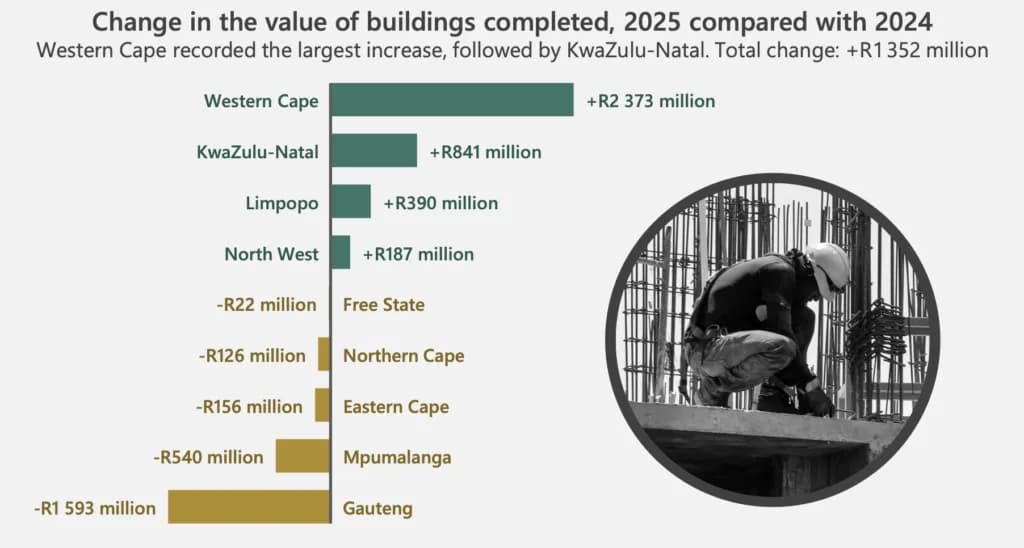
The Western Cape recorded the largest increase at +R2.373 billion, followed by KwaZulu-Natal (+R841 million), Limpopo (+R390 million), and North West (+R187 million). In contrast, Gauteng suffered a sharp decline of -R1.593 billion, with Mpumalanga (-R540 million), Eastern Cape (-R156 million), and Northern Cape (-R126 million) also posting losses.
The above graphic tells a story far beyond construction: it reflects governance quality, investor confidence, service delivery, and the growing trend of South Africans, particularly the tax-paying middle class and businesses, voting with their feet and wallets by relocating to better-managed regions.
Western Cape: A Model of Relative Success
The Western Cape’s dominance is no accident. Under sustained Democratic Alliance (DA) governance in Cape Town and provincial leadership for over 15 years, the region has prioritised fiscal discipline, infrastructure maintenance, and an enabling environment for business and investment. The +R2.373 billion surge in completed buildings indicates robust private sector activity, particularly in residential developments, additions, and alterations that support population growth and economic expansion.
Cape Town and surrounding municipalities like Stellenbosch, George, and Mossel Bay continue to attract both local and international capital. Reliable services such as better electricity reliability through proactive diversification, improved water management, and relatively functional roads, deliver tangible value for rates and taxes. This contrasts sharply with national trends of decay and creates a virtuous cycle: good governance attracts investment, which funds further improvements.
Gauteng: Economic Heartland in Distress
At the opposite end of the provincial spectrum lies Gauteng, ironically also South Africa’s economic engine, home to Johannesburg, Tshwane, and Ekurhuleni, which saw dismal, completed building values, drop by R1.593 billion. This is not an isolated blip. Years of ANC-led mismanagement, followed by unstable coalitions, have resulted in chronic service failures, rampant corruption, and crumbling infrastructure. The province’s contribution to national building activity has weakened as businesses and residents seek stability elsewhere.
The recent National Treasury decision to withhold additional support funds from poorly performing municipalities (including several in Gauteng) due to dismal MPAC oversight and massive irregular, unauthorised, and fruitless expenditure comes as no surprise. Gauteng municipalities have been among the worst offenders in the national totals of R145 billion irregular, R118 billion unauthorised, and R24 billion fruitless expenditure accumulated between 2021 and 2026.
Residents face a punishing “second tax”: private security amid high crime rates, solar and generators for unreliable electricity, boreholes for erratic water supply, and private education and healthcare. Crime statistics continue to show Gauteng leading in violent offences, further eroding quality of life and deterring investment. Rapidly rising property rates and taxes continue to yield diminishing returns for residents, as potholes multiply, water leaks persist, and load shedding or municipal outages disrupt businesses.
KwaZulu-Natal and Other Regions: Mixed Performance
KwaZulu-Natal showed respectable growth (+R841 million), driven by areas like eThekwini and KwaDukuza, but remains vulnerable to political instability and infrastructure backlogs. Limpopo and North West posted smaller gains, while the Eastern Cape, Northern Cape, Free State, and Mpumalanga lagged, reflecting deeper structural challenges in rural and historically disadvantaged provinces.
The Broader Migration and Enclave Trend
These building statistics align with observable demographic and economic shifts. Professionals, businesses, and retirees are increasingly moving to the Western Cape or well-run secondary cities, seeking better value for their tax contributions. Emigration from Gauteng to Cape Town and surrounds has accelerated, with many citing service delivery, safety, and economic opportunity.
This regional “enclaving” is a rational response to national governance failures. Taxpayers in well-managed areas see tangible outcomes, with cleaner streets, functioning infrastructure, and supportive policies for SMEs and property development. In poorly governed regions, high taxes fund elite capture, bailouts, and inefficiency, prompting self-reliance that further strains municipal revenues.
Implications for Economic Growth and Policy
The data reinforces a critical lesson: governance matters. Provinces and municipalities that maintain fiscal prudence, combat corruption, and prioritise service delivery attract private investment and foster growth. The Western Cape’s performance under DA leadership provides empirical evidence that alternative approaches can deliver results even within a challenging national environment.
For Gauteng, the decline signals urgent need for reform. Bringing experienced leaders like Helen Zille into Johannesburg’s political arena reflects recognition that technical and managerial competence must trump political loyalty. Without consequence management, such as firing underperforming officials, prosecuting corruption, and enforcing accountability, funding freezes from treasury, will merely accelerate deeper collapse.
Nationally, South Africa cannot afford a decaying economic heartland. Gauteng’s woes ripple across the country through reduced tax contributions, business exodus, and weakened supply chains. Policymakers must address root causes: over-reliance on cadre deployment, weak institutions, and the misalignment between voters (often grant-dependent) and payers (middle class and corporates).
Future Failure or Future Fixes?
The building statistics highlight both crisis and opportunity. South Africa’s private sector retains dynamism, as evidenced by the overall (if modest) national increase in completions. Harnessing this requires scaling what works in the Western Cape: clean audits, efficient procurement, investment in infrastructure, and crime reduction.
The construction industry itself, one of the key employment sectors, has been a victim of this situation with the industry having faced a 15-year decline. This is predominantly caused by poor development policies and management of accountability that has gradually squeezed the life out of South Africa’s key economic region.
Citizens and businesses should rigorously demand accountability from government administration through voting, litigation, advocacy, and supporting competent local governance.
The stark provincial contrasts in the Stats-SA data are a wake-up call. Regions that deliver value thrive; those that don’t face depopulation and decline. The choice, as always, lies in leadership and citizen pressure for results over rhetoric.