Kearney 2026 FDI Confidence Index: A World Recalibrating
The 2026 FDI Confidence Index, released by Kearney’s Global Business Policy Council in early April 2026, is based on a survey of senior executives conducted in January 2026. It measures investor sentiment toward foreign direct investment (FDI) across 25 major markets and in addition, provides an emerging markets ranking. This year’s report, titled “World Recalibrating”,

Kearney 2026 FDI Confidence Index: A World Recalibrating
The 2026 FDI Confidence Index, released by Kearney’s Global Business Policy Council in early April 2026, is based on a survey of senior executives conducted in January 2026. It measures investor sentiment toward foreign direct investment (FDI) across 25 major markets and in addition, provides an emerging markets ranking. This year’s report, titled “World Recalibrating”, captures a global investment landscape being reshaped by geopolitical volatility, expanding industrial policy, accelerating technological competition, and rising economic uncertainty.
Despite these headwinds, 88% of executives surveyed, still plan to increase FDI over the next three years — a four-percentage-point increase from 2025.
However, capital is becoming more selective, with investors shifting toward markets that demonstrate strong technological leadership, innovation capacity, and geopolitical resilience. The United States retains the top spot for the 14th consecutive year, however its score declined noticeably. Asia has now claimed the largest share of ranked markets for the first time in over a decade, signalling a broader rebalancing of global capital flows toward innovation hubs and “middle powers”.
Global Rankings and Key Shifts
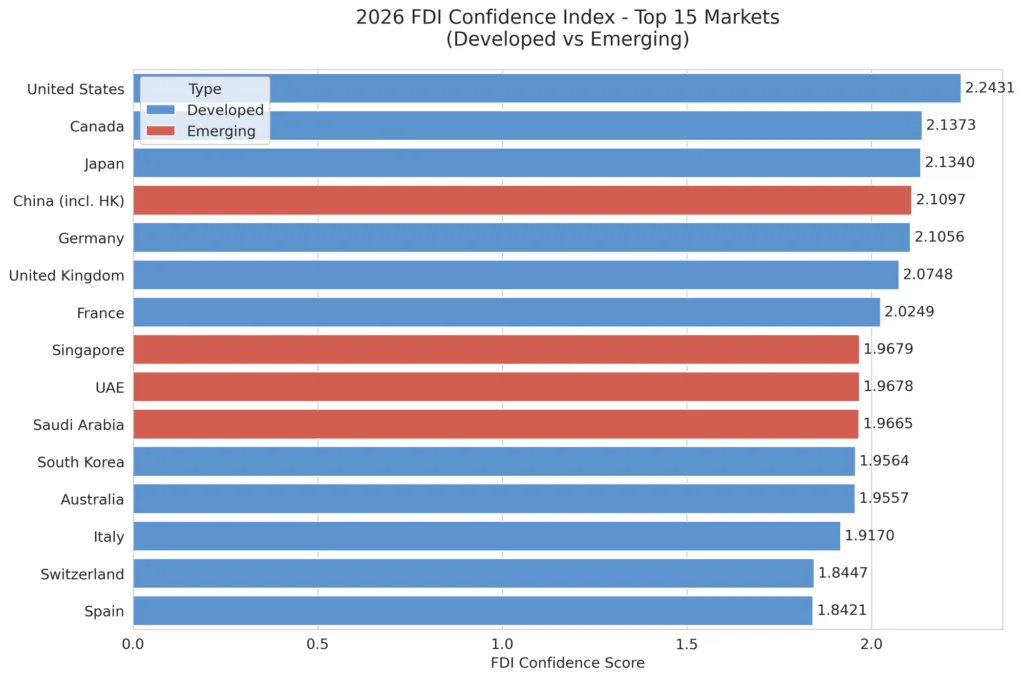
- United States remains #1 (score 2.2431), driven primarily by technological innovation (43% of respondents) and economic performance.
- Canada holds #2 (2.1373), closing the gap with the US thanks to natural resources and stable fundamentals.
- Japan rises to #3, and China climbs to #4, reflecting Asia’s growing appeal.
- Asia now accounts for the largest share of the top 25 markets. “Middle powers” such as Singapore (jumping to #8) and Saudi Arabia (entering the top 10 for the first time) show strong gains.
Developed markets still dominate (17 of 25 spots), but their share has declined as fragmentation and supply-chain diversification favour emerging and middle-power destinations.
Developing/Emerging Markets Performance
The emerging markets ranking shows significant movement and increased overlap with the global Index:
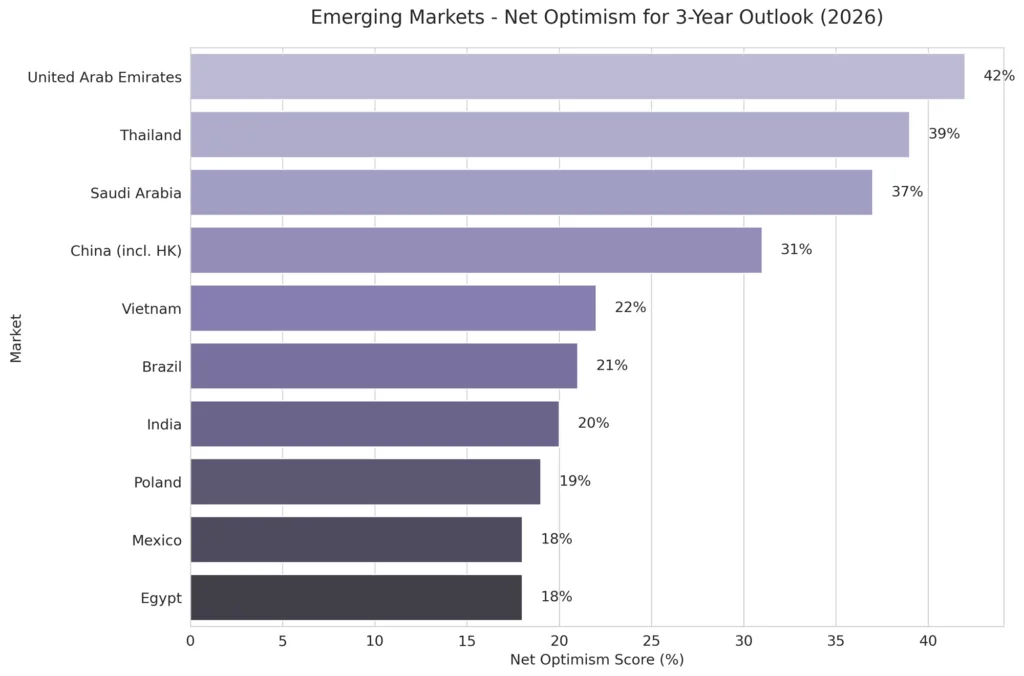
- China, United Arab Emirates, and Saudi Arabia lead the emerging markets Index for the third consecutive year.
- Thailand and Malaysia posted notable gains, climbing the rankings due to continued China+1 supply chain diversification and growing middle-power appeal.
- South Africa slipped five positions (from 7th to 12th in the emerging markets list). Investors cited concerns over the mining sector’s contraction, infrastructure challenges, and political uncertainty as key factors. Natural resources, traditionally a strong draw, are now being outweighed by perceptions of weaker technological capabilities and skills availability.
Other notable movers include Vietnam and Peru rising, while India dropped from 5th to 8th.
Most Critical Influencing Factors for FDI Decisions
A major shift this year is the rise of technological and innovation capabilities as the single most important factor influencing FDI intentions (cited by 18% of respondents). This has overtaken efficiency of legal/regulatory processes and domestic economic performance, which had previously dominated FDI decision making.
Key factors ranked (2026):
- Technological and innovation capabilities — 18%
- Efficiency of legal and regulatory processes — 14%
- Ease of moving capital into and out of the market — 14%
- Domestic economic performance — 13%
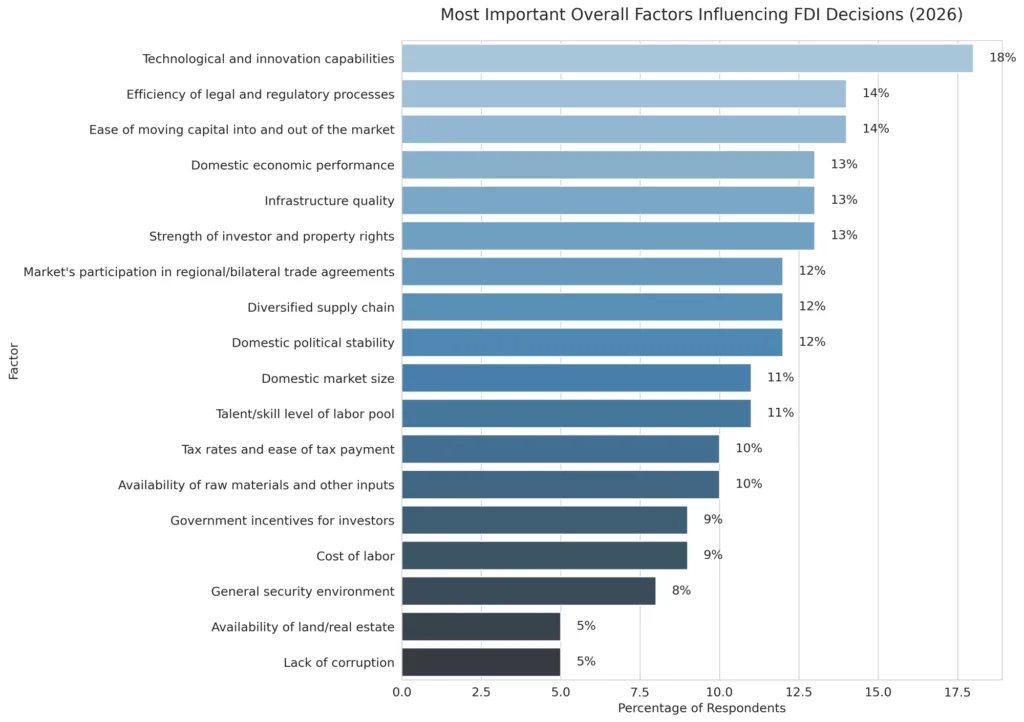
This marks a clear evolution: investors are prioritising markets that can sustain long-term technological advantage, particularly in AI, digital infrastructure, and advanced manufacturing. Markets perceived as lacking in tech capabilities and skilled labour are losing ground, even if they offer natural resources or traditional infrastructure advantages. South Africa’s decline illustrates this dynamic — its natural resource strengths are being deprioritised relative to competitors demonstrating stronger innovation ecosystems.
Industrial Policy and Risk Landscape
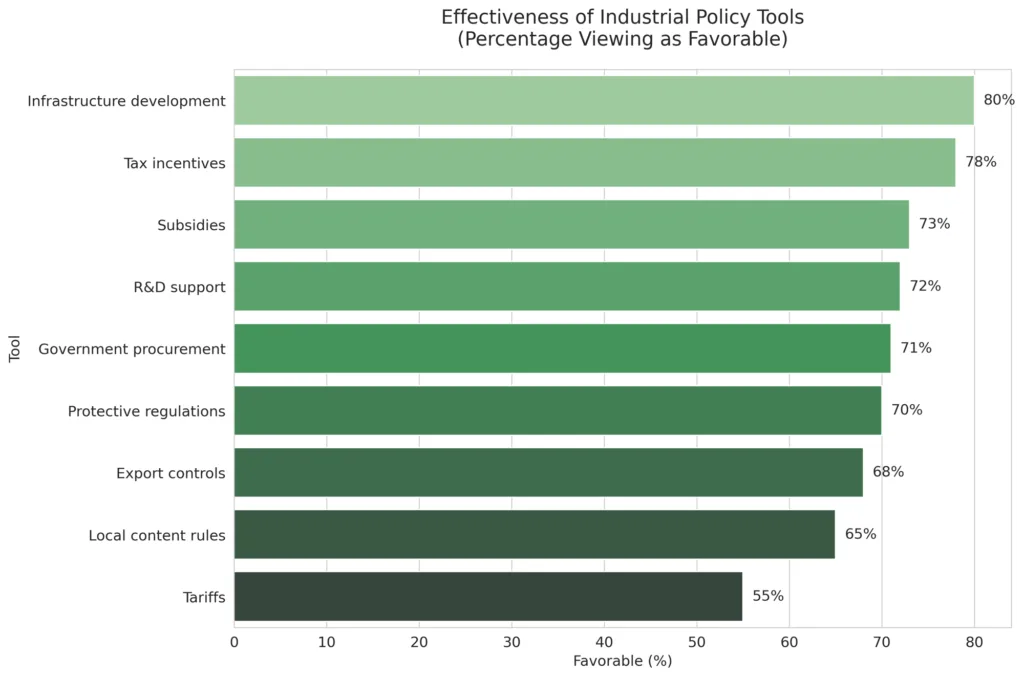
84% of investors view industrial policy as “extremely” or “very” important. A majority (57%) see it positively impacting business performance, with strongest support in Asia Pacific (63%). Infrastructure development, tax incentives, and subsidies rank as the most effective tools; tariffs and local-content rules are viewed least favourably.
Implications for African States
The report’s findings carry important lessons for African economies wishing to attract further FDI. Technological and innovation capacity is now the dominant driver of FDI, outranking historic and traditionally followed factors such as natural resources and basic infrastructure. This creates a structural challenge for many African nations, where skills gaps, limited R&D investment, and underdeveloped digital ecosystems limit appeal to forward-looking investors.
What African states should prioritise:
- Tech development and innovation support: Targeted policies to build local AI, digital infrastructure, and advanced manufacturing capabilities. This includes incentives for R&D, tech parks, and public-private partnerships.
- Education and skills development: Urgent investment in STEM education, digital literacy, and vocational training to address the talent/skills gap. Investors explicitly cite “talent/skill level of labour pool” as a top consideration.
- Predictable and investment-oriented industrial policy: Clear, consistent frameworks that support FDI rather than protectionist measures. Investors favour infrastructure development, tax incentives, and subsidies over tariffs or local-content rules.
- Regional integration and middle-power positioning: Leveraging AfCFTA to create larger markets and positioning as neutral, stable hubs (similar to Singapore or Thailand) to attract diversified supply chains.
African countries that successfully bridge the tech and skills gap will be better positioned to attract meaningful, high-value FDI in a recalibrating world. Those that continue to rely primarily on natural resources without parallel investment in innovation risk continued marginalisation in global capital flows.
Overall Assessment
The 2026 FDI Confidence Index reflects a world in transition. Investors are not necessarily retreating from globalisation but are becoming far more selective, favouring markets that combine innovation and leadership with geopolitical stability and policy certainty. For Africa, this represents both a challenge and an opportunity. The report underscores that future FDI success will depend less on traditional endowments and more on the ability to build technological capabilities and human capital.
According to the report’s findings, African policymakers and business leaders must treat skills development, tech infrastructure, and predictable pro-investment policies as strategic priorities if the continent is to capture a larger share of global capital in the coming years.