Isuzu – Targets becoming Africa's Truck Manufacturing Hub
There is an Automotive success story coming out of the Eastern Cape with a dedicated team determined to drive further growth in Africa. Eight years ago, news of the pending closure of a major Automotive assembly plant in Port Elizabeth was devastating to the local community. GM was heading out of the country again and
Isuzu – Targets becoming Africa's Truck Manufacturing Hub
There is an Automotive success story coming out of the Eastern Cape with a dedicated team determined to drive further growth in Africa.
Eight years ago, news of the pending closure of a major Automotive assembly plant in Port Elizabeth was devastating to the local community. GM was heading out of the country again and for a small city and for the automotive industry in general, this was a message no-one wanted to hear.
At that point, Isuzu Motors made a bold move to take over the plant and many of the staff as well, not only supporting the local community but laying down a solid foundation that today has transcribed into a success story for the industry.
Isuzu Wants to Move Your World
Last week I had the opportunity to visit the Isuzu Plant in Struandale, and engage with Isuzu’s up-beat management team. The new positioning for the truck and bakkie manufacturer is to “move the world for you”, an adept positioning statement that ties in with an ambitious goal.
Billy Tom, President of Isuzu Motors South Africa spoke of the new position saying, “We believe that to move is to prosper, and that better transport leads to a better life. Therefore, our aim is to help move more goods and business, as well as people”
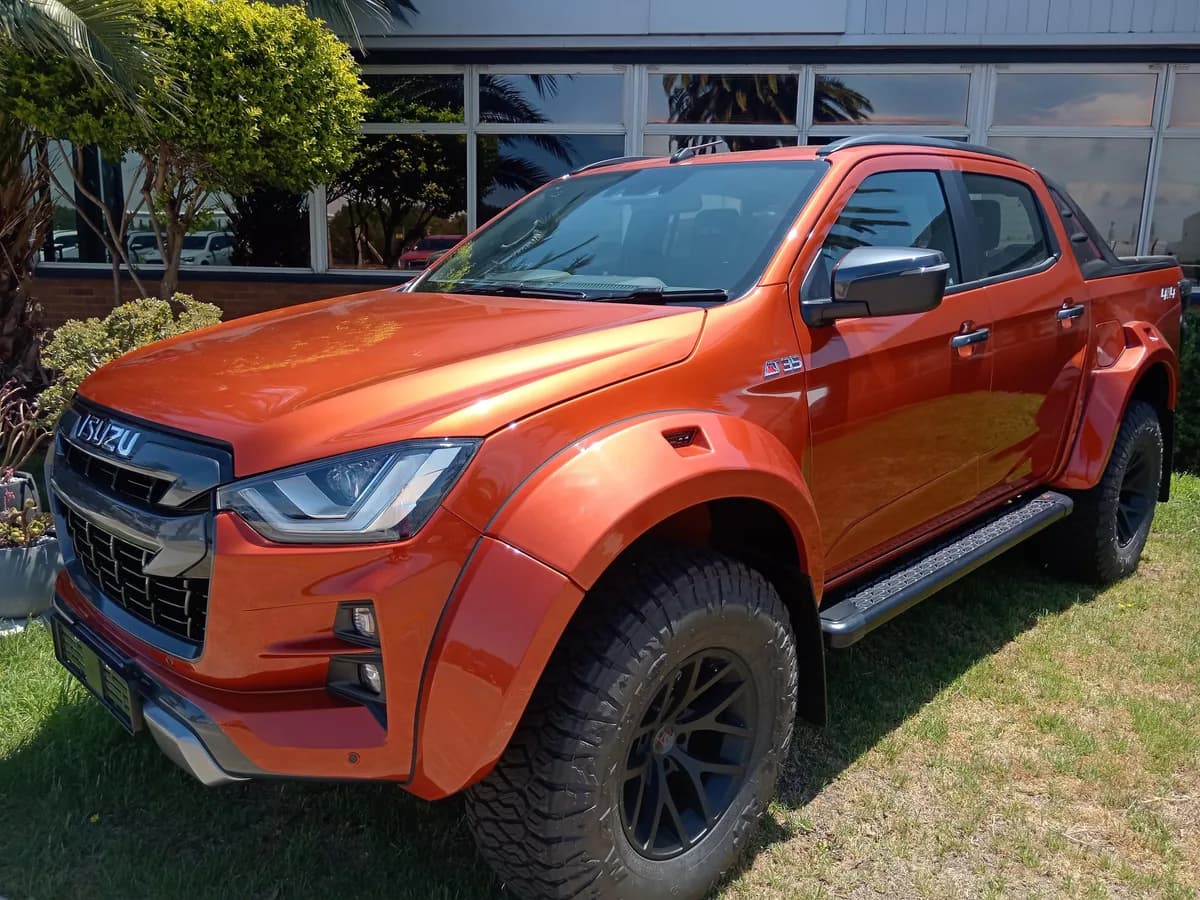
The core vehicle in the Isuzu line-up is the Bakkie (pickup truck) light commercial vehicle range that drives around 47% of the auto-makers current revenue. So it’s quite important. And our light commercial vehicle segment is anchored by the legendary D-Max, as well as the versatile M-Max, which is currently primarily the engine driving Isuzu’s global growth.
Isuzu set to beat Sales Expectations on Locally Produced Vehicles
Billy Tom indicated that Isuzu South Africa, had significantly exceeded initial expectations by reporting 123,000 unit sales worldwide in the first half of the year alone. “On the back of this exceptional performance, we’re confident that our full year target of 258,000, which represents a substantial 12% increase over our original projections will be achieved”. Said Tom.
“This performance is more than just growth. It is a clear demonstration of the momentum we are building in our core markets. Whilst our success is global, it is being pioneered most notably right here in Africa. For us as a resource in South Africa, our primary focus area is Africa,” We have witnessed a remarkable 24% in regional performance, with 29,000 units sold in just six months, and we are firmly on track to hit 56,000 units across the continent by the end.” “Our Africa first strategy is not just a plan, it is working”.Tom stated.
Consistency Of Product
During a a private one-on-one interview with the group’s Executive Vice President Revenue Generation, Craig Uren, he outlined how future developments were shaping the group into a force of change on the African continent beyond simple vehicle retail sales approach but into a perspective that Isuzu is an integral part of the continent’s development.
A key to Isuzu’s success has been a philosophy of consistency and reliability that has been built into the DNA of their vehicles that avoids the emotional but focusses on creating “Work-Horse” class LCV’s that people who need absolute reliability to deliver product and carry loads can count on.
Repeat Purchase Clients a Top Strategy For Isuzu
This is a counter balance in a vehicle market that is being drowned by imported and untested cheaper vehicles that perhaps do not have the staying power of the Isuzu marque. When asked about his statement that the “consumer will have the final say” Craig Uren states “So I’m a demand economics person, an economist actually I’m not an engineer”. “So when I look at the environment now, it’s very supplier driven and the consumer has got this massive choice, and is overwhelmed by what’s happening, and that’s very difficult in the emotional space”.
“As I said, we don’t play in that emotional space, we stick to the rational space, and in the rational space, it’s a capital good.” “It comes with planning, it comes with decision makers that have got a balance sheet to look at and they’ve got an earnings projection to look at and they need certainty.” “So it’s as simple as following the demand,” “And if you’ve got products that are reliable, durable, make you money, and look after your earnings projections, you’re going to be very popular with the clientele”, Uren States
For Isuzu this translates into a repeat client percentage of around 60-70% and on the LCV range a repeat client percentage sitting in a very positive 40%-70% repeat client ratio. Reliability that keeps building repeat business is a philosophy that has worked well for the group.
Total Cost of Ownership Approach a Winner
Isuzu Trucks and Bakkies are stringently tested in local conditions for sometimes years before being released and this together with a keen sense of the challenges of their clients, who predominantly are business owners, is leading the success story from the Eastern Cape.
CPK or cost of operations, that includes service and maintenance cost, is perhaps an overlooked dimension of owning a vehicle. But for business owners this cost in African conditions is critical. “By making sure we stay very, pricing strategically is driven by the operating cost”, says Uren. “So if we’re to remain cost effective and cost efficient because every consumer, big fleet owner, everyone’s looking for savings, … “So if we don’t have to repair our vehicles too often, which is the reliability part, (that) comes with a saving”, he states.
The CPK for Isuzu according to Uren has led to a 3% decrease in total running cost, and over the lifespan of a vehicle this leads to a saving worth making for business owners and consumers alike.
Part of this process is driving more local supply where the more Isuzu manages to localize, the more benefit owners get.
Producing panels locally has been a game-changer with local partnership with VLS situated right next to the Isuzu Plant as one example. Isuzu’s drive has been to create enough scale on commonality, with the three litre engine used in the D-Max bakkie range is the same as that used in their the trucks. By utilising the same fuel filters, oil filters, and more has enabled enough scale to drive down costs.
African Truck Building Hub – More than Ambition
The Isuzu Leadership team has set their eyes on turning its South African manufacturing plant into the Isuzu truck manufacturing hub for Africa. Clearly a wonderful vision. But is that possible?
“We say that on the basis of Isuzu globally, we’re just one territory of 120, where in the greater portion of more than a third of that we market leaders”. “So whether it’s Australia, US, New Zealand and a lot of the East, Africa needs to be moved on trucks and buses, and we need to create scale Says Uren.
“So why ship a truck all the way from Japan, fully built up to Western Africa, when we can build it here and ship it up the coast? And then benefit by the Africa Free Trade Agreement”, argues Uren. “So I’m a big proponent, if you don’t try, you won’t know”. “The vision really is Africa is going to go through a massive infrastructural development phase, and if you are in with trucks, it’s collaborative. None of us can do anything, we’ve got to build a body, we’ve got to build a function, we’ve got to work with the operator, etc. So collaboratively”.
“You will grow in Africa through these collaborations of infrastructure development. What do you naturally need? Yellow equipment, trucks, then bakkies”. So if you go through the practicalities of how you get into (a market), you’re never going to just wait for the economy to grow and then I’ll deliver a whole lot of vehicles”, ” You’ve got to be involved in the construction of the economy says Uren emphatically.
Only The Beginning
The concept behind the optimism is that Isuzu believes that by aligning themselves with development projects around the African continent they will be opening up opportunity to deliver large batches of vehicles for specific projects as apposed to driving sales via retail outlets alone. This will in turn drive the infrastructure scale and build more volume of vehicle’s for the group.
“This is just the start, claims Craig”, “We said we’re whetting the appetite, we’ll hopefully bring everyone back every year to see where the next bay is” he concludes.