Is the "Coup Belt" a Workable Economic Structure in Africa?
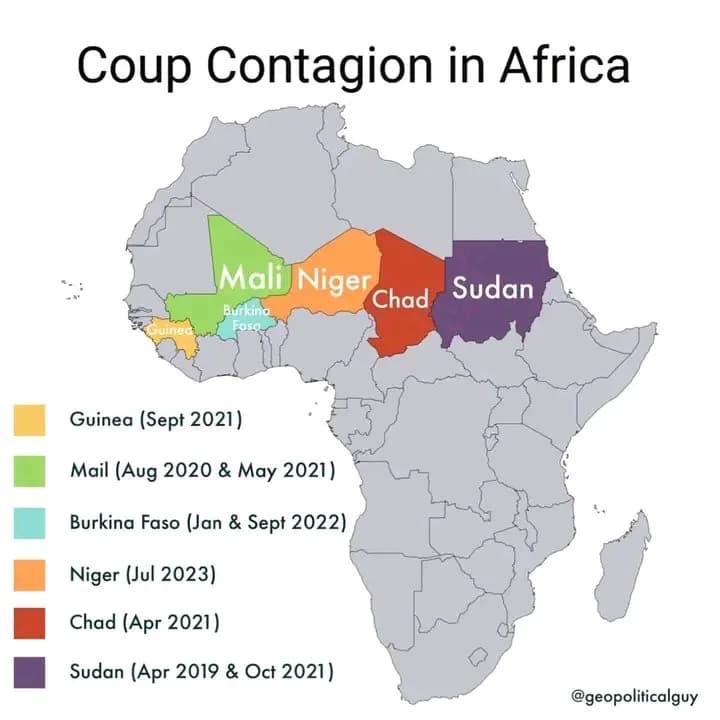
The North African states of Mali, Niger, and Burkina Faso are all governed by military juntas following a series of coups d'état between 2020 and 2023. These Sahel nations, collectively known as the "coup belt," have suspended their countries constitutions, dissolved parliaments, and extended "transitional" periods indefinitely, citing security threats from jihadist insurgencies as justification.
Is the "Coup Belt" a Workable Economic Structure in Africa?
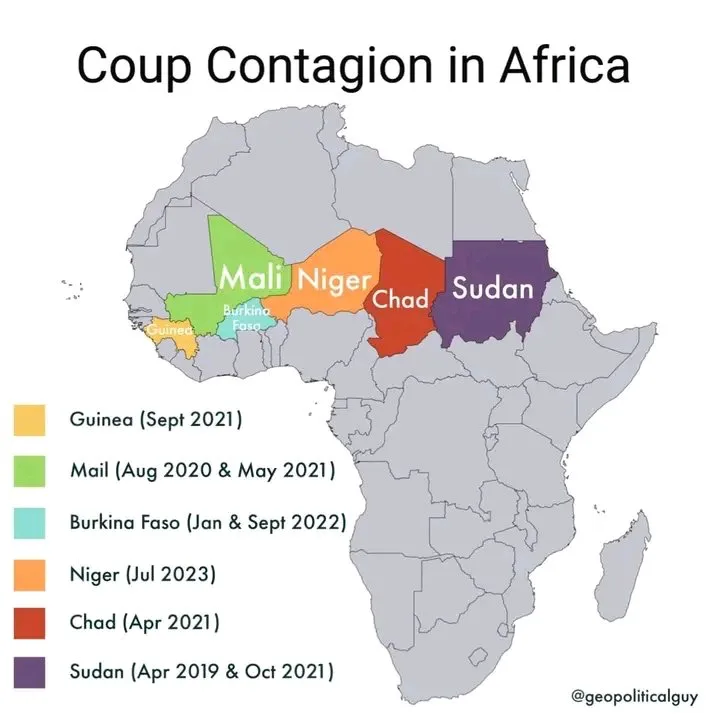
The North African states of Mali, Niger, and Burkina Faso are all governed by military juntas following a series of coups d’état between 2020 and 2023. These Sahel nations, collectively known as the “coup belt,” have suspended their countries constitutions, dissolved parliaments, and extended “transitional” periods indefinitely, citing security threats from jihadist insurgencies as justification.
None of these ruling junta’s have held promised elections, drawing international criticism for democratic backsliding and human rights abuses. The three, formed the Alliance of Sahel States (AES) in September 2023 as a mutual defence pact, evolving into a confederation amid ECOWAS isolation.
Summary of each Nation’s Current Status:
- Mali: Under military rule since two coups in August 2020 and May 2021, led by Colonel Assimi Goïta, who declared himself interim president in 2021. The junta (National Committee for the Salvation of the People) has delayed elections repeatedly (originally slated for 2024, now postponed beyond 2026). Focus is on counter-terrorism against al-Qaeda affiliate JNIM, but recent advances by militants in northern Mali have strained control. Mali withdrew from ECOWAS in January 2024 and relies on Russian Wagner/PMC support.
- Niger: Military takeover on July 26, 2023, ousted President Mohamed Bazoum; General Abdourahamane Tchiani heads the National Council for the Safeguard of the Homeland. The junta has rejected ECOWAS sanctions and mediation, extending the transition indefinitely. Security operations target Boko Haram and IS affiliates, but instability persists. Niger expelled French forces in 2023 and pivoted to Russian partnerships.
- Burkina Faso: Two coups in January and September 2022 installed Captain Ibrahim Traoré as interim president, leading the Patriotic Movement for Safeguard and Restoration. The transition was extended to July 2029 amid escalating jihadist violence (e.g., over 1,000 civilian deaths in 2024). The junta has nationalized foreign mines and sought Russian aid, while facing internal purges and displacement of 2 million people.
The AES Confederation Treaty: Details and Approval Process
The Confederation of Sahel States Treaty, signed on July 6–7, 2024, in Niamey, Niger, formalizes the AES as a political, economic, and security union among Mali, Niger, and Burkina Faso. Key provisions include:
- Open borders: Immediate free movement of people, goods, and services, with a joint biometric passport introduced in January 2025 to facilitate cross-border travel and reduce smuggling.
- Trade integration: Establishment of a free trade zone, harmonized customs tariffs, and a common external tariff to boost intra-AES commerce (currently <5% of total trade). Plans for a shared currency (Sahel CFA or new unit) by 2027–2028.
- Other elements: Joint military command for counter-terrorism, coordinated foreign policy (e.g., anti-Western pivot), and pooled resources for infrastructure like roads and energy grids. The treaty aims for a confederation by 2025, potentially evolving into a federation.
Approval status: The treaty has been fully approved and ratified by the three military governments. Each junta’s transitional council endorsed it via decree, bypassing legislatures. Implementation began immediately: Open borders were enacted in phases from July 2024, with joint security patrols activated in November 2024. By November 2025, a joint action plan for regional security is operational, and economic working groups meet quarterly. No formal ratification by parliaments was required, as constitutions remain suspended.
Citizen participation: There was no direct public consultation, referendum, or citizen voting on the treaty. It was a top-down initiative by the juntas, announced amid anti-ECOWAS rallies in 2023–2024 that drew thousands in support of sovereignty. Public enthusiasm was evident in state-orchestrated demonstrations (e.g., 2024 “March for the People” in Ouagadougou), but critics note limited civil society input due to crackdowns on dissent. Youth and trader groups have voiced informal support for economic relief, but human rights organisations decry the lack of inclusivity, with no town halls or surveys conducted.
Economic Impact
The AES has fostered intra-regional trade (up ~15–20% in informal cross-border flows since 2024 via open borders), pooled security resources (reducing some smuggling losses), and attracted non-Western investment (e.g., Russian/Chinese mining deals worth $500M+). GDP growth has shown resilience, averaging 4–6% annually across the trio, driven by extractives (gold, uranium) and agriculture rebounds post-COVID. However, ECOWAS sanctions (2023–early 2025) cost an estimated $2–3B in lost trade, exacerbating inflation spikes and supply chain disruptions.
Post-coup focus has shifted to sovereignty-driven initiatives (e.g., local mining control, Russian/Chinese partnerships), but Western aid cuts have stalled many developments. AES enables joint funding, with approximately $200M pooled since 2024 for roads/energy.
Possible Outcomes: Economic, Development, and Social Impacts
The AES treaty could reshape the Sahel’s 80+ million population, but outcomes hinge on execution amid jihadist threats, sanctions, and resource constraints. Analysts project mixed results over 5–10 years.
- Economic Impact: Positive for intra-regional trade, potentially growing from $500M to $2–3B annually by 2030 via reduced tariffs and border efficiencies, easing smuggling (e.g., gold, livestock). A common market could attract FDI in mining/agriculture, with GDP uplifts of 1–2% per country if infrastructure aligns. Risks: ECOWAS sanctions (lifted partially in 2025) have cost $2B+ in lost trade; unequal benefits may favor Niger’s uranium/minerals over Burkina Faso’s cotton, exacerbating disparities. Long-term: Currency union could stabilize inflation (currently 5–10%) but risks devaluation without reserves.
- Development Impact: Enhanced security cooperation might reclaim 20–30% of jihadist-held territory, freeing resources for roads, solar grids, and schools (AES pledged $1B joint fund in 2025). Free movement could spur labor mobility, boosting remittances ($1B+ combined). However, without Western aid (cut post-coups), development lags: 40% poverty rates persist, and climate shocks (droughts) could strain shared resources. Optimistic scenario: AES as a “mini-ECOWAS” model, accelerating AfCFTA goals; pessimistic: Isolation deepens underdevelopment if Russia/China ties falter.
- Social Impact: Greater mobility fosters cultural ties (e.g., shared Hausa/Fulani heritage), reducing ethnic tensions and enabling family reunions across porous borders. Youth (60% under 25) could access jobs in cross-border trade, curbing migration to Europe (down 15% since 2024). Drawbacks: Increased refugee flows from conflicts (2.5M displaced regionally) strain services; jihadist recruitment may rise if economic gains unevenly distributed. Overall, social cohesion strengthens via “Sahel identity,” but without democratic reforms, protests (e.g., 2025 Bamako riots) could escalate.
Is This Model a Workable Structure for Africa?
The AES marks a bold sovereignty play, but success will depend largely on balancing security with inclusive growth. There have been positive outcomes and regional cohesion across multiple fronts. GDP growth has been good while mining and agriculture have developed.
The social stability in the region however continues to be of concern with protests against delayed elections and insecurity, refugee demonstrations, ethnic/clan violence, and spillover from armed conflicts. Violence has intensified, with over 10,000 deaths in 2024 alone across the trio, displacing 2.5 million people.
In November 2025, renewed violence in the north of Mali led to vigilante riots against perceived junta inaction. The regime’s 2029 transition extension prompted student-led demonstrations in Ouagadougou, met with crackdowns.
The region has certainly provided a petri-dish experiment in African Socio-Economic approach with the economies growing but stability scarce. The ongoing Isolation may also exclude the region of broader trade within Africa under the African Continental Free Trade Area Agreement.
Time only will tell if this is a workable solution, however time is not a luxury that Africa has on its side. If the Junta leaders can find a way to peaceful democratic transitions, the foundation for greater regional prosperity and greater investment appeal may have been laid through current developments.