Consumer Debt Levels in South African Show Improvement
Johannesburg, 25 September 2024 — Experian’s latest Consumer Default Index (CDIx) report, covering the Q2 period ending in June 2024 reveals a small but encouraging year-on-year (YoY) improvement, as it is the first sign of recovery over a two-year period. This improvement indicates possible stabilisation in consumer debt management, although challenges do remain. Debt such

Consumer Debt Levels in South African Show Improvement

Johannesburg, 25 September 2024 — Experian’s latest Consumer Default Index (CDIx) report, covering the Q2 period ending in June 2024 reveals a small but encouraging year-on-year (YoY) improvement, as it is the first sign of recovery over a two-year period. This improvement indicates possible stabilisation in consumer debt management, although challenges do remain.
Debt such as Home Loans saw a noticeable decline in performance according to the latest report with a drop of 3%. While this is an improvement compared to the 21% drop observed in Q1 2024, it remains a concern as this represents 53% of total consumer debt exposure in the country. With interest rates now cut by 0,25% in September, the hope is that this will see further recovery in Q4.
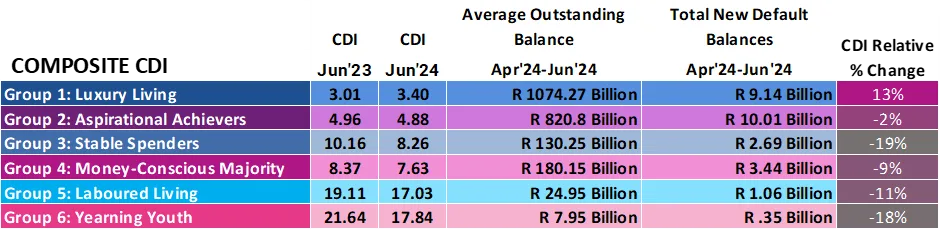
The CDIx measures the quarterly default behaviour of South African consumers across various loan types including home loans, vehicle loans, personal loans, credit cards and retail loan accounts. The composite CDI improved from 4.88 in June 2023 to 4.77 in June 2024.
Specifically, the CDIx provides views on the latest:
- Macroeconomic Market Context that has a direct bearing on consumers
- Market appetite for credit
- Qualification and take-up of credit (i.e. new business)
- Performance of credit consumers (i.e. arrears/defaults and vintages, CDI and Debt Review)
Experian’s Financial Affluence Segmentation (FAS) is a consumer lifestyle segmentation system that classifies the South African population and enumeration areas into 6 primary groups each with variable exposure to secured and unsecured lending products. Read more about the 6 primary segments, here.
Head of Commercial Strategy & Innovation at Experian, Jaco van Jaarsveldt, said, “As Experian continues to empower individuals through innovative financial solutions, it is encouraging to see the Consumer Default Index (CDI) show signs of returning to the typical cyclical pattern, as this pattern has not been observed over the preceding 18 months.”
Financial product areas such as credit cards and vehicle loans, were strong enough to offset the dip in Home Loan Payment levels with Credit Cards seeing a notable improvement of 9%, with the CDI improving from 8.17 to 7.41 year-on-year (Y-o-Y). Vehicle Loans also saw a substantial improvement, with a 5% decrease in the CDI from 4.85 to 4.58.
“The improving trends across most credit products are evident at the Financial Affluence Segment (FAS) level, with only the most affluent Luxury Living segment, showing a YoY decrease. This continued decline correlates with the continuous deterioration in the home loan performance, as this FAS group holds the majority market home loan exposure,” adds van Jaarsveldt.
Market Appetite Remains High, Approval Levels Low
The appetite for consumer credit has shown a reduction in Q1, following the heightened demand during the festive season. This is reflected in the National Credit Regulator’s (NCR) report on total credit enquiries (considering all credit bureaus in South Africa). Overall, appetite remains high, highlighting that consumers are looking for credit to cover shortfalls in their cost-of-living expenses. Approval levels remain low at 32.7% in the latest data. This means that more than two-thirds of applications are rejected by credit providers, contributing to the improved CDIx performance across most products and Financial Affluence Segment (FAS) groups.
Women Have lower Debt Levels
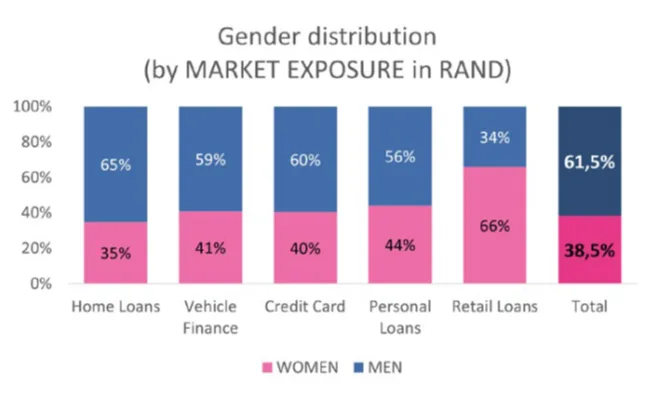
The latest report also reveals a complex picture of women’s participation in the South African credit landscape. Despite constituting over half of credit bureau consumers, women hold only 38% of outstanding debt, indicating an underrepresentation in the credit economy. However, positive strides are evident in women’s growing participation in secured credit, with notable increases in home loans and vehicle finance over the past four years. This progress, coupled with women representing two-thirds of the retail loan market, underscores the significance of this sector for credit-active South African women.