Call to Rebuild the Construction Industry in South Africa
The Big 5 Construct South Africa and South Africa Infrastructure Expo, featuring Transport Evolution Africa, closes off today (11 June) at the Gallagher Convention Centre in Johannesburg. The event brings together stakeholders across construction, infrastructure and transport supply chain to deliver the country's development priorities. The event provided over 400 exhibitors from more than 25
Call to Rebuild the Construction Industry in South Africa
The Big 5 Construct South Africa and South Africa Infrastructure Expo, featuring Transport Evolution Africa, closes off today (11 June) at the Gallagher Convention Centre in Johannesburg. The event brings together stakeholders across construction, infrastructure and transport supply chain to deliver the country’s development priorities.
The event provided over 400 exhibitors from more than 25 countries, showcasing products, technologies and solutions for South Africa’s construction, infrastructure and transport sectors, creating opportunities for collaboration, procurement and knowledge exchange aligned with the country’s ongoing and upcoming project pipeline.
Construction Industry Concerns Raised
Beyond the scope of the product exhibition, the event also provided a stage for some topical and serious discussions around the poor performance of the construction industry as a whole over the last decade.
The South African construction industry has experienced a prolonged contraction, with roughly eight to nine consecutive years of decline in real output and contribution to GDP (roughly 2016/2017 through 2025). This is one of the longest downturns in the sector’s modern history.
Timeline of Decline
- 2016–2021: The sector contracted sharply. From 2016 to 2021, construction gross value added (GVA) fell by an average of ~5% per year, while the broader economy grew modestly by 0.4%.
- 2017–2020: Massive job losses — approximately 118,000 jobs shed between June 2017 and June 2020 (a ~20% drop in employment).
- 2022–2025: Continued decline. The industry’s contribution to the economy in 2024 was reportedly 33.6% lowerthan in 2016. In 2025, it was projected to shrink by a further ~2% in real terms due to rising costs, declining private investment, and weak residential activity.
- Overall Trend: The sector has struggled with low public and private investment, infrastructure delivery failures, and weak business confidence.
The “Stadium Debacle” and Loss of Trust
The erosion of trust in the industry is frequently traced back to the 2010 FIFA World Cup stadium projects.
Major construction firms were later found to have engaged in widespread bid-rigging and collusion. The Competition Commission uncovered that several of the country’s largest companies colluded on tenders for stadiums and other public projects, agreeing on profit margins and allocating contracts among themselves. This resulted in inflated costs and “unfair profits” estimated at around R4.7 billion.
The scandal severely damaged the industry’s reputation, leading to large fines, legal battles, and a deep-seated lack of trust between government, clients, and contractors. Industry experts often cite this as a turning point that contributed to ongoing suspicion, higher risk premiums, and reluctance to collaborate on large projects.
Major Company Closures and Business Rescue
The prolonged downturn led to several high-profile failures:
- Group Five (one of SA’s largest contractors) filed for business rescue in 2019 after decades of operation.
- Basil Read, another major player, also entered business rescue.
- Other notable casualties or restructurings include Murray & Roberts (which largely exited building and civil construction), Lukhanji, Esor, and several mid-tier firms.
These collapses resulted in thousands of job losses and further reduced capacity in the sector.
Failed High-Level Engagements
Repeated attempts at high-level engagement between government and the construction industry (through bodies like the Construction Industry Development Board and various summits) have produced limited results. Issues such as slow infrastructure procurement, late payments, policy uncertainty (B-BBEE, labour laws), and under-investment in public infrastructure have persisted despite promises of reform. The lack of consistent delivery on these engagements has deepened frustration and distrust.
Call for a Chatham House Industry Gathering
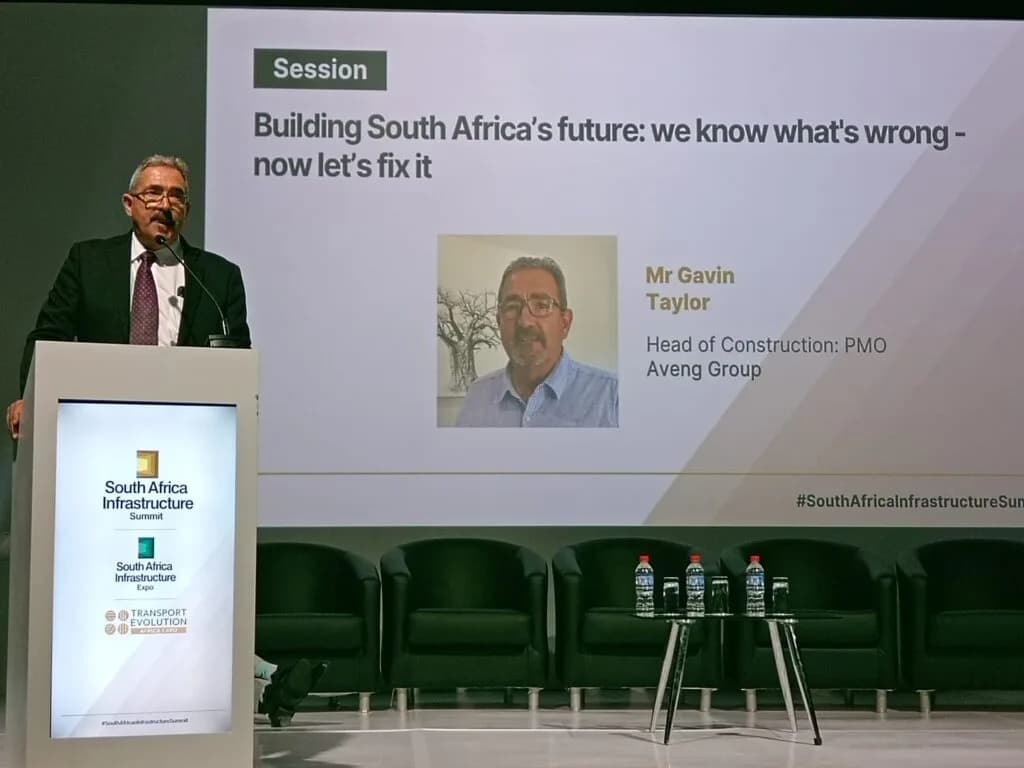
It is against this backdrop that highly experience construction industry expert Gavin Taylor gave his Key-Note address on Tuesday, calling for the industry and government to work together to fix this flagging industry, once the pride of African construction and key employment and skills creator.
Taylor commented in his address “Industry cannot grow sustainably if confidence rises and collapses, and unless we align pipeline with capacity and net capacities with realistic aspirations for growth, we will simply recreate the boom and bust cycles again and again.” “This is fixable, not easy, but definitely fixable. Buy on value, not simply price.And by that, I mean procure on price, coupled with financial stability, capability, competence, leadership visibility, and realistic and appropriate risk allocation. “
We interviewed Gavin After his address where is expanded on his call for the Construction Industry to have a Chatham House type intervention with open discussions on the industry today and how to find a path forward
Watch the Interview Here:
Call to Rebuild
According to Taylor, the problems facing the construction industry, are not project specific issues, they are systemic problems which require systemic reform.
“My intention is to expand beyond this keynote, for this reason I’m currently working on what I call a system level framework, focused specifically on the issues that have been raised today. A framework that can inform a Chatham House discussion, and help us navigate through these honest conversations that we need” says Taylor.
In conclusion Gavin Taylor exhorted the industry to move forward, saying “Because if we’re serious about rebuilding South Africa’s capability and capacity, then reform cannot remain an abstract discussion, it must become a structured national discussion. And importantly, this cannot merely be identifying what’s failing, but helping create a credible platform for what comes next. Because South Africa does not lack engineering expertise, we do not lack opportunity, and we definitely do not lack ambition. What we do lack is the collective courage to change the behaviours undermining the industry.”