Africa Needs Policy Reforms and Accountability to Rise
The Heritage Index, scores economies on four pillars, rule of law, government size, regulatory efficiency, and open markets, with a rating out of 100. Higher scores correlate strongly with sustained GDP growth, investment inflows, diversification, and human development. In the 2025 Index, Singapore scores an exceptional 84.1 (world #2, "mostly free"), reflecting its archetype of

Flight Tickets Getting Affordable in South Africa
The Heritage Index, scores economies on four pillars, rule of law, government size, regulatory efficiency, and open markets, with a rating out of 100. Higher scores correlate strongly with sustained GDP growth, investment inflows, diversification, and human development.
In the 2025 Index, Singapore scores an exceptional 84.1 (world #2, “mostly free”), reflecting its archetype of pro-growth policies. Argentina scores 54.2 (“repressed,” but improved by +4.3 points under President Javier Milei), still lagging due to decades of economic interventionism. Sub-Saharan Africa’s regional average is just 53.2, but a handful of African nations stand out with scores above 60 and “mostly free” status. These leaders demonstrate that progressive policies such as market liberalisation, fiscal prudence, regulatory streamlining, investment in human capital and infrastructure, trade openness, and anti-corruption efforts do drive GDP growth even in resource-constrained or smaller economies.
Top African Performers: Mauritius, Botswana, and Island Economies
Mauritius leads Africa decisively with a score of 75.0 (world #15th, up 3.5 points, regionally #1 in Sub-Saharan Africa). The once sugar-dependent nation, has transformed into a diversified upper-middle-income hub through consistent post-independence reforms including low flat taxes (15% corporate), full capital account convertibility, strong property rights, efficient judiciary, and open markets. Key progressive policies include the 2006-ongoing Economic Transformation Strategy, fintech/blue economy incentives, and heavy investment in education (literacy >95%) and infrastructure. Tourism, financial services, and manufacturing now dominate; GDP (PPP) per capita reached ~$29,511 in recent data, with 7.0% growth in 2023 and steady 4-7% averages. Public debt is managed at ~78% of GDP via transparent budgeting. Mauritius proves small-island states can leapfrog via openness—FDI inflows support its status as Africa’s most business-friendly jurisdiction.
Botswana follows at score of 69.9 (world #24, “mostly free”). Its success stems from prudent diamond revenue management since independence: the Pula Fund (sovereign wealth mechanism), low corruption (top African ranking), stable multiparty democracy, and fiscal rules limiting spending. Progressive elements include diversified spending on infrastructure/education (human capital index strong), streamlined business registration, and trade openness via SADC. Despite resource reliance, it avoided the “resource curse” through parliamentary oversight and audits. GDP growth has been steady (3-5% averages), per capita high for Africa, with low debt. Botswana’s policies emphasise predictability, attracting mining and tourism FDI while funding social services, delivering a model of inclusive, rules-based development.
Other African Economic Leaders
Cabo Verde (score of 68.7, world #29) and Seychelles (score of 66.4, world #35) round out the island standouts. Both liberalized via EU trade agreements, tourism/finance diversification, digital tax administration, and property rights strengthening. Cabo Verde’s debt discipline and renewable energy push (despite vulnerabilities) support resilient growth; Seychelles focuses on sustainable fisheries/offshore finance. These micro-states show progressive policies—market openness and institutional credibility—enable high per-capita outcomes despite size.
Morocco (60.3, world #59, “mostly free,” up 3.5 points) leads North Africa. Vision 2030/Industrial Acceleration Plan drives infrastructure megaprojects (Tanger-Med port, high-speed rail), renewable energy leadership (world’s largest solar plants), and FTAs with the EU, US, and Africa. Automotive/aerospace manufacturing hubs attract FDI; tax reforms and investment agencies (AMDIE) streamline entry. Growth averages 3-4%, with diversification reducing phosphate/agriculture dependence. Morocco balances monarchy-led stability with market incentives, positioning as an AfCFTA gateway.
Growth Outliers with Bold Reforms: Rwanda and Others
Even some “mostly unfree” scorers (50-60 range) pursue highly progressive, growth-oriented policies. Rwanda (score of 54.8, up 3.2 points) exemplifies this: despite rule-of-law challenges, its Vision 2020/2050 and NST2 prioritise digital transformation (Irembo e-services, Kigali Innovation City), ease-of-doing-business reforms (top African rankings in World Bank metrics), agriculture modernisation (PSTA5: irrigation, mechanisation, private seeds), and green growth. Anti-corruption is rigorous; gender-inclusive policies and MICE/tourism investments shine. GDP growth is exceptional at a rate of 8.2% in 2023, 8.9% in 2024, with Q3 2025 sitting at a remarkable double-digit 11.8%, that has been driven by growth in services/industry, FDI in tech and mining, and regional trade. Per capita income sits at $3,511 PPP, but poverty reduction has been rapid. Rwanda’s state-guided but market-friendly approach (public-private partnerships, AfCFTA focus) delivers “Singapore-lite” ambition in East Africa.
Tanzania (score of 59.3) and Namibia (58.7) show incremental progress via port/energy liberalisation, digital tax systems, and mining/tourism openness. Benin and Côte d’Ivoire (at around 57-58) benefit from WAEMU integration, digitalisation, and private infrastructure. Broader trends: AfCFTA ratification, fintech/mobile money (e.g., M-Pesa legacy), and green investments (renewables in Morocco/Rwanda) mark progressive shifts. However, most of Africa’s 47 Sub-Saharan nations score less than 55 (“repressed economies”), hampered by corruption, weak judiciary, and over-regulation, explaining the continent’s 3.8-4.2% average 2025 growth (per AfDB/IMF) despite youthful demographics and major mineral and land resources.
Comparisons: Singapore as Benchmark, Argentina as Cautionary Tale
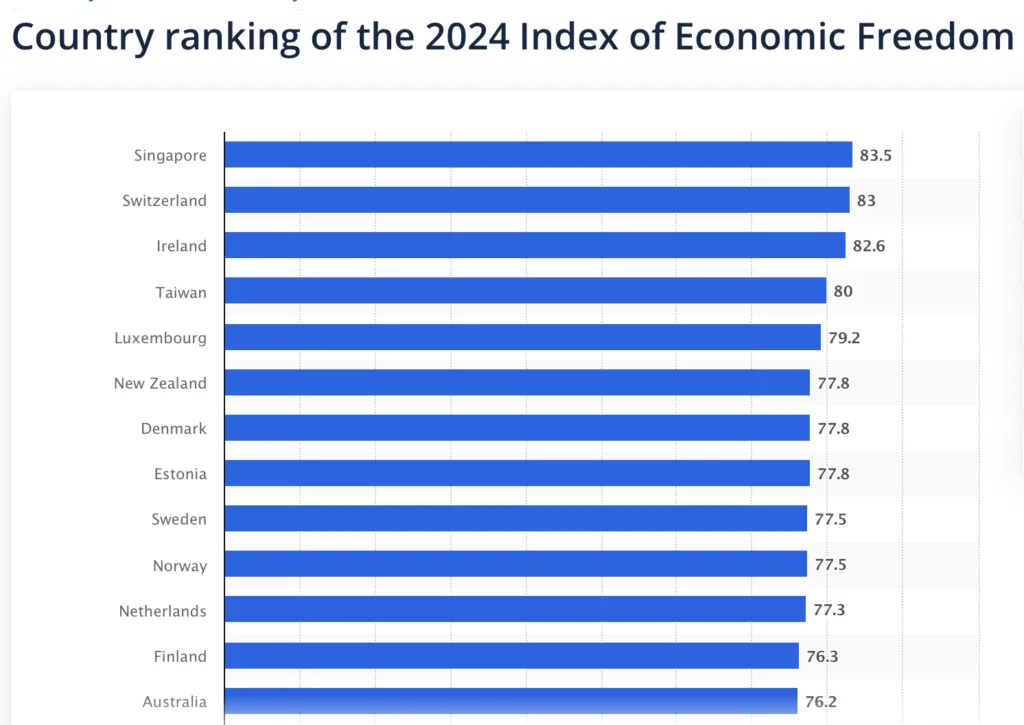
Singapore embodies ultimate progressive success. Starting as a resource-poor nation in 1965, it adopted low taxes, zero tolerance for corruption, built world-class education and meritocracy based employment, as well as building export-led industrialisation, and targeting strategic FDI investment. The country’s success was built on Rule of law and regulatory efficiency that are near-perfect, with trade openness, that has made it a global hub. 2025 GDP growth hit 4.8-5.0% (electronics/finance-led), with nominal per capita income of between $94,000-$99,000, positioning the country among the world’s highest. Adding to the success, the public debt is low, while the country sits with massive budget reserves.
Singapore’s administrative efficiency + market freedom delivered sustained a 5-7%+ growth for decades, transforming it into a high-income model. African leaders like Mauritius have echoed this approach (openness & education), but scale, location, and governance depth differ while Rwanda aspires similarly via tech/human capital advances.
A Story of Success Despite the Odds
Argentina contrasts sharply. Historically a resource-rich region, that suffered from Peronist socialist populism: this included protectionism, price controls, money-printing, and debt defaults, yielding economic volatility including a dramatic 211% inflation rate in 2023, with repeated recessions hitting the country. Its 2025 score of 54.2 while still “repressed”, reflects improvements with high government size adjustments, and lingering historic debt burden, with relatively weak monetary stability despite a +4.3 jump under Milei’s bold leadership(elected 2023).
Milei’s “shock therapy” saw 30% real government spending cuts, leading to the country’s first fiscal surplus in 14+ years, driven by deregulation with major labor/tax reforms via decree, export tax reductions, and capital control easing. These measures resulted in monthly inflation plunging from 25%+ peaks to around 2%, lowering of poverty from 53% to around 32%, and spurred a 5%+ annualised growth by late 2024 into 2025 projections (IMF 5.5%).
In 2023 GDP contracted by -1.6%; 2024 saw recession but with a rebound. FDI has now risen in mining and energy pointing to a broader recovery trend. Yet challenges persist: political and union led opposition and previously acquired debt (still at around 91% GDP), as well as incomplete reforms have restricted further possible gains, and while Milei remains popular he has an uphill battle to push further reforms. Argentina illustrates how reversing non-progressive policies (statism) can unlock potential, however consistency matters and will require Singapore’s decades-long stability or Mauritius/Botswana’s institutional continuity to see further improvements.
Lessons and Outlook
Africa’s top performers prove progressive policies yield results without question. Mauritius and Botswana via sustained openness and prudence have achieved high freedom and stable growth. Rwanda and Morocco accomplished steady growth via targeted modernisation, and have delivered rapid expansion despite lower scores.
The key ingredients for sustained growth are fiscal discipline, regulatory ease, trade integration, human capital, and anti-corruption, which mirror Singapore’s playbook and Milei’s corrective agenda in Argentina. Challenges to affect these on the continent however remain with infrastructure gaps, debt (many sitting at over 70% to GDP), and political risks limit scale. Sub-Saharan growth is projected at 4.1-4.4% for 2025-27 (IMF/World Bank), but reformers could potentially hit 6-8% sustainably.
With AfCFTA implementation, digital leaps, and infrastructure initiatives accelerating, nations adopting these policies (e.g., expanding Mauritius-style incentives or Rwanda’s digital/agri reforms) stand to close the gap with Singapore’s prosperity type projection. Argentina’s ongoing experiment shows even laggards can rebound with bold liberalization. For Africa, the path is clear, it is time to emulate the consistent, evidence-based progressivism of its economic leaders for inclusive, high-GDP development. Persistent reform and fiscal discipline, not size or resources, will separate the winners.