Africa Provides the Ingredients, Others Build the Cars
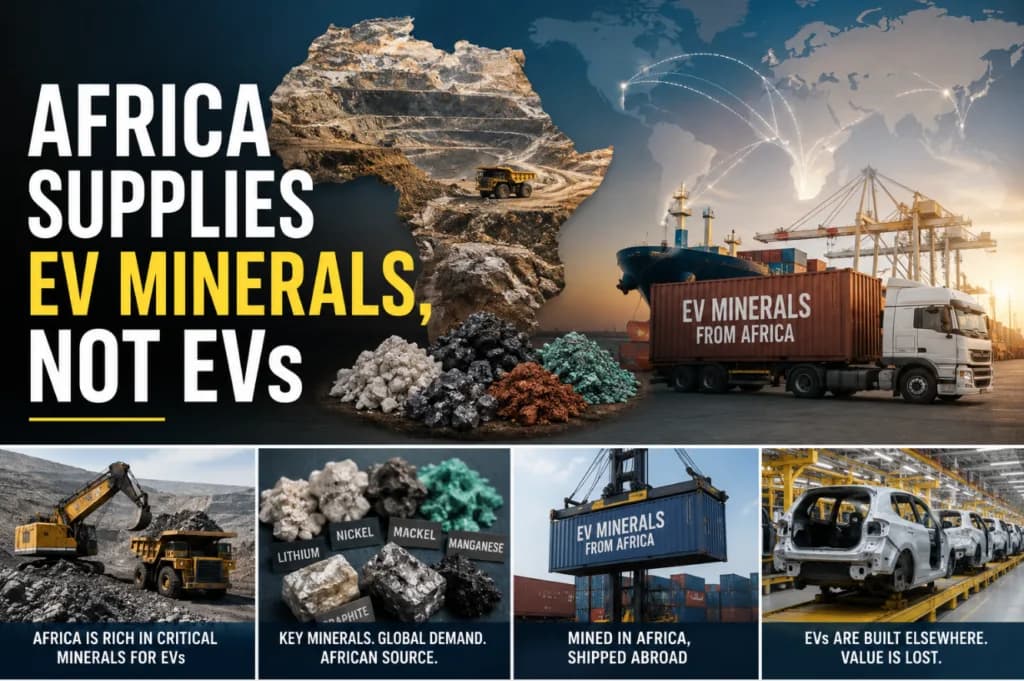
Africa is central to the electric vehicle story. However, it mainly supplies the minerals that power batteries rather than manufacturing the products themselves. The Democratic Republic of Congo produces much of the world's cobalt. Zambia remains a major source of copper. Zimbabwe has also become an important lithium producer. Together, these minerals place Africa at
Africa Provides the Ingredients, Others Build the Cars
Africa is central to the electric vehicle story. However, it mainly supplies the minerals that power batteries rather than manufacturing the products themselves. The Democratic Republic of Congo produces much of the world’s cobalt. Zambia remains a major source of copper. Zimbabwe has also become an important lithium producer. Together, these minerals place Africa at the centre of a supply chain that feeds battery plants and vehicle factories worldwide.
Yet the continent has little presence further down that chain. Global demand for electric vehicles continues to grow. Even so, Africa remains a minor player in battery manufacturing, vehicle assembly and EV adoption. A January 2026 report by the United Nations Economic Commission for Africa (UNECA) found that the continent’s role centres on supplying raw materials. It plays a far smaller role in producing or buying electric vehicles.
A familiar trade pattern
For many African economies, the rise of electric vehicles follows a familiar pattern. Mining companies extract minerals locally. Exporters then ship them abroad for processing and manufacturing. Manufacturers sell the finished products into global markets at much higher values. As a result, countries outside Africa capture much of the economic benefit. This happens despite the continent’s role in supplying many of the minerals.
Companies that buy critical minerals face growing pressure from regulators, investors and consumers. They must show where their materials come from and how suppliers source them. An April 2026 study by IPIS and Levin Sources for Germany’s GIZ examined the growing use of digital traceability systems. These systems operate across critical mineral supply chains. They track minerals from mine to market and help buyers verify compliance with environmental and labour standards. Supporters say traceability can improve transparency and reduce mining-related abuses. Critics argue that compliance can be expensive, especially for producers in developing markets.
Standards set far from the mines
The debate extends beyond traceability. A June 2026 report by the International Institute for Sustainable Development (IISD) examined environmental, social and governance practices among Chinese companies in critical mineral supply chains. The report raises a broader question. Who decides the standards that govern minerals that have become vital to the global economy?
Many of these requirements originate in consumer markets thousands of kilometres from African mines. International buyers often require compliance with those standards. However, meeting them can add costs and administrative burdens for producers.
The bigger issue is not mining itself. It is what happens afterwards. Mining generates export earnings and employment. However, refining minerals, producing battery materials and manufacturing vehicles create more value. These activities support larger industries, attract investment and create higher-skilled jobs. That is why several African governments want to encourage local processing. They also want to attract manufacturing investment linked to battery minerals. Their goal is to keep a larger share of the economic activity generated by the continent’s natural resources.
Can demand for battery minerals change the equation?
Demand for lithium, cobalt and copper has given resource-rich countries more bargaining power. They have not enjoyed this level of leverage in many previous commodity cycles. The question is whether governments and industry can turn that leverage into long-term industrial development.
Building processing plants and manufacturing capacity requires reliable electricity. It also requires transport networks, investment and policy certainty. These foundations remain uneven across much of the continent. For now, Africa remains a critical supplier of EV minerals. Yet it captures only a small share of the industries that process those materials and turn them into finished products. Whether that changes will depend on decisions made by governments, investors and businesses while demand remains strong.